



























A Comprehensive Guide to Human-AI Collaboration
Businesses need a clear process before they introduce AI into daily workflows. A structured AI implementation strategy can help teams identify suitable use cases and define clear responsibilities. The growing advancement in the field of artificial intelligence has led to some significant innovations, including human-AI collaboration. It is one of the latest developments in AI that is revolutionizing business processes by bridging the gap between humans and machines.
Modern generative AI models are the result of advanced Human AI collaboration and have the potential to change how people work. From content automation to idea generation, data analysis, and more, everything is now possible thanks to collaborative intelligence.
In this blog, we will help you understand what Human AI collaboration is and everything else that comes with it. Read now to know more.
What is Human AI Collaboration?
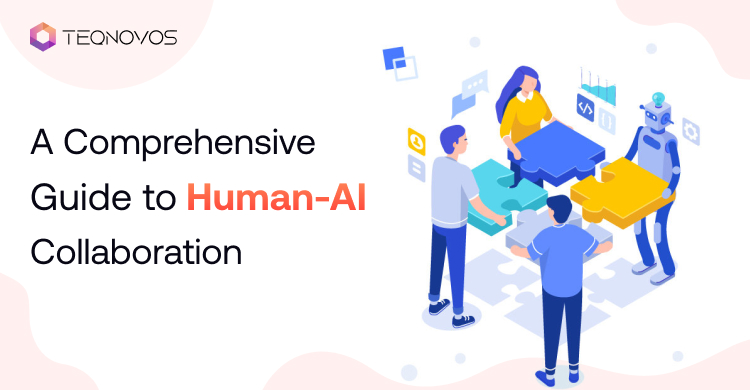
Human AI collaboration is the coming together of humans and AI technologies to produce top-notch results like never before. It is the merger of human intelligence and AI capabilities to do things beyond our imagination and do them better.
For example, with the help of the latest generative AI tools, business professionals can generate creative and informative content. Human-AI collaboration also makes it easier for business leaders to use data-driven analysis for precise decision-making.
Although traditional artificial intelligence technologies were designed to augment human efforts, they were not fully prepared for it. However, with the rise of collaborative AI, the latest AI tools have a more user-centric approach to delivering results as desired.
How Human AI Collaboration Works
Human AI collaboration works by combining human judgment with the speed and processing power of artificial intelligence. Each side handles the tasks it performs best. Humans provide context and creativity. AI processes information and supports faster execution.
The process usually follows a simple workflow.
1. Humans Define the Goal
The process starts with a clear objective. A person identifies the problem and sets the expected outcome. This direction helps the AI system understand what it needs to achieve.
2. AI Processes the Information
The AI system analyzes available data and instructions. It can identify patterns and generate suggestions based on the task. This stage can reduce the time needed for research and repetitive work. Businesses can also use AI workflow automation to connect AI with repeatable business processes.
3. Humans Review the Output
AI generated results still need human review. People can check the output for accuracy and relevance. They can also apply business context that the AI system may not fully understand.
4. AI Supports Further Improvement
Human feedback can guide the next AI response. The system can refine content and recommendations based on updated instructions. This creates a more useful working process between humans and AI.
5. Humans Make the Final Decision
The final responsibility should remain with people when a decision involves risk or business impact. AI can support the process with insights and suggestions. Human judgment ensures that the final action matches business goals and real world needs.
This approach makes human AI collaboration more effective than using AI without proper guidance. Strong AI human collaboration depends on clear roles and regular review. It also requires people to know when AI can assist and when human judgment should take priority.
Build Smarter Human-AI Workflows —Talk to Our AI Experts Today!
Schedule a Call
Role of Generative AI in Human and AI Collaboration
As we talk about the growth and future possibilities of human-AI collaboration, we cannot overlook generative AI. It is at the forefront of human-AI interaction, as it has rapidly changed how businesses use artificial intelligence for different purposes.
Generative AI is one of the latest human artificial intelligence collaboration technologies that goes beyond the conventional idea of automation. It leverages deep learning techniques and neural networks to understand data patterns and generate appropriate responses accordingly.
Businesses worldwide are using generative AI development to create content and analyze data. It can also improve customer experiences through chatbots and other AI tools.
Therefore, it’s safe to say that generative AI plays a crucial role in human-AI collaboration today, and will in the future as well.
Top Benefits of Human AI Collaboration
AI human collaboration has abundant advantages to offer to modern enterprises looking to make the most of artificial intelligence. The sooner you learn about them, the easier it will be for you to decide whether to opt for them or not.
Here, we have listed the top benefits of human-AI collaboration that you must know about. Go through them below and decide for or against this cutting-edge AI tech wisely.
1. Effective Decision-Making
As mentioned before, one of the key benefits of the coming together of humans and AI is decision-making. AI techs can analyze vast amounts of data quickly and accurately to understand patterns and predict future trends. This is something human brains can’t do.
By carrying out faster data analysis, AI tools help businesses understand what’s best for their business in that given time. They are capable of making decision support using detailed insights that can often be missed by humans unintentionally.
2. Improved Productivity
Next-gen AI tools can take over and automate several repetitive and boring tasks that consume a lot of your time. By doing so, these tools allow you to invest your time in more meaningful business activities that need your attention.
Once the mundane tasks are delegated to AI tools, overall business productivity also increases. The reason is that AI lets you focus on core business processes while taking care of routine tasks effectively. It is one of the most important benefits of human-AI collaboration.
3. Risk Mitigation Across Industries
Businesses, regardless of their niche, are prone to several risks associated with their industry. Although these risks cannot be eliminated, AI human collaboration can reduce them to a greater extent. They help businesses carry out business operations accurately, which mitigates risks.
For instance, in the healthcare industry, generative AI tools are assisting with error-free diagnosis and treatment recommendations. It not only saves both patients and professionals time but leads to better healthcare services without the risk of mistakes.
4. Customization at Scale
Traditional AI models are quite rigid and only have one way of doing things. However, this is not the case with human-AI collaboration. Human-artificial intelligence coming together enables businesses to know and provide customized solutions to customers.
Business owners can rely on AI tools to write all kinds of content that resonates with their brand voice. Moreover, human-AI collaboration also means that AI-based customer support is more personalized, as they acknowledge queries and responds accurately.
5. Endless Creativity and Innovation
Perhaps the greatest benefit of AI human collaboration is its ability to generate unique and creative solutions repeatedly. Unlike humans, AI can come up with creative content, ideas, and strategies again and again without fail, which helps it in several business processes.
Whether it’s product design, marketing campaign creation, or social media content generation, you can benefit from endless creativity with AI. Human AI collaboration has proven to be a great way for organizations to bring creativity and innovation to their businesses.
Human AI Collaboration Examples Across Business Functions
Human AI collaboration is already changing how teams complete daily work. The best results usually come when AI handles repetitive or data heavy tasks. Humans then apply judgment and context. The following human AI collaboration examples show how this model works across different business functions.
Customer Support
Businesses can use AI chatbot development to support customer interactions and common queries. AI can review customer questions and suggest relevant responses. Human agents can then review complex cases and handle situations that require empathy or careful judgment.
Marketing
Marketing teams can use AI to create first drafts and campaign ideas. AI can also analyze audience data and identify patterns. Human marketers still guide the strategy and approve the final message. This keeps the content aligned with the brand.
Software Development
Developers can use AI software development services to integrate AI into software workflows. AI can suggest code and explain errors. It can also help create test cases and documentation.
Data Analysis
AI can process large datasets and highlight useful patterns. It can also generate summaries that make complex information easier to understand. Human analysts then review the findings and connect them with business goals. This makes AI human collaboration useful for faster decision support.
Healthcare
AI can help professionals review medical data and organize information. It can also support administrative tasks and clinical workflows. Healthcare professionals must still review important outputs and make final decisions. Human oversight remains essential when patient care is involved.
These examples show that human AI collaboration is not about replacing people. It is about assigning the right task to the right person. AI can improve speed and scale. Humans add judgment and accountability.
Human AI Collaboration Challenges Businesses Should Consider
Human AI collaboration can improve speed and productivity. It also creates new risks that businesses need to manage. These human AI collaboration challenges can affect output quality and data security. They can also weaken trust if teams rely on AI without proper controls.
AI Hallucinations
AI systems can generate incorrect or misleading information. These outputs may still sound confident and convincing. Human review is essential before teams use AI generated information for important business decisions. Businesses can also use AI guardrails to set boundaries around AI behavior and reduce uncontrolled outputs.
Data Privacy Risks
AI tools often process large amounts of business and customer data. Poor data handling can expose sensitive information. Businesses should define clear rules for what data employees can share with AI systems.
Bias in AI Outputs
AI models can reflect patterns or bias found in their training data. This can influence recommendations and generated content. Human teams should review important outputs and check for unfair or inaccurate results.
Overreliance on AI
Employees may begin to trust AI outputs without enough review. This might make critical thinking less efficient, and there will be an increased chance of making mistakes.
Unclear Human and AI Roles
Difficulties will arise if there is no clear definition of responsibility for various aspects of the workflow. AI should be used only in the areas where it is effective. Human beings should take charge in situations where decision-making skills are needed.
Skill Gaps
It is important for workers to have the required competencies to interact with the AI systems. This involves understanding how to give proper instructions and check the outcomes produced by the AI.
Turn Human-AI Collaboration Into Business Value —Start Your AI Project Today!
Schedule a Call
How Businesses Can Build Effective Human AI Collaboration
The company requires a certain procedure to be put in place before the AI is brought into the workflow process.
1. Identify the Right Tasks
Start with tasks that are repetitive or time consuming. AI can support research and data analysis. Human teams should still handle work that needs judgment or business context.
2. Define Human and AI Roles
The workflows need to clearly outline what the AI can achieve and what needs to be reviewed by humans. This prevents any misunderstandings and reduces dependence on the computer output too much. Clear roles also make AI human collaboration easier to manage.
3. Add Human Review Points
Human oversight should be part of the workflow from the start. Teams should review important AI outputs before they are used. This is especially important when the task affects customers or business decisions.
4. Protect Business Data
Companies should create clear rules for data use. Employees need to know what information can be shared with AI tools. Sensitive business and customer data should always follow defined security controls.
5. Train Employees
Teams need practical AI skills to use these tools well. Employees should know how to write clear prompts and verify outputs. They should also understand where AI can make mistakes.
6. Measure Results
Businesses should track the impact of human AI collaboration over time. Useful measures can include task completion time, output quality, and error rates. These results can show where the workflow needs improvement.
7. Improve the Workflow
AI systems and business needs will continue to change. Teams should review workflows regularly and adjust responsibilities when needed. This helps businesses build a more reliable and useful collaboration model over time.
The Future of Human AI Collaboration
The pace at which the latest AI technologies are growing indicates that the future of human-AI collaboration has immense potential. In the coming years, we should expect significant advancements in generative AI tools and their ability to automate content generation.
However, the future of AI human collaboration is not limited to generative AI. A lot of new technologies will emerge that will change how AI is perceived. All these techs combined will foster a culture where humans and machines can collaborate seamlessly.
Apart from this, we will also see the rise of AI solutions that take ethical considerations and privacy safeguards into account. These AI models will generate more responsible solutions that don’t raise any concerns or cause harm to society.
AI agents will also play a larger role in future workflows. Businesses exploring agentic AI development services can build systems that complete defined tasks while people maintain oversight of important actions.
Lastly, when we talk about the future of AI, many people often assume that generative AI will replace humans. But in reality, AI is not going to replace the need for humans but will augment human capabilities. Therefore, business experts across industries shouldn’t view AI as a threat.
To Sum It Up
Human-AI collaboration is the biggest AI trend as of now that is transforming how businesses are run. It is not only helping in automating operations but also assisting decision-makers with future predictions. Generative AI is the best example of what collaborative AI is capable of.
From creative content to accurate future forecasting, and more, there’s so much you can expect from this AI trend. Besides these use cases, the benefits of human-AI collaboration are immense. Risk mitigation, improved productivity, and enhanced scalability are a few of them.
Reach out to the experienced and skilled AI experts at Teqnovos to learn more about AI-human collaboration. We are a generative AI development company where you can hire top AI developers to build custom AI solutions around your business requirements. Get in touch to start today.