















How Custom Software Development Helps Startups: Guide 101
Startups need software that fits a clear business idea. Ready made tools can work well at an early stage. They can become limiting when a product depends on unique workflows or specific customer needs.
Custom software development for startups gives product teams more control over how an application works. It also gives them room to change features as the business learns from real users.
A focused startup software development plan can start small. The first version can test the core idea before the team invests in a larger product. This keeps development tied to real customer needs.
Modern custom software solutions development can also support automation and integrations. It can include AI when the feature solves a useful problem. The goal is to build around the product rather than force the product into a fixed tool.
What is Custom Software Development?
Custom software development is the process of creating software for a specific business need. The product may be a web platform or a mobile application. It may also be an internal system or a data product.
Standard software serves a broad group of users. Software development for startups can focus on a narrower problem. This gives the product team more control over features and workflows.
Experienced custom software developers can turn product requirements into working software. Their work can cover planning and development. It can also include testing and integration.
Custom development is not the right choice for every idea. It needs time and technical planning. It also brings ongoing work such as maintenance and security.
Advantages of Custom Software Development to Startups
The value of custom software depends on the problem being solved. It works best when standard tools cannot support an important part of the product.
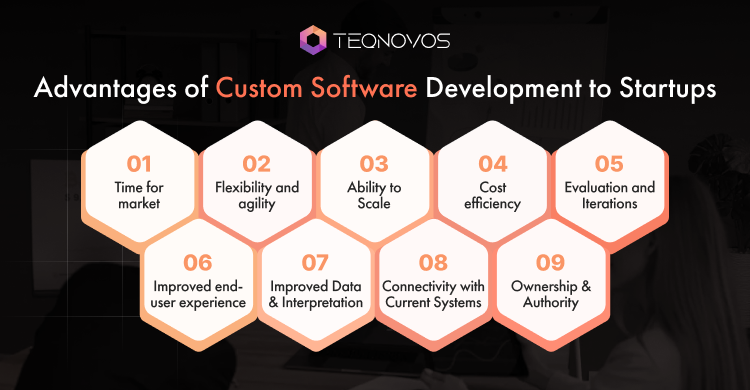
The following benefits show where custom software development for startups can support an early stage business.
1. Faster Product Validation
A startup does not need a large product to test an idea. An MVP can focus on the features that matter most. The team can release the MVP to a smaller group of users. Their feedback can show what works and what needs more attention.
A clear MVP can also reduce time spent on features that users may not need. This makes early product validation an important part of custom software development services.
Some teams use no code app development when the first product has a simple feature set. It can help test an idea before the business commits to a larger custom build.
2. More Flexibility as the Product Changes
Startups often learn new things after launch. Customer feedback may reveal a better workflow. Market demand may also change the product direction.
A flexible startup software development approach makes these changes easier to plan. The team can update features around new priorities instead of waiting for a software vendor to change its product.
Flexibility still depends on the quality of the original code. A poorly structured application can become hard to update even when the startup owns the code.
3. Better Support for Growth
Custom software can support growth when the system has a strong technical foundation. Scalability does not happen only because the product was built from scratch. Good custom software solutions development considers database structure and application performance early. It also looks at cloud infrastructure and future integrations.
The JobTable case study gives a practical example of a custom web application built with scalable architecture and real time data sync.
A scalable foundation makes it easier to add users and features later. It can also reduce the need for major technical changes after growth begins.
4. Better Control Over Long Term Costs
Custom software often needs a larger initial investment than a standard subscription tool. The financial value depends on how the software supports the business over time. Some custom software solutions can replace several disconnected tools. Others can automate repetitive work. These cases may reduce some operating costs.
The full cost still includes hosting and maintenance. It can also include security work and paid external services. This makes the total cost of ownership more useful than looking at the development price alone.
5. Faster Testing and Product Iteration
Startups learn more when they test ideas with real users. A smaller release can provide useful feedback before the next feature is planned. A practical approach in software development for startups uses that feedback to guide each release. It gives the team a clearer reason for every change.
AI assisted development can also help with coding and testing tasks. It can support documentation and debugging as well. Human review still matters because generated code may not match the product requirements or security needs.
Software development trends explain how AI and cloud systems are changing modern development work. This context can help product teams understand where newer tools fit into the development process.
6. Better User Experience
Generic software is designed for many types of users. That can lead to extra steps that do not fit a specific customer journey. Custom software can focus on the actions users perform most often. A simpler flow can make the product easier to understand.
The team can also improve forms and search features after launch. Navigation and notifications can change as user behaviour becomes clearer. This is where custom software solutions development can provide control over the experience without forcing the product into a fixed software structure.
7. Better Use of Business Data
A custom product gives the startup more control over the data it collects. The team can decide what information matters and how it moves across the system. Useful reporting can help the business understand product activity. Advanced analytics can also support forecasting when the startup has enough reliable data.
These features need careful planning. Data quality matters as much as the reporting tool itself. Well planned custom software development services can connect data requirements with the wider product architecture. This helps prevent reporting from becoming an afterthought.
8. Easier Integration With Existing Systems
Startups often use several external tools. These may support payments and accounting. They may also manage customer information or marketing activities. Custom software development for startups can connect these systems through an application programming interface or API. An API allows different software systems to exchange information.
The result can reduce repeated manual work. It can also keep important data more consistent across tools. Integration still depends on the systems involved. Some older applications have limited access to data. Application modernization can help teams understand how legacy code and older architecture can be updated without replacing every useful workflow.
9. Control Over the Product
A custom product gives the startup more control over feature priorities. The team can respond to customer feedback without relying on another software company for every product change.
Custom software developers can also help maintain technical consistency as the application grows. This becomes more important when new modules or integrations affect the original system.
Ownership still depends on the development agreement. A startup may own its application code while using external cloud services or commercial tools.
Turn a Product Concept Into Working Software. Bring Your Software Idea to Life!
Schedule a CallWhen Does Custom Software Make Sense for a Startup?
Not every startup needs a custom product at the beginning. Existing software can be enough when the business process is common, and the tool already solves the problem well. Custom development becomes more useful when the product needs unique logic or a specific customer journey. It can also fit when several tools create too much manual work.
A startup software development company can help assess the technical scope after the startup has defined the problem. A dedicated development team can also fit a longer product roadmap when the business needs consistent technical support across releases.
The final decision depends on the value of the custom feature. It also depends on cost and maintenance needs.
Security and Maintenance Need Early Attention
Security is easier to manage when the team considers it during development. Leaving it until the end can create more work. Reliable custom software development services can include code review and testing. Access controls and dependency checks can also become part of the development process.
AI generated code also needs human review. A useful code suggestion can still contain a security problem or logic error. Maintenance matters for the same reason. Clear code and technical documentation make future changes easier. They also help reduce technical debt as the product grows.
Build for the Next Stage of Growth. Scale Your Product With Teqnovos!
Schedule a CallConclusion
Custom software development for startups can provide more control when a product depends on unique workflows or integrations. It can also support a more focused customer experience. The value still depends on product planning and technical choices. Good architecture and regular testing matter throughout the product lifecycle.
A clear startup software development process starts with the most important user problem. It then expands as the team learns more from real use. Custom software development can be a strong option when standard tools no longer fit the product. The business gains the most value when each feature has a clear purpose.
Get your custom software solution with Teqnovos. Book your free consultation call with us!