
























Amazon Bedrock Integration: A Complete Implementation Guide
Successful Amazon Bedrock integration starts with the right decisions. A team must define the business problem before choosing a model. It must also review data quality, security needs, user roles, cost limits, and expected outcomes. Amazon Bedrock gives organizations access to foundation models through a managed Amazon Web Services environment. However, platform access alone does not create a reliable solution. The final result depends on architecture, model evaluation, application connections, data controls, and production monitoring. A weak plan can lead to poor responses, rising costs, security gaps, and difficult maintenance.
This guide explains how organizations can plan and implement Amazon Bedrock within existing applications. It covers integration patterns, system architecture, and model selection. It also covers enterprise data, security controls, cost planning, and production readiness. The guide covers when Amazon Bedrock fits the use case and when another option may offer more control.
What Is Amazon Bedrock Integration?
Amazon Bedrock integration connects an application with foundation models through Amazon Web Services. A foundation model is an AI system trained to handle tasks such as content generation and data analysis. The connection works through an API. The application sends a request to Amazon Bedrock. The selected model processes it and returns a response.
Businesses can also connect private data through Amazon Bedrock Knowledge Bases. This method is called Retrieval Augmented Generation (RAG). It allows the model to use approved business information when creating answers.
A reliable integration also needs secure access, clear data flows, response testing, cost controls, and production monitoring.
Assess Readiness Before Implementation
A strong implementation begins with proper planning. The team must confirm business value and technical readiness before development starts. Businesses can use generative AI consulting services to assess feasibility and plan the right implementation path.
Define the Use Case
A successful AWS Bedrock implementation starts with a clear business problem. The team should identify the target users and expected outcome. It should also define how the solution will improve the current process.
Review Data and Systems
The team should assess data quality and access rules. It must identify privacy needs and compliance duties. It should also map existing systems and technical dependencies.
Set Success Criteria
The team should define accuracy and response speed targets. It should estimate request volume and budget needs. It must also decide when human approval is required.
This assessment should produce a readiness brief. The brief should include goals, risks, data needs, and technical requirements.
How to Choose the Right Amazon Bedrock Integration Pattern
The integration pattern shapes system complexity and cost. The team should choose an approach based on the task and data needs.
Use Direct Model Access
Direct model access fits simple tasks. These tasks may include summarisation and content generation. The application sends a request to the model and receives a response.
Use Retrieval Augmented Generation
Retrieval Augmented Generation (RAG) connects the model with approved business data. This pattern fits applications that need current and reliable information. Amazon Bedrock Knowledge Bases can manage this retrieval process.
Use Agent-Based Workflows
Agent based workflows fit complex tasks that need tools or external systems. An agent can select approved actions and complete defined steps. The team should use this pattern only when a fixed workflow cannot meet the requirement.
The selected pattern should match the use case and risk level. It should not add complexity without clear business value.
Building a Secure Amazon Bedrock Architecture
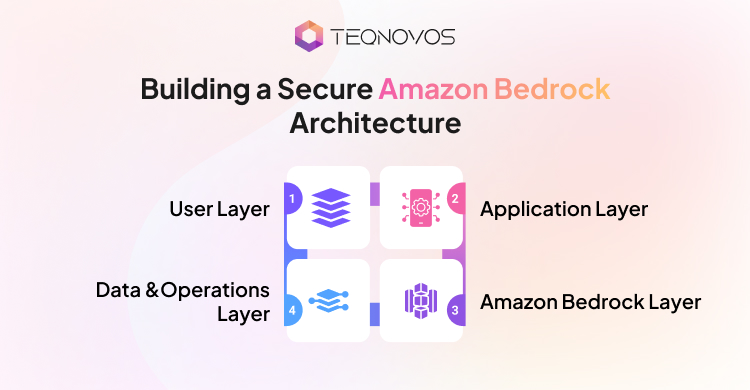
A strong Amazon Bedrock architecture connects users, business systems, and models through a secure workflow. Each layer should have a clear purpose.
User Layer
The user layer includes web apps, mobile apps, and internal tools. It collects requests and displays approved responses.
Application Layer
The application layer manages authentication, business rules, and request validation. It also controls user access and response formats. Teams may use AI software development services to build these connections.
Amazon Bedrock Layer
This layer processes model requests. It may also use Knowledge Bases, Guardrails, and Agents based on the selected integration pattern.
Data and Operations Layer
The data layer stores approved documents and business records. The operations layer tracks errors, response time, and usage costs. It also supports alerts and audit records.
The final architecture should show data flows, access rules, and failure paths before development begins.
Build Smarter AI Applications Today —Schedule a Free Consultation!
Schedule a Call
Find the Best Model for Your Amazon Bedrock Use Case
The right model should match the business task and technical limits. Amazon Bedrock model selection should rely on testing instead of popularity.
Test Real Business Tasks
The team should create a test set from actual user requests. It should review answer accuracy, instruction handling, and response consistency.
Compare Performance Factors
Each model should be tested for response speed and context capacity, output format, and token use. Regional availability should also guide the decision.
Review Risk and Cost
The team should test unsafe requests, incorrect inputs, and sensitive data scenarios. It should compare quality against the expected usage cost.
Amazon Bedrock supports automatic evaluation and human evaluation for models and Knowledge Bases. These options allow teams to assess performance with defined metrics and human feedback. The final scorecard should name a primary model and a fallback model. Teams that need support with model evaluation and custom AI planning can explore large language model development services.
How Can Amazon Bedrock Use Private Business Data?
Amazon Bedrock Knowledge Bases can connect a model with approved enterprise data. This approach grounds generated answers in relevant source content. It can also return citations to the original sources.
Prepare Reliable Data
The team should remove duplicate and outdated files. It should assign content owners and set clear access rules. Poor source data can lead to weak or misleading answers.
Structure Content for Retrieval
Documents must be divided into smaller sections called chunks. The team should test chunk size and metadata quality. Good metadata can improve filtering and retrieval accuracy.
Test Retrieved Results
The team should test real user questions before launch. It should review source relevance and answer accuracy. A reranking model can reorder retrieved content based on its relevance to the query.
The final setup should include a data source register, an access model, and a refresh plan.
When Should a Team Use Amazon Bedrock Agents?
Amazon Bedrock Agents suit workflows that need dynamic planning and tool use. They can select approved actions based on the user request. Teams should not use agents for tasks that follow fixed and predictable steps.
Use Agents for Complex Actions
Agents fit workflows that may need different tools or data sources. They can retrieve information, call approved systems, and complete multi step tasks.
Restrict Permissions
Each agent should access only the tools required for its role. The team should set clear action limits and failure rules. Sensitive actions should always require human approval.
Track Every Action
The application should record tool calls, errors, and completed actions. These records make reviews and incident checks easier.
Protect Data and Model Access at Every Layer
Amazon Bedrock security requires more than encryption or content filters. The team must protect user access, business data, and model requests across the complete workflow.
Apply Least Privilege Access
AWS Identity and Access Management (IAM) controls access to Amazon Web Services resources. Each user and application should receive only the permissions required for its task. This approach can reduce unauthorized model access and unwanted changes.
Protect Prompts and Business Data
The team should review what information enters prompts and logs. Sensitive data should be removed or masked when the task does not require it. Clear storage and retention rules should also cover prompts and model responses.
Combine Guardrails With Application Security
Amazon Bedrock Guardrails can detect harmful content and sensitive information. They can also identify some prompt injection attempts. Prompt injection occurs when a user tries to override system instructions. Guardrails do not replace access controls, response validation, or secure application logic.
The final security plan should assign every control to a clear owner. It should also define logging and incident response and regular access reviews. Teams planning agent-based workflows can review this guide to building a production ready AI agent. Agent workflows also need defined safety boundaries. Teams can also review how AI guardrails in agentic systems control unsafe requests and restricted actions.
Amazon Bedrock Implementation in Eight Clear Steps
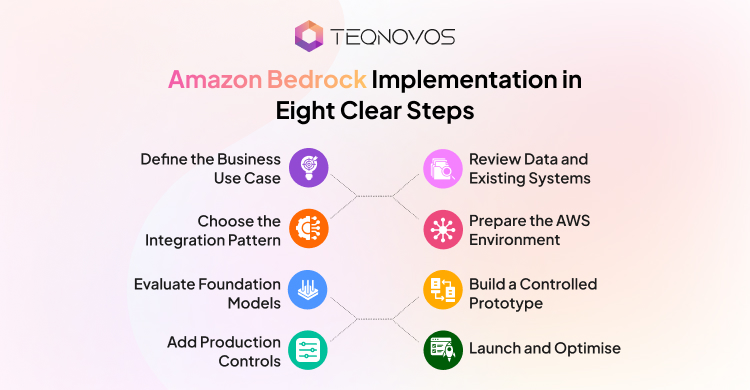
A structured process reduces technical risk and prevents costly rework. Each stage should produce a clear output before the team moves forward.
1. Define the Business Use Case
The team should identify the main business problem and target users. It should also set measurable goals and define where human review is required.
2. Review Data and Existing Systems
The team should map data sources, system connections, and user roles. It should also confirm data quality, ownership, and access rules.
3. Choose the Integration Pattern
The team should choose direct model access, a Knowledge Base, or an agent workflow. The final choice should match the task complexity and data needs and risk level.
4. Prepare the AWS Environment
The team should select a suitable Amazon Web Services region and configure model access. It should also set secure permissions, service quotas, and budget alerts.
5. Evaluate Foundation Models
The team should test suitable models with real business requests. The final scorecard should compare response quality, speed, cost, and safety.
6. Build a Controlled Prototype
The prototype should use approved data and limited user access. It should test the main workflow and confirm that the selected design meets the agreed criteria.
7. Add Production Controls
The team should add request validation, rate limits, and controlled retries. It should also prepare monitoring and fallback rules and rollback procedures.
8. Launch and Optimise
The team should release the solution to a limited user group first. It should monitor quality and latency, errors, and cost before expanding usage.
Launch Enterprise AI with Amazon Bedrock —Talk to Our Team Today!
Schedule a CallWhat Determines Amazon Bedrock Implementation Cost?
Amazon Bedrock implementation cost includes development work and ongoing cloud usage. The final amount depends on the selected model and system complexity and request volume.
Calculate Model Usage
Amazon Bedrock charges often depend on input and output tokens. A token is a small unit of text processed by a model. Model choice, service tier, and cross-region inference can affect usage charges.
Include Supporting Services
The cost may also include data ingestion, embeddings, vector storage, Guardrails, and agent actions. Monitoring and log storage can add further charges. Custom workflows may require extra development and security review.
Track Every Workload
Teams should monitor spending by application, department, and environment. Amazon Bedrock offers cost attribution options for users, teams, and workloads. These controls can reveal costly prompts and unexpected usage patterns.
Common Amazon Bedrock Implementation Mistakes
Small planning gaps can create major issues after launch. Teams should avoid these common mistakes during Amazon Bedrock implementation.
Choosing a Model Too Early
A team should define the task before selecting a model. Popular models may not match the required quality, speed, or cost.
Using Agents for Simple Workflows
Agents add complexity. A fixed workflow often works better when the process follows clear and predictable steps.
Connecting Poor Quality Data
Outdated or duplicate content can weaken generated answers. Teams should clean and review business data before connecting it.
Ignoring Access Rules
Private data should follow the same access rules inside the AI system. Weak permissions can expose restricted information to the wrong users.
Testing Only Successful Requests
Real users may enter unclear or harmful prompts. Teams should test failed requests, blocked actions, and invalid responses before launch.
Skipping Cost Controls
Long prompts and large outputs can increase usage costs. Teams should set budgets, usage alerts, and response limits early.
Launching Without Fallback Logic
Models and connected services can fail. The application should use timeouts and fallback models and clear recovery paths.
Changing Models Without Retesting
A new model can change response quality and format. Every model update should pass regression testing before release.
Final Thoughts
Amazon Bedrock integration can add generative artificial intelligence to existing applications. Success depends on clear goals, reliable data, and secure access. A well planned Amazon Bedrock implementation should remain useful and manageable as usage grows.