



























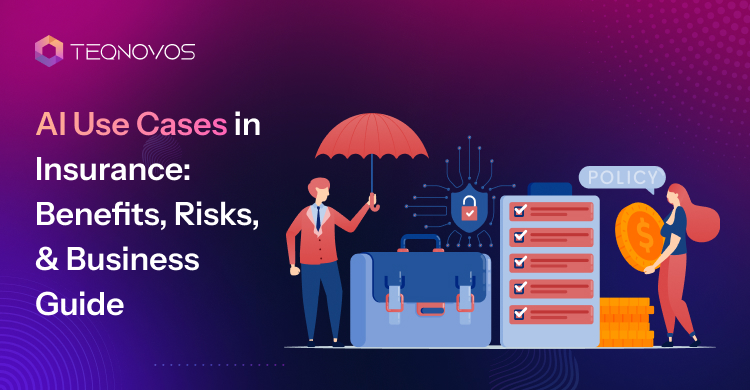
AI Use Cases in Insurance: Benefits, Risks, and Business Guide
Insurance teams handle large volumes of claims documents, risk signals, customer questions, and policy data every day. Manual review slows decisions when records come from many sources. This is where AI use cases in insurance become more practical for modern insurers.
AI in insurance can read documents, review claim images, detect unusual patterns, and guide teams through high-volume workflows. Claims teams can sort routine cases faster. Underwriters can review risk with better context. Fraud teams can find warning signs before losses grow. Customer service teams can answer common policy questions with less delay.
This guide explains artificial intelligence in insurance through real business use cases. It covers claims processing, underwriting, and fraud detection. The blog will also cover virtual assistants, risk prevention, benefits, risks, and adoption steps. Businesses planning ai-powered insurance app development need the right data with clear rules, secure systems, and responsible review before they scale AI workflows.
What Industry Research Shows
Industry adoption is moving beyond early testing. The National Association of Insurance Commissioners reported that 84% of surveyed health insurers use Artificial Intelligence and Machine Learning in some capacity. This shows that AI in insurance has moved into real operational planning. It also proves why insurers need clear data controls, human review, and safe rollout plans before they scale AI across claims underwriting and customer service.
How AI Works in Insurance
Data Comes First
Insurance companies use Artificial Intelligence to turn large data flows into faster business actions. The process starts with clean and secure data. Claims forms, policy records, customer messages, medical bills, photos, videos, and payment history can guide AI driven workflows.
Pattern Review
How AI is used in insurance industry depends on the workflow. ML can review past claims and flag unusual activity. Natural Language Processing reads and understands human language. It can review email policy documents and customer messages. Computer vision is AI that reads images and videos. It can inspect vehicle damage, property damage, and upload claim photos.
Team Support
AI in insurance industry works best when it assists teams instead of replacing every decision. Claims teams can sort cases by urgency. Underwriting teams can review risk signals with better context. Fraud teams can detect suspicious claim patterns. Support teams can answer simple policy questions faster.
Strong AI in insurance workflows connects data, rules, user roles, and human review. This keeps the process useful, secure, and controlled. It also gives insurers a safer way to improve speed, accuracy, and customer response quality.
AI Use Cases That Matter Most in Insurance
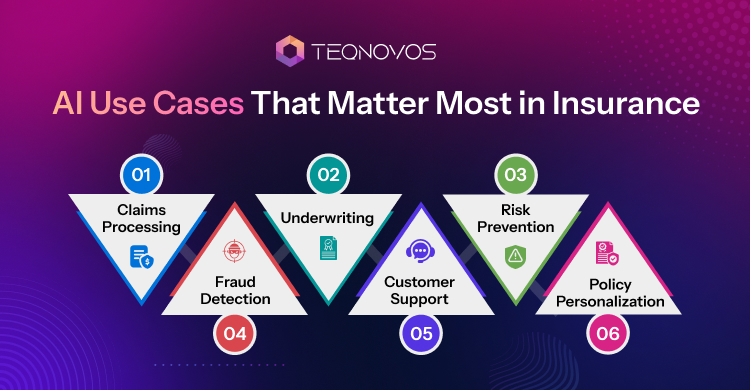
The strongest AI use cases in insurance solve clear workflow problems. Insurers do not need AI in every process at once. They gain better control when they start with high volume tasks that depend on document data review, customer messages, and risk signals.
Claims Processing
Claims teams manage forms, photos, repair bills, medical records, and policy details. AI can read these inputs and sort claims by type, urgency, and risk level. In auto insurance, computer vision can review uploaded vehicle images and identify visible damage. Computer vision is AI that reads images and videos.
Important workflow points:
- Claim forms can move into the right queue faster.
- Damaged images can receive an early review before adjuster action.
- Routine claims can follow a faster review path.
- Complex claims can move to expert teams earlier.
- Customers can receive status updates with less manual follow-up.
This does not remove the claim adjuster. It gives the adjuster a better context before review.
Fraud Detection
Fraud teams need to find suspicious patterns without slowing every valid claim. AI insurance fraud detection can compare current claims with past claims, document payment records, and customer behavior. Machine Learning can flag unusual patterns that may need deeper review.
Important workflow points:
- Reused documents can trigger review alerts.
- Duplicate claims can receive risk scores.
- Sudden claim spikes can show unusual activity.
- Mismatched customer details can move to the investigation teams.
- Payment patterns can reveal hidden risk signals.
Human investigators still need to review flagged cases. AI should raise risk signals. It should not make final fraud accusations without proper checks.
Underwriting
Underwriting teams review risk before issuing or pricing a policy. AI can collect and compare risk signals faster than manual review alone. It can review applicant data, claim history, property details, driving behavior, and other approved data sources.
Important workflow points:
- Applicant records can move through faster data checks.
- Claim history can guide early risk review.
- Property or vehicle details can add more context.
- Risk scores can guide underwriter attention.
- Pricing suggestions can follow approved business rules.
In auto insurance, telematics can support risk review. Telematics means vehicle data that shows driving behavior such as speed and mileage. In health or life insurance, wearable data may support review only when laws and business policies allow it.
AI can guide underwriters with risk scores and pricing suggestions. The final decision still needs clear rules and human review.
Customer Support
Customers always have inquiries regarding policy information, claim details, and renewal documents for insurance. With the use of artificial intelligence chatbots, customers’ most common inquiries can be answered anytime.
Important workflow points:
- Policy questions can receive instant responses.
- Claim status requests can use secure system data.
- Renewal queries can move to the right team.
- Document guidance can reduce support delays.
- Complex issues can reach human agents faster.
The best customer support workflows use AI for fast answers and human agents for sensitive or complex cases.
Policy Personalization
Insurance buyers expect coverage that fits their actual needs. AI can review customer profiles, usage patterns, risk signals, and past interactions to suggest better policy options. This can improve product matching and renewal experiences.
Important workflow points:
- Customer profiles can guide better product suggestions.
- Usage patterns can reveal coverage needs.
- Renewal journeys can feel more relevant.
- Cross sell offers can match the actual customer context.
- Policy recommendations can follow approval rules.
Personalization needs careful control. Insurers must avoid unfair pricing and unclear recommendations. The data model must follow compliance rules and internal approval standards. The customer also needs clear information about coverage choices.
Risk Prevention
Traditional insurance often starts after a loss has happened. AI can move insurers toward earlier risk prevention. Internet of Things (IoT) sensors can track property signals, fleet activity, and equipment behavior.
Important workflow points:
- Smart home alerts can warn about water leaks.
- Fleet telematics can identify unsafe driving patterns.
- Commercial equipment data can reveal early risk.
- Property monitoring can alert teams before damage grows.
- Risk reports can guide prevention plans.
These AI in insurance industry examples show that AI works best as a decision support layer. It can read data faster. It can detect patterns earlier. It can guide staff through complex workflows. The most valuable systems keep people in control while AI improves review speed and operational visibility.
Ready to Modernize Insurance Operations? Talk to Teqnovos Today!
Schedule a CallHow AI Improves Claims Review
Claims work often starts with mixed information. A customer may submit a form, photo, or invoice and an estimated medical bill. AI in insurance claims processing can organize this information before a claim adjuster reviews it.
Claim Intake
AI can read the first claim submission and capture key details. FNOL means the first report a policyholder submits after an insured event. AI can identify the policy number, loss type, and date. It can also detect location and attached documents.
Document Review
Insurance teams receive many files in different formats. OCR reads text from scanned files and images. It can extract details from invoices, bills, and repair estimates. This reduces manual data entry and gives claim teams a cleaner review path.
Damage Check
Computer vision can review uploaded images and videos. It can detect visible damage in vehicles, property, or equipment. This early review can support routine claim triage. A human adjuster still needs to verify complex damage and final settlement details.
Risk Flagging
AI can compare the claim with past records, policy rules, and known risk patterns. It can flag missing details, duplicate files, unusual timing, or mismatched information. These alerts guide reviewers toward claims that need closer attention.
Team Routing
Claims can move to the right team based on claim type, value, urgency, and risk level. Routine claims can follow a faster path. Complex claims can reach senior adjusters earlier. Fraud-flagged claims can move to investigation teams.
Public insurer examples also show why claims teams are a strong starting point. McKinsey reported that Aviva rolled out more than 80 AI models in claims and reduced liability assessment time for complex cases by 23 days. It also improved routing accuracy by 30% and reduced customer complaints by 65%.
AI Fraud Detection in Insurance
Fraud detection needs speed and caution. Insurance teams must find suspicious claims without slowing every valid customer request. AI insurance fraud detection can review claim data faster and flag patterns that need closer human review.
Pattern Checks
AI can compare a new claim with past claims, policy records, payment history, and customer activity. It can detect repeated documents, unusual timing, and mismatched information. These signals help investigators focus on claims that need deeper review.
Deloitte notes that AI fraud workflows can combine business rules, machine learning, text mining, and network link analysis. This gives investigators a stronger claim scoring without removing human review.
Document Risk
Fraud risk often appears in documents. AI can review repair bills, medical records, claim forms, and uploaded files. It can flag missing fields, changed values, reused images, or details that do not match the policy record.
Behavior Review
Machine Learning can study claim behavior over time. It can detect sudden claim spikes, repeated claim types, and unusual activity across connected records. This gives fraud teams a wider view than manual review alone.
Investigator Support
AI should not accuse a customer of fraud. It should create a risk signal. Human investigators must review the claim context, supporting documents, and policy rules before any action happens.
False Positive Control
False positives are valid claims that AI marks as risky. Too many false positives can delay real customers and create trust issues. Insurers need to review rules, audit trails, and feedback loops to improve fraud models over time.
Fraud teams can connect AI claims processing and fraud detection with secure dashboards, user roles, and review notes. This gives teams better visibility while keeping final decisions under human control.
How AI Strengthens Underwriting
Underwriting teams need accurate risk context before they approve a price or issue a policy. AI in insurance can review large data sets faster than manual checks. It can also highlight risk signals that need deeper review.
Risk Scoring
AI can study applicant records, claim history, policy details, and external risk signals that the insurer has approval to use. Dynamic underwriting means risk review that uses updated data to guide pricing and policy decisions. This can give underwriters a clearer view before final approval.
Data Checks
Underwriters often review many records before making a decision. AI can compare submitted information with policy rules, past claims, and risk models. It can flag missing details, unusual values, and records that need manual review.
Telematics Review
Telematics helps in showing the driving behavior. Auto insurers can use telematics to review speed, braking, and driving patterns. This can guide risk assessment when the customer has given consent, and the process follows legal rules.
Health and Life Signals
Health and life insurers may use approved data sources to review risk context. Wearable data can show activity patterns only when consent rules and local regulations allow it. The system must avoid unfair use of sensitive data.
Human Approval
AI can suggest risk scores, pricing ranges, and review notes. It should not replace every underwriting decision. Underwriters still need clear rules, audit trails, and final review authority.
Strong artificial intelligence in insurance works best when it gives underwriters a better context. It can reduce manual review pressure. It can also keep risk decisions more consistent across teams.
Generative AI in Insurance Workflows
Generative AI creates text summaries, drafts, and answers from approved data. Generative AI in insurance works best when teams use it for support tasks. It should not make final claim underwriting or legal decisions without human review.
Claim Summaries
Claims teams review long forms notes, photos, and customer messages. Generative AI can summarize claim details for adjusters. It can highlight missing information. It can also prepare review notes before a staff member checks the case.
Policy Search
Insurance teams often need quick answers from policy documents. Generative AI can search approved policy data and explain coverage details in simple language. This can save time for support staff agents and claim teams.
Customer Replies
Support teams can use Generative AI to draft replies for common customer questions. These replies can cover claim status document needs, renewal steps, and policy queries. A human agent should review sensitive replies before sending them.
Agent Support
Insurance agents can use Generative AI to prepare call notes, product summaries, and follow-up messages. This gives agents faster access to useful information. It also reduces time spent on repeated writing tasks.
Safe Limits
Generative AI can produce wrong answers when data is missing, unclear, or outdated. This is why insurers need approval rules, source checks, audit logs, and human review. Final claim denials, pricing decisions, and legal guidance must stay under controlled review.
Businesses planning advanced AI workflows can work with a generative AI development company to design secure data access, role based controls, and review steps before launch.
Business Benefits of AI in Insurance
The benefits of AI in the insurance industry become stronger when insurers connect AI with clear business goals. AI can improve speed control accuracy and customer response quality when teams use it inside real workflows.
Faster Decisions
AI can reduce delays in early review. Teams can receive cleaner claim files, risk notes, and customer details before manual action starts. This gives staff more time for complex cases.
Better Risk Control
AI can show risk signals earlier. Fraud teams, underwriters, and claim reviewers can see patterns that may be hard to find through manual checks. This improves review quality without removing human judgment.
Lower Operational Pressure
Insurance teams often manage repeated checks and document heavy tasks. AI can reduce routine work when rules access and approval steps are clear. Staff can then focus on exceptional customer care and final decisions.
Stronger Customer Experience
Customers want quick answers and clear updates. AI can support faster responses for common policy claim and renewal questions. Human agents can stay focused on sensitive issues and high value conversations.
Improved Business Visibility
AI can give leaders a clearer view of claim volume, risk patterns, service delays, and workflow gaps. This helps teams improve processes with better data instead of relying only on manual reports.
Strong AI in insurance adoption depends on clean data, secure access, and human review. These controls turn AI into a useful operating layer instead of just another software feature.
AI Examples by Insurance Segment
AI in insurance industry examples become more useful when they match the type of insurance business. Each segment uses different data sources, risk signals, and customer workflows. This makes AI planning more practical for insurers and InsurTech teams.
Auto Insurance
An auto insurance provider can analyze driver behavior, vehicle images, and accident data by utilizing AI. Information from telematics technology provides valuable insights into the frequency of braking, speeding, total miles traveled, and route behavior. This gives teams better context for claim review, risk scoring, and prevention alerts.
Health Insurance
Health insurers can use AI to organize medical bills, treatment records, and claim documents. The system can flag missing files, billing gaps, and unusual claim patterns. Sensitive data needs strong access control and consent rules and human review.
Life Insurance
Life insurers can use AI to review application data, claim history, and approved health signals. This can guide underwriters during risk review. The process needs extra care because life insurance decisions often involve sensitive personal data.
Property Insurance
Insurers can use AI to examine images, sensor messages, inspection notes, and repair records regarding property damage. Also, smart devices can be used to monitor possible water damage, fire risk, or other unusual property signals.
Commercial Insurance
Commercial insurers can use AI to monitor fleet activity, property risk, and business interruption signals. AI can organize risk reports and show patterns that need action before losses grow.
These AI use cases in insurance work best when each segment starts with a clear workflow. The goal is not to automate every decision. The goal is to give teams better data, better signals, and safer review control.
AI Risks Insurers Must Control
Every AI use case in insurance plans needs risk control. AI can speed up review and improve visibility. It can also create problems when insurers use poor data, unclear rules, or weak human oversight. This section matters because insurance decisions affect claims pricing, coverage, and customer trust.
Data Bias
Data bias means unfair patterns in data that can lead to unfair decisions. Artificial intelligence in insurance can repeat old decision patterns when past data contains gaps or imbalances.
Key controls:
- Review training data before model use.
- Test results across claim types and customer groups.
- Keep human review active for sensitive decisions.
- Update models when data quality changes.
False Alerts
AI can flag a valid claim as risky. This is called a false positive. Too many false positives can slow customers and increase review pressure.
Key controls:
- Set clear fraud review rules.
- Route risky claims to trained investigators.
- Track which alerts were useful.
- Improve the model through feedback loops.
Wrong Answers
Generative Artificial Intelligence can create confident but wrong answers. This is called hallucination. It can happen when the system uses outdated data unclear policy wording or missing records.
Key controls:
- Connect AI with approved data sources.
- Add source checks before customer replies.
- Review sensitive answers before sending.
- Block AI from giving final legal or claim decisions.
Privacy Risk
Insurance data can include financial, medical, property, and identity details. Weak access control can expose sensitive records.
Key controls:
- Use role-based access.
- Store data in secure systems.
- Keep audit logs for user activity.
- Follow consent rules for sensitive data.
Poor Explainability
Explainability is the ability to understand why AI gave an answer or score. Insurance teams need clear reasons behind claim flags, risk scores, and underwriting suggestions.
Key controls:
- Show the reason behind each risk flag.
- Keep decision notes in the system.
- Make review paths easy to audit.
- Avoid black box decisions for high-risk cases.
Model Drift
Model drift means AI performance changes over time as data patterns change. Claim behavior fraud methods, customer needs, and policy rules can shift.
Key controls:
- Monitor model performance after launch.
- Review weak or wrong signals.
- Update models when claim patterns change.
- Retest workflows after policy updates.
Over Automation
AI works best as a decision support layer in the AI in insurance industry. It should not replace every claim decision, underwriting judgment, or customer response.
Key controls:
- Keep final approval with trained staff.
- Use AI for review support.
- Add approval steps for high-value claims.
- Escalate sensitive cases to human teams.
The application of AI needs better governance before scaling. The insurance company requires clean data, proper approval mechanisms, and secure access audits. These help to maintain AI’s effectiveness, safety, and accountability.
AI Adoption Roadmap for Insurers
Insurance companies need a clear rollout plan before they scale AI. The best starting point is not the most advanced model. It is the workflow where AI can solve a real business problem with low risk and clear review steps.
Choose the First Workflow
Start with one focused workflow. Claims intake, fraud alerts, document review, or customer support can work well because these areas involve high volume tasks.
Key checks:
- Define the business problem.
- Select one workflow first.
- Avoid sensitive final decisions at the start.
- Set clear success measures.
Prepare the Data
AI needs clean records before it can give useful results. Teams need to review claim files, policy data, customer messages, and document formats before development starts.
Key checks:
- Remove duplicate records.
- Organize documents by type.
- Check data access rules.
- Secure sensitive customer data.
Build Review Controls
Human review keeps AI safe and trusted. Claims teams, underwriters, and fraud investigators need clear approval steps before AI output affects a customer.
Key checks:
- Add human approval for key decisions.
- Keep audit trails.
- Define user roles.
- Review high value or sensitive cases manually.
Connect the System
AI workflows need secure links with claim systems, policy systems, document storage, and customer support tools. This keeps teams working inside one controlled process.
Key checks:
- Map each system connection.
- Test data flow before launch.
- Keep user access limited.
- Monitor errors after release.
Improve After Launch
AI adoption does not end after deployment. Teams need to review model behavior, staff feedback, customer issues, and workflow results over time.
Insurers that need custom workflows can plan secure products with AI software development services. This gives the project stronger control over data access review rules and long term scaling.
Build AI-powered insurance tools with speed, control, and human review. Start Your AI Insurance Project!
Schedule a CallFinal Takeaway
AI in insurance offers a wide range of benefits, including speed, risk visibility, and customer response. AI proves most effective when insurers combine clear data, set policies, restricted access, and human oversight.
The future of AI in the insurance sector will involve a balanced approach. Smart automation helps to enhance efficiency. Human intuition is still necessary to safeguard credibility and integrity.