

























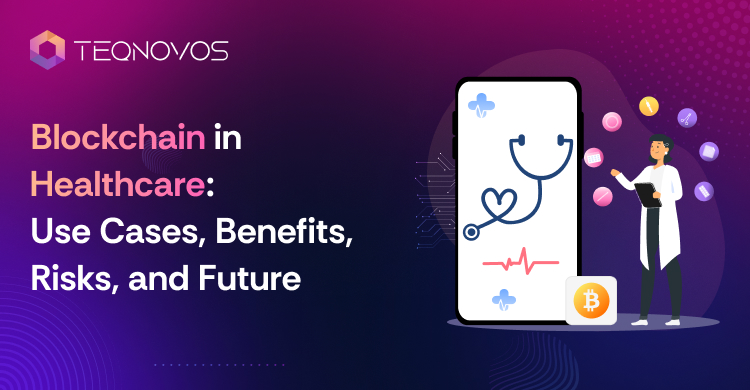
Blockchain in Healthcare: Use Cases, Benefits, Risks, and Future
Healthcare organizations exchange records across hospitals and insurers. They also work with pharmacies and laboratories. A standard database can manage this process when one trusted organization controls the data. The model becomes less effective when independent parties must verify the same activity without giving one participant full control. Blockchain in healthcare creates a shared record that approved members can verify under agreed rules. Its value still depends on the problem and the system design. This guide explains where blockchain fits and where it does not. It also explores practical applications and benefits. Later sections examine risks and adoption decisions.
What Is Blockchain in Healthcare?
Blockchain in healthcare refers to the use of distributed ledger technology to record and share verified healthcare information across approved participants. Distributed ledger technology is a digital record system that stores matching copies of transaction data across connected computers. Hospitals, insurers, pharmacies, laboratories, and regulators can use the same trusted record without giving one organization full control.
Most healthcare networks use a permissioned blockchain. This network allows only approved organizations to view or add records. It can track consent updates and document references. It can also record medicine movement and verification events.
This model makes blockchain technology in healthcare useful for processes that involve several independent organizations. Other applications of blockchain technology also use this shared verification model.
How Does Blockchain Work in Healthcare?
A healthcare organization creates a transaction when an approved user records an event. The event may relate to patient consent or medication movement. It may also confirm a document update. Network nodes then check the transaction. A network node is a computer that stores ledger data and follows the network rules.
The nodes use a consensus mechanism to confirm that the transaction meets the agreed conditions. A consensus mechanism is the method network members use to approve new records. The network then places the approved transaction in a block. Each block contains a cryptographic hash. A cryptographic hash is a fixed digital value that shows if recorded information has changed.
Smart contracts can apply preset rules during this process. Sensitive medical files can remain in protected off-chain storage. The blockchain can record a hash or document reference. This explains how blockchain is used in healthcare without placing every clinical file on the shared ledger.
Blockchain Versus a Traditional Healthcare Database
Healthcare teams should choose a system based on data ownership and participant trust. The comparison below explains where each option fits best.
| Decision Factor | Traditional Healthcare Database | Healthcare Blockchain |
| Control | One organization controls the system | Approved participants share control |
| Best use | Internal workflows | Multi-organization workflows |
| Trust model | Users trust one system owner | Participants follow shared rules |
| Record changes | Authorized teams can update or delete records | Approved records remain difficult to alter |
| Data speed | Usually faster for internal operations | Can be slower due to validation |
| Governance | One organization sets the rules | All participants need agreed rules |
| Cost | Lower setup and operating cost | Higher setup and network management costs |
| Best choice | One trusted owner manages the process | Independent parties need shared verification |
Major Blockchain Applications and Use Cases in Healthcare
The most practical blockchain applications in healthcare focus on shared verification. They do not move every medical file to a distributed ledger. These blockchain use cases in healthcare connect organizations that use separate systems but need one trusted record. This shows where blockchain in healthcare may offer value.
1. Health Record Exchange and Patient Consent
Healthcare providers can record consent approvals and access events on a permissioned network. Clinical files can remain inside the Electronic Health Record (EHR) system. The blockchain can store a document reference or proof of a consent change. This approach does not correct missing or inaccurate clinical information.
2. Pharmaceutical Supply Chain and Drug Traceability
Manufacturers, distributors, and dispensers can record product movement across the medicine supply chain. Each approved participant can verify shipment and receipt events for serialized products. An FDA pilot recorded product provenance through shipment receipt and dispense actions. The network still needs common standards and active participation.
3. Health Insurance Claims
Healthcare providers and insurers can use a shared ledger to verify authorization details and claim status. Smart contracts can apply agreed rules to routine transactions. Complex cases still need human review. The Office of the National Coordinator for Health Information Technology has explored claims processing as a potential blockchain use case.
4. Clinical Trials and Research Data
Research teams can record timestamps for study data and later changes. This creates a visible history of how the information developed. The FDA presented TrialChain as a platform for validating data integrity in biomedical research. Blockchain can verify the record history, but it cannot confirm the scientific quality of a study.
5. Medical Credential Verification
Universities, licensing bodies, and hospitals can issue and verify digital credential records. Hospitals can confirm the source and status of a qualification without requesting the same documents several times. The network must still trust each credential issuer. It also needs clear rules for renewal and revocation.
6. Medical Device and Remote Monitoring Records
Connected medical devices can produce large volumes of health data. A blockchain network can record the source and history of selected data events. Raw readings can remain in protected off chain storage. The ledger can make later changes more visible. However, it cannot confirm that a sensor produced an accurate reading.
Benefits of Blockchain in Healthcare: When the Use Case Fits
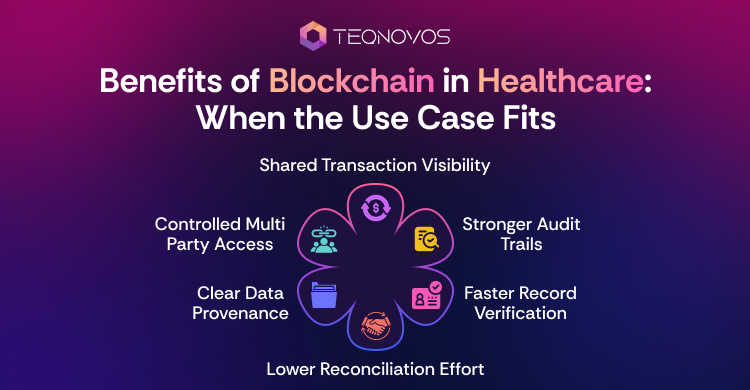
The benefits of blockchain in healthcare depend on the process and network design. The technology creates value when independent organizations need to verify shared activity across separate systems.
1. Shared transaction visibility
Approved participants can view the same verified transaction history. This reduces conflicting records between connected organizations.
2. Stronger audit trails
Blockchain records can show when an approved transaction occurred and which participant submitted it. NIST notes that distributed ledger technology maintains integrity-protected records across participating organizations.
3. Faster record verification
Teams can verify selected records through a shared source instead of requesting the same information from several parties.
4. Lower reconciliation effort
Organizations can spend less time comparing separate versions of the same transaction when participants follow common data rules.
5. Clear data provenance
The ledger can show where a record originated and how approved activity changed over time.
6. Controlled multi-party access
A permissioned network can restrict participation to approved organizations. FDA research has also explored semi-private blockchain networks for validating biomedical research data.
These benefits require accurate source data and active network participation. Blockchain cannot fix poor governance or unreliable information.
Healthcare Blockchain Architecture and System Integration
Practical blockchain solutions for healthcare work with existing clinical systems. They do not replace the software that hospitals already use. The blockchain acts as a shared verification layer between approved organizations. Moreover, the role of blockchain in healthcare becomes important when independent organizations need to verify the same activity without giving full control to one participant.
Existing Healthcare Systems
An EHR stores patient details and clinical files. Patient portals and administrative systems manage other healthcare workflows. The blockchain connects these systems through controlled data exchange. It records selected events without becoming the main clinical database.
On-Chain and Off-Chain Data
Sensitive medical data should remain in protected off-chain storage. Off-chain storage keeps files outside the blockchain network.
The blockchain can store a cryptographic hash or a document reference. A cryptographic hash is a digital value that confirms whether information has changed. The network can also record consent updates and access events.
This approach reduces the amount of private information placed on the shared ledger.
FHIR and API Integration
Fast Healthcare Interoperability Resources (FHIR) is a standard for exchanging healthcare information electronically. FHIR-based APIs can connect the blockchain layer with EHR systems and patient portals.
Blockchain does not replace FHIR. It records proof that an approved exchange or update occurred. Healthcare teams can address healthcare interoperability challenges through careful data mapping and system integration.
Identity and Network Controls
Identity controls decide who can join the network. They also define what each participant can view or update. Approved network nodes verify transactions under shared rules. A network node is a computer that stores ledger data and follows the network process.
Hospitals and other healthcare organizations must also define access rights and participant roles. Clear governance keeps the network controlled and accountable. Custom healthcare app development services can connect the blockchain layer with existing clinical and administrative workflows.
This structure makes blockchain in healthcare more practical without moving every clinical record onto the ledger.
Risks, Limitations, and When Blockchain Is the Wrong Choice
The use of blockchain in the healthcare industry creates new technical and operational risks. Healthcare teams must assess these risks before choosing a network model.
1. Incorrect Source Data
Blockchain can protect a record after network approval. It cannot confirm that the original information was accurate. Incorrect patient details or supply chain events can become part of the permanent history.
2. Privacy and Compliance Risks
A permanent ledger can conflict with data correction and removal needs. Sensitive medical files should remain outside the blockchain where possible.
Blockchain also does not make a system compliant with the Health Insurance Portability and Accountability Act (HIPAA). Healthcare organizations still need administrative safeguards and physical safeguards. They also need technical safeguards to protect electronic Protected Health Information or ePHI.
Healthcare teams should review healthcare data privacy and security before planning the data architecture.
3. Lost or Stolen Access Keys
Private keys control access to blockchain accounts and transactions. A lost key can block an approved user. A stolen key can allow an attacker to submit unauthorized activity. Healthcare networks need secure key storage and recovery procedures.
4. Smart Contract Errors
Smart contracts apply preset rules automatically. Faulty code can approve the wrong action or block a valid transaction. Teams must test every contract before deployment. NIST explains that blockchain transactions usually cannot be changed after publication under normal network operation.
5. Weak Governance and Low Adoption
A shared network needs clear membership rules and operating duties. Participants must agree on validation rules and system updates. The project may fail when key organizations refuse to join or follow different data standards. FDA pilot programs also examined adoption and interoperability capabilities across diverse supply chain participants.
6. When Blockchain Is the Wrong Choice
A standard database may offer better value when one trusted organization controls the process. Blockchain may also be unnecessary when an existing audit log meets the business need. It is a weak choice when teams need frequent record deletion or very fast internal transactions.
The value of blockchain in healthcare depends on shared trust and clear governance. Healthcare teams should not use it only because the technology appears innovative.
How Healthcare Organizations Can Plan a Blockchain Project
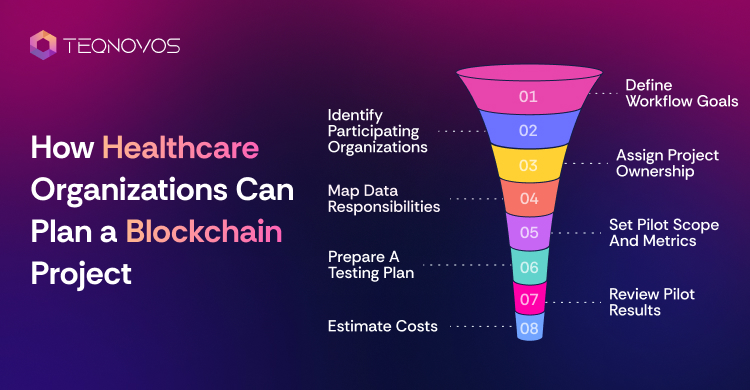
A healthcare blockchain project needs clear ownership and a narrow scope. The team should define what the pilot must prove before development starts. A pilot is a small test project used to check technical and business value.
1. Define the Workflow and Expected Result
The team should select one healthcare process with a clear problem. It should document delays and manual checks. It should also define the result the project must achieve.
2. List Every Participating Organization
The project should identify every hospital and insurer involved. It should also include pharmacies and laboratories when relevant. Each participant needs a defined role in the network.
3. Assign Project and Network Ownership
The team should name the project owner. It should also assign responsibility for network rules and technical operations. Clear ownership prevents delays during testing and approval.
4. Create a Data Responsibility Map
The project should show which organization creates each data point. It should also define who can review and approve each transaction. This map reduces confusion during development.
5. Set Pilot Scope and Success Metrics
The pilot should focus on one workflow and a limited participant group. The team can track verification time and error rates. It can also measure reconciliation effort and user adoption.
6. Prepare the Testing Plan
The testing plan should cover access control and transaction accuracy. It should also review system performance and recovery procedures. Each participant should test their assigned workflow.
7. Review Results Before Scaling
The team should compare pilot results with the current process. It should scale only when the network shows clear value. Poor results may show that another solution is more suitable.
8. Estimate Setup and Operating Costs
The cost of blockchain solutions for healthcare depends on network design and participant count. It also depends on integration and security testing. Training and ongoing network management affect the long-term budget.
A blockchain development company can review the project scope and technical requirements before development begins.
The Future of Blockchain in Healthcare
The future of blockchain in healthcare will likely focus on permissioned networks with clear ownership and shared rules. Healthcare organizations may use these networks for identity checks and consent records. They may also use them for trusted data exchange between separate systems. Privacy focused methods will become more important as regulations evolve.
Wider adoption will depend on common standards and measurable value. The growth of blockchain in healthcare will remain strongest where several organizations need one verified record without giving full control to a single participant.
Conclusion
Blockchain in healthcare works best when several independent organizations need one trusted record. It can improve verification and accountability across shared healthcare processes. Its value still depends on accurate data and clear governance. Healthcare teams should assess the business problem before choosing the technology. A focused pilot can show if blockchain improves the current process. The right approach keeps sensitive data protected and uses blockchain only where shared verification adds clear value. Healthcare organizations can also hire healthcare app developers to plan secure integrations and build connected digital health systems.