

























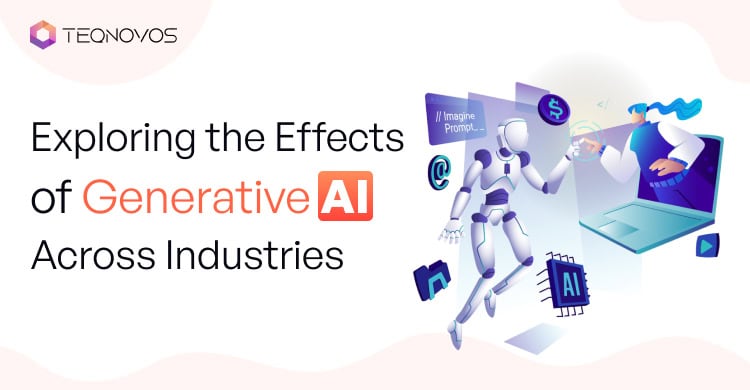
Exploring the Effects of Generative AI Across Industries
Generative artificial intelligence has moved beyond content creation. Businesses now use it to support various industries. This Gen AI tech helps with customer service, software engineering, product development, and knowledge work. The most valuable generative AI use cases across industries solve a defined business problem instead of adding AI simply because the technology is available.
The shift is already visible at the enterprise level. This guide explores generative AI applications across industries and explains where the technology can add practical value. It also looks at the impact of generative AI across industries through marketing and financial services. The goal is to help businesses identify useful opportunities while understanding the risks that come with implementation.
What Is Generative AI and Why Does It Matter to Businesses?
Gen AI is a technology that generates new information through learning patterns in existing datasets. It uses data in any digital format. This includes text, images, and even videos.
Many modern systems use a large language model. An LLM is an AI model trained to understand and generate human language. Some systems also use multimodal AI to process more than one type of input, such as text and images within the same workflow.
The strongest business applications of generative AI connect these capabilities with real company data and defined processes. A business may use the technology to summarize documents, generate draft content, or automate steps within a larger workflow.
Companies that need a solution built around their own processes can work with a generative AI development company to evaluate model options and deployment needs.
Where Generative AI Creates Value Across Industries
The best generative AI use cases across industries differ by sector. The technology solves a specific problem and supports a measurable business outcome.
| Industry | Common Use Cases | Potential Business Value | Key Consideration |
| Marketing | Content support and campaign ideation | Faster creative workflows | Brand accuracy |
| Software Development | Code assistance and documentation | Higher developer productivity | Code review |
| Healthcare | Clinical documentation and summarization | Lower administrative workload | Privacy and human oversight |
| E-Commerce | Product content and support | Faster merchandising workflows | Customer data protection |
| Education | Learning support and lesson creation | More personalized learning | Academic integrity |
| Manufacturing | Knowledge support and production insights | Better operational visibility | Reliable production data |
| Financial Services | Document analysis and service support | Faster knowledge work | Compliance and security |
These generative AI applications across industries show that the technology has value beyond content generation. The right use case depends on workflow complexity and the cost of mistakes.
Build Industry-Specific Generative AI Solutions —Talk to Our AI Experts Today!
Schedule a Call
How Generative AI Supports Modern Marketing Teams
Generative AI in marketing can support teams across content production and campaign planning. It helps marketers write first drafts quicker and convert existing material into new formats.
The marketing department can utilize the power of AI to compile summaries of their customer research and modify their copy based on different readers. It helps teams analyze vast amounts of customer data and pick out important themes for further analysis.
These systems support marketers rather than replace brand judgment. Human reviewers still need to check tone and campaign context. This becomes especially important when content represents a regulated product or makes factual claims.
Businesses can explore the wider relationship between generative AI and marketing before choosing the right workflow. Strong generative AI in marketing starts with a clear content process and defined approval rules.
How Generative AI Changes Software Engineering Workflows
Use of Generative AI in software development helps the software developers in multiple phases of the software development process. It will not only reduce redundancy but also allow faster completion of coding and testing processes.
Where Developers Can Use It
- Create code suggestions for defined functions or development tasks.
- Draft test cases that developers can review before execution.
- Explain unfamiliar functions or complex code structures.
- Prepare first drafts of documentation for APIs and system components.
- Identify possible causes of errors and suggest fixes.
- Support code modernization and help teams understand legacy components.
AI-generated code still needs human review. Developers test every output and check security before using it in production. AI tools can produce incomplete logic when they lack enough project context.
AI can also support release workflows and operational tasks through AI powered DevOps. This creates a more connected development process where coding support can work alongside testing and deployment automation.
Best application of generative AI in software development is the combination of generative AI with testing, code reviews, and engineering guidelines.
How Generative AI Is Being Used in Healthcare
In healthcare, the uses of generative AI could be in administrative operations and knowledge-based workflows. Generative AI in healthcare ensures organizations analyze data quickly while retaining human expertise in the decision-making process.
Where Healthcare Teams Can Use It
- Turn lengthy patient records into concise summaries for faster review.
- Prepare first drafts of notes based on approved medical information.
- Create clear responses and educational content for routine patient interactions.
- Summarize relevant findings and organize large volumes of medical information.
- Help structure and align information across connected healthcare systems.
Retrieval augmented generation can strengthen these workflows. It connects an AI model with selected and approved information before generating a response. This approach can help healthcare teams retrieve relevant information without relying only on the model’s general training data.
AI can also assist with structured healthcare information across connected systems. Look how AI supports complex data mapping across healthcare workflows in a healthcare interoperability solution.
Safeguards Remain Essential
Healthcare AI requires strong privacy controls and reliable source data. Clinical outputs need expert validation. Access controls also help protect sensitive patient information.
However, the potential for long-term benefits from the use of generative AI in healthcare is dependent on safety, clear human oversight, and good governance.
How Generative AI Enhances E-Commerce Operations
Generative AI can be used to assist in merchandising and catalog management within the e-commerce industry. Generative AI in e-commerce aids online retailers in performing tasks such as managing content and services more efficiently.
Where E-Commerce Teams Can Use It
- Draft product copy using structured catalog information.
- Help shoppers find relevant products through conversational search.
- Summarize and organize product details across large inventories.
- Draft responses and summarize previous customer conversations.
- Adapt product messaging for different customer groups and shopping needs.
Conversational search can make product discovery more direct. A shopper can describe what they need in natural language instead of working through several filters. The AI system can use structured product data to identify relevant options.
Customer service can also benefit from faster access to conversation history and approved information. These workflows are explored further in the guide on generative AI for customer service, where AI supports response generation and routine service interactions.
Data Quality Matters
Accurate catalog information plays an important role in AI powered recommendations. Incomplete product details can lead to irrelevant results. Also, customer information requires proper privacy protection measures during AI processing for support or shopping purposes.
The usefulness of generative AI in e-commerce depends on accurate product data, proper workflow, and human supervision.
How Does Generative AI Help With Education and Training?
Generative AI for education can help with lesson planning and personalization. It also assists students with practice and content creation. Teachers can prepare learning material faster while giving students ways to understand difficult topics.
Where Educators and Students Can Use It
- Create first drafts of lesson outlines and activity ideas.
- Generate exercises based on a specific topic or learning level.
- Present complex topics in simpler language or alternative formats.
- Adjust learning material for different skill levels and learning needs.
- Translate educational content for multilingual learning environments.
Students can also use AI as a study assistant within clear academic boundaries. A learner can request another explanation of a difficult concept or generate practice questions for revision. This can support independent learning while teachers remain responsible for instruction and guidance.
Academic Integrity Still Matters
AI generated answers can contain errors or unsupported information. Schools need clear policies for academic integrity and disclosure of AI use.
Effective generative AI in education works best when it supports learning instead of completing assignments for students. Teacher guidance and student critical thinking remain essential.
Where Generative AI Fits in Manufacturing
Generative AI in manufacturing can help teams access operational knowledge faster. Manufacturing environments often rely on production records and quality reports.
Where Manufacturing Teams Can Use It
- Turn operational records into concise updates for faster review.
- Help teams organize and summarize complex instructions.
- Retrieve relevant information from service records and equipment documents.
- Summarize quality data and highlight information that needs further review.
- Assist engineering teams with documentation and early stage design exploration.
AI becomes more useful when it connects with existing manufacturing systems instead of working as a separate chat tool. This approach appears in an AI driven manufacturing project built around real processes within an LED light manufacturing facility.
Reliable Data Remains Essential
AI outputs depend on the quality of the information behind them. Incorrect production data can lead to misleading summaries or poor recommendations.
Companies can define clear approval rules for high impact actions. This keeps human oversight in place while allowing AI to support routine operational tasks.
The value of generative AI in manufacturing depends on accurate data and clearly defined workflows.
Where Generative AI Fits in Financial Services
Generative AI in financial services can help teams manage documents and knowledge intensive work. Financial institutions often handle large volumes of policies and regulatory information.
Where Financial Teams Can Use It
- Turn long reports and internal documents into concise summaries.
- Help employees find approved information across internal knowledge sources.
- Review large volumes of text and flag items for further human review.
- Help teams retrieve product information and prepare consistent responses.
- Organize information before analysts complete a deeper evaluation.
AI can also support broader digital finance workflows when it connects with existing systems and controlled data sources. These applications form part of the wider use of AI solutions for fintech across customer service and financial technology processes.
Security and Validation Remain Critical
Financial information often contains sensitive customer or business data. Strong access controls can limit which users and systems can access this information.
AI generated outputs also need validation when they affect regulated processes or customer communication. Clear permissions and human review help maintain control.
The value of generative AI in financial services depends on secure data access and reliable information.
How Enterprises Can Move From AI Experiments to Useful Workflows
Enterprise generative AI use cases work best when they begin with a clear business objective. Companies gain more value when they identify a real problem first and then select the right AI model for that need.
Start With a Clear Business Problem
A useful AI opportunity often involves a repeatable task and a defined user group. It also needs an outcome that the business can measure. Teams can begin with one limited workflow and test its performance before expanding AI into more complex processes.
Connect AI With Business Workflows
AI becomes more useful when it connects with systems employees already use. AI workflow automation software can link AI outputs with document processing and knowledge workflows.
This connection moves AI beyond standalone chat tools. It allows the technology to support real operational processes and reduce repetitive manual work.
Define Ownership and Success Metrics
Enterprise generative AI use cases also need clear ownership. Teams can define who reviews outputs and who controls data access and how errors are reported. They can also select success metrics that match the original business objective.
These metrics may include time saved and user adoption. Clear ownership helps businesses expand AI use while maintaining human control.
Turn Generative AI Into Business Value —Start Your AI Project with Teqnovos!
Schedule a Call
How to Choose the Right Generative AI Use Case
A strong use case combines business value with manageable risk. This is especially important when companies compare several generative AI use cases across industries and need to decide where to invest first.
Use this six-point framework:
- Define the problem. Identify the task that creates unnecessary cost or delay.
- Check the data. Confirm that reliable information is available for the system.
- Estimate the risk. Consider the cost of an incorrect or unsafe output.
- Set human review. Decide when a person must validate the result.
- Review integration needs. Identify the systems and data sources the AI must connect with.
- Choose a measurable outcome. Track time saved, resolution speed, output quality, or another relevant business metric.
The business applications of generative AI become easier to prioritize when teams use this framework. It helps separate useful projects from ideas that look impressive but lack a clear return.
A structured AI implementation strategy can then turn the selected use case into a realistic roadmap.
How Generative AI Creates Business Value
The impact of generative AI across industries depends on how well each solution fits the process around it. A successful implementation can reduce repetitive work. It can shorten research time and improve access to faster workflows.
1. Workflow Efficiency
Generative AI can help employees complete routine tasks with less manual effort. It can support research and information retrieval across daily business operations.
2. Knowledge Access
Generative AI can make complex information easier to use. Employees can ask questions in natural language instead of searching several systems manually. This works best when the system uses reliable and permission based sources.
3. Performance Tracking
Businesses can measure the value of each AI project through clear performance indicators. A productivity tool may track task completion time. A knowledge system may track successful answers and escalation rates.
What Risks and Challenges Should Companies Be Aware Of?
Generative AI risks and challenges include inaccurate outputs and overreliance on automated responses.
Some of the risks and challenges of Generative AI technology involve output inaccuracies and excessive use of automatic responses.
1. Output Accuracy
Hallucinations refer to the AI produced responses that provide inaccurate or false information and are considered trustworthy. It poses a major risk when users do not validate the output before taking any action.
2. Data Security
AI systems may process sensitive business or customer information. Controlled access and good handling of data can help to avoid exposure and any kind of misuse.
3. Risk Governance
Governance needs to begin before deployment. The NIST provides a Generative Artificial Intelligence Profile that covers content provenance and incident disclosure.
4. Human Oversight
Human review remains important for high risk workflows. Companies can define when employees need to verify AI generated content and when additional approval is required.
Generative AI can be evaluated for its opportunities and risks while devising security measures around its implementation. Addressing generative AI risks and challenges can help to make AI adoption easier in the future.
What Is Next for Generative AI in Different Industries?
Generative systems are moving toward multimodal input and connected workflows. Models can increasingly work with data within the same experience.
AI agents are also becoming an important part of enterprise discussions. An AI agent is a system that can plan steps and use connected tools to pursue a defined goal.
Smaller specialized models may also matter for companies that need stronger control or lower operating costs for a narrow task. The next phase of generative AI use cases across industries will depend less on novelty. It will depend more on reliable integration and governance.
Conclusion
Generative AI is becoming part of everyday business technology. Companies need to identify a real problem first. They must evaluate data and measurable value.
The range of generative AI use cases across industries continues to expand as models gain stronger reasoning and multimodal capabilities. The right opportunity will differ for every business. A focused use case with trusted data and human oversight creates a stronger foundation for adoption.
Teqnovos can help evaluate the opportunity and define the architecture around your workflows. Book your free call with us today to get started!