



























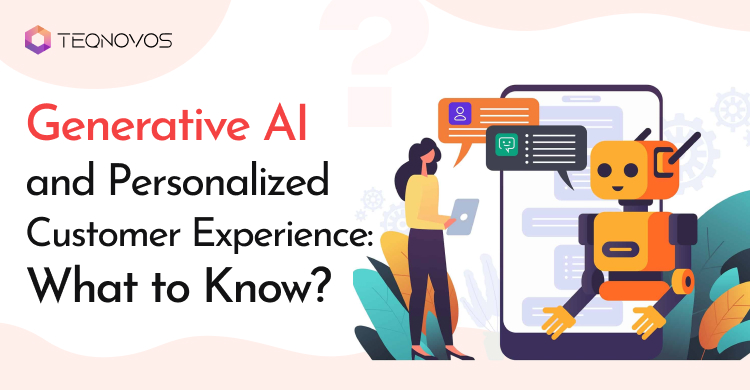
Generative AI and Personalized Customer Experience: What to Know?
Customer experience depends on more than fast replies. Customers expect useful answers and relevant support. They also expect businesses to remember the context of an interaction.
Generative AI has made this easier. Businesses use generative AI for customer service to create responses and summarize conversations. They also use it to find approved information and support customer requests across different channels.
The role of AI in customer experience has also expanded. Modern systems can connect language models with customer data and business tools. This helps businesses create a more personalized customer experience without treating every customer in the same way.
The value goes far beyond content creation. Current systems can support customer agents, chatbots and voice interactions, and product discovery. This article explains how that works and where the limits still matter.
Generative AI and Its Role in Customer Service
Generative artificial intelligence creates new content based on patterns learned during training. It can create text, images, and audio. Many current systems use a large language model. A large language model is an AI model trained to understand and generate human language.
Older customer support tools often followed fixed rules. Modern AI customer service software can combine generative models with business knowledge and connected systems. Current agent platforms can also connect models with search, files, and approved tools. This lets the system use current information instead of depending only on what the model learned during training.
This change has taken AI for customer service beyond simple question answering. A system can retrieve information, summarize a case, and guide a user through a task. More advanced systems can also use approved tools to complete specific actions.
Generative AI tools can produce answers that sound correct even when the information is unsupported. Businesses reduce this risk through trusted knowledge sources and testing and human review.
Generative AI and Personalization
Generative AI gives businesses a more flexible way to use context during each interaction. A system can use previous conversation details or product information when that data is available and permitted. It can then create a response that fits the current need.
This makes generative AI for customer service useful for a personalized customer experience. It can support tailored messages, relevant recommendations, and clearer service guidance. It can also help human agents understand a long customer history faster.
The strongest results come when the AI works with trusted business information. A model alone cannot know every current policy or product detail.
Build Smarter Customer Experiences With Generative AI —Talk to Our AI Experts Today!
Schedule a CallHow Generative AI Improves Customer Experience
Businesses now use AI in customer experience across more parts of the service journey. The technology can help before a support request begins. It can also help during a conversation and after the issue is resolved. The following generative AI use cases for customer service show where the technology adds practical value.
1. Personalized Content Creation
One of the established benefits of generative AI is its ability to create content quickly. Businesses use generative AI tools for support messages, emails, and follow up content. The system can adapt the response to the information available in the current interaction.
This makes AI powered customer service useful when teams handle a high volume of routine communication. It also gives human agents a useful starting point without forcing them to write every response from the beginning.
2. Context Based Customer Assistance
Generative AI can use information from connected customer systems when the required access exists. This gives the system more context before it creates an answer.
A customer may ask about a return policy. The system can retrieve the current policy before responding. It can also summarize earlier messages so the customer does not need to repeat the same details.
Many AI customer service solutions use RAG. It lets a model retrieve relevant information before creating a response. RAG improves access to current knowledge. It does not remove the need for testing and access controls.
3. AI Chatbots and AI Agents
Chatbots remain one of the most common uses of AI for customer service. Modern chatbots can understand natural language and remember conversation context.
An AI chatbot customer service system can answer routine questions and find relevant information. It can also pass a request to a human agent when the issue needs more judgment.
More advanced AI agents for customer service can go further. An AI agent can plan a set of steps and use approved tools to complete a defined task. This may include checking an order status or updating a support ticket. Current customer agents can also work across channels such as web and mobile.
Businesses exploring AI chatbot development often evaluate context handling, knowledge access, and human handoff alongside conversation quality. The growth of AI powered customer service does not remove the need for people. It gives support teams another way to handle routine work while keeping complex cases with human agents.
4. Personalized Recommendations
Product discovery is another practical use of generative AI for customer service. A conversational system can ask what a customer needs. It can then use current product data to narrow the available options. It can also explain why a product fits the stated need.
This works better when the model has access to current product information. A language model alone does not know live stock or current prices unless a connected system provides that information. This use case fits customer experience better than treating generative AI as a pricing engine.
5. Agent Assistance and Human Handoff
Generative AI can also support human service teams. A system can summarize a long conversation. It can surface relevant knowledge. It can also suggest a response for an agent to review.
This makes AI customer service software useful even when the business does not want full automation. Human agents can stay in control while the system reduces repetitive work.
Strong AI customer service solutions also define clear handoff points. Sensitive complaints and unusual requests often need human judgment.
Current Generative AI Use Cases for Customer Service
Businesses use generative AI for customer service across chat, email, voice, and agent assistance. These generative AI use cases for customer service depend on language and context. They also depend on access to reliable information.
An AI chatbot customer service workflow can answer common questions and retrieve approved account details. A voice system can handle spoken requests. An agent assistant can summarize a case before a human responds.
The move toward AI agents for customer service adds another layer. Agents can use approved tools and complete defined actions across connected systems. OpenAI expanded agent development around tool use and retrieval. Google has also expanded customer experience agents across conversational support and product discovery.
Businesses that need this type of controlled action use agentic AI development. They can help businesses to understand different tools and permissions.
What Makes Generative AI Personalization Reliable?
Reliable personalization depends on how well generative AI uses context and trusted information. Businesses get better results when systems combine accurate data with clear controls and human oversight.
1. Relevant Customer Context
The system needs information that relates to the current request. More customer data does not always create a better answer. The right context matters more.
2. Grounded Knowledge
A customer facing AI system can retrieve approved information before creating a response. This helps reduce dependence on model memory. Teams working with production systems can also understand how production ready AI agents use retrieval and tool access.
3. Clear Permissions
Customer data needs controlled access. The AI needs access only to the information required for the task.
4. Human Escalation
Automation works best within clear limits. Complex or sensitive requests can move to a human agent when more judgment is needed.
These elements help AI customer service solutions work with more control. They also support a better customer experience without turning every interaction into an automated process.
Risks and Limits of Generative AI in Customer Experience
Businesses already use AI in customer experience across many customer service workflows. This makes risk management part of normal implementation.
1. Incorrect Responses
Generative AI can produce unsupported information. Grounding, evaluation, and human review can reduce this risk.
2. Privacy and Data Access
Personalization often relies on customer data. Businesses need clear access rules for every connected system.
3. Prompt Injection
Prompt injection happens when harmful instructions try to change how an AI system behaves. This matters more when the system can access tools or business data.
Our practical guide to AI guardrails in agentic systems explains how businesses can limit actions and control system behavior.
4. Over Personalization
Personalization can feel intrusive when a system uses information that the customer did not expect to influence the interaction. Useful personalization stays relevant to the current need.
5. Transparency
Customers benefit from knowing when they are interacting with an AI system. The European Union AI Act applies transparency duties to certain interactive AI systems from August 2 2026.
These limits do not remove the value of AI for customer service. They help businesses define where automation works and where human involvement adds more value.
How Businesses Choose the Right AI Customer Service Approach
There is no single best AI tool for customer support for every business. Some companies need an AI chatbot customer service system for common questions. Others need a connected agent that can use knowledge and complete approved actions.
Businesses evaluating customer service technology often look at data access, escalation, and monitoring. They also look at how easily human agents can take control. The right approach depends on the workflow. It also depends on the type of customer information involved.
Businesses that want a broader implementation example can review this AI driven SaaS transformation case study. It shows customer support as one part of a wider software transformation.
A custom system may involve generative AI development when existing tools cannot support the required knowledge sources or integrations.
Bring Generative AI Into Customer Service Workflows —Start Your AI Project Today!
Schedule a CallUsing Generative AI for Personalized Customer Experience
Chatbots and email remain useful starting points. Modern customer experience systems now extend into voice support, agent assistance, and workflow actions.
A business may use generative AI for customer service to create a tailored support response. Another workflow may retrieve product information for a customer. A human agent may use an AI summary before taking over a case.
These generative AI use cases for customer service show why the technology now covers more than content generation.
The value comes from combining language models with current information and clear business rules. Human oversight remains part of that process.
Conclusion
Generative AI has changed how businesses personalize customer service. It now supports content creation, contextual assistance, product discovery, and agent support.
Useful results depend on clear use cases and controlled access. Businesses also need testing and monitoring because AI responses can still be wrong. The next stage of customer service AI is not about removing every human interaction. It is about using automation where it reduces effort and keeping people involved where judgment matters.
Connect with us to build your chatbot. Get in touch with our experts and bring value to your brand.