























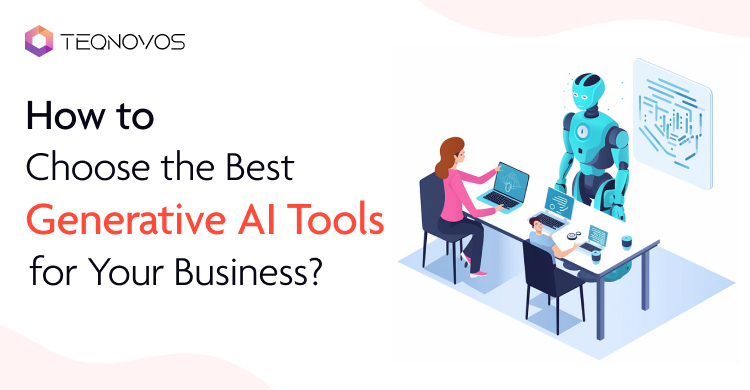
How to Choose the Best Generative AI Tools for Your Business?
The number of generative AI tools for business keeps growing. Companies can now use artificial intelligence for content creation. They can also use it for customer support and software development. It also helps with data analysis and workflow automation.
A tool may look impressive during a demo but still fail in daily work. The best generative AI tools for business solve a clear problem. They fit existing systems and help build a secure system.
This guide explains how to choose AI tools for business in a practical way. It also covers the AI tool selection criteria that companies review before they invest.
Introduction to Generative AI Tools
Generative artificial intelligence creates new content or responses from patterns learned during training. These systems can produce structured responses in the form of text and images.
Many tools use large language models. A large language model is an artificial intelligence model trained to understand and generate language. Some tools also support multimodal artificial intelligence. This means the system can work with more than one type of input.
Modern generative AI tools for business can do more than respond to prompts. Some can connect with company data. Others can work with business software through an application programming interface. An API allows separate software systems to exchange information and trigger actions.
Some platforms also use artificial intelligence agents. An AI agent can plan steps and take approved actions to reach a goal. This gives businesses more options for complex workflows.
The right tool depends on the problem that needs to be solved. It also depends on how much control the company needs.
Choose the Right Generative AI Tools —Talk to Our AI Experts Today!
Schedule a Call
Benefits of Using AI Tools for Business
AI tools for business can support many daily tasks. Their value depends on the use case. It also depends on how well the tool fits the process.
1. Automate Routine Business Processes
Automation remains one of the strongest uses of Gen AI. Companies can use AI tools for business automation to route requests and process documents. It also helps with trigger approvals and supports customer service.
Some systems can also manage tasks that involve various steps. Businesses can learn more about how AI workflow automation software manages connected tasks across different systems. An artificial intelligence agent may review context before choosing the next action. This can make automation more flexible than a fixed rule.
A company may not need an advanced system for every task. A general assistant may be enough for content support. A connected workflow platform may make more sense when several tools and actions are involved. Connected AI systems also combine automation with business data and external platform integrations.
2. Improve Process Consistency
Generative artificial intelligence can reduce repetitive manual work. It can also help teams follow the same process more consistently. This does not mean every output will be correct.
Artificial intelligence systems can still produce false or unsupported information. Human review remains important when an error could affect a customer. A business decision may also need extra checks.
The strongest tools support review and validation. They do not remove the need for judgment.
3. Support Customers Around the Clock
Artificial intelligence can answer common questions outside normal working hours. This can help support teams respond faster. Generative AI for customer service can also support human agents with faster responses and approved business information.
A company still defines clear limits. The system knows which requests it can handle. It also knows when a person needs to step in. This matters more for complaints and situations that need human judgment.
Tips for Choosing the Best Generative AI Tools for Business
Knowing how to choose AI tools for business requires more than comparing feature pages.
The process starts with the business problem. Companies can then compare each option against clear AI tool selection criteria.
1. Define the Business Requirement
The company first decides what it wants the tool to improve. The need may involve content support and customer service. It also involves coding, internal search, document processing, and workflow automation.
The expected result is also clear. A clear AI implementation strategy can help connect each use case with measurable business goals. Support teams may want faster response times, and finance teams may want quicker document review.
Clear goals make it easier to compare the best generative AI tools for business. This step also helps companies avoid paying for features they do not need.
2. AI Level
Not every task needs the most advanced system. A simple assistant may be enough for writing support. A knowledge assistant may need access to approved company information. An artificial intelligence agent may need permission to use software and complete tasks.
A production ready AI agent also needs controlled access and clear workflow logic before deployment. More autonomy can also create more risk. Companies identify which actions the system can perform on its own. They also decide which actions need approval.
This makes the selection process more practical. It also stops a company from buying an advanced platform for a simple task.
3. Review the Full Cost
The monthly subscription price does not show the full cost. Some tools charge per user. Others charge based on model usage. Storage may create extra costs. API usage may also affect the final bill.
A company may also need to pay for integration and training. They also may need help with evaluation and ongoing administration.
This point matters more when companies compare enterprise generative AI tools. A more expensive product can still provide better value if it reduces integration work. It may also include controls that the business already needs.
4. Research and Shortlist the Right Tools
Once the goals and budget are clear, the company can build a shortlist. Each tool must be reviewed against the same use case. The company checks the models it uses and the integration options. Administration controls need to receive the same attention.
A short list is easier to test than a large list of products. Companies looking at AI tools for business automation focus on workflow logic. They also review integrations, human approvals, and visibility into automated actions.
The aim is not to find the tool with the longest feature list. The aim is to find the tool that fits the work.
5. Check Security and Data Governance
Security needs to have its own place in the buying decision. Before adopting enterprise generative AI tools, the company understands how the provider handles prompts. Business records need the same level of review.
The company checks data retention controls and access management. They also check for encryption and administrator permissions. AI guardrails can also help companies define limits for automated decisions and system actions.
Businesses in regulated sectors may need stricter controls. Good AI tool selection criteria therefore cover privacy and governance before deployment starts.
6. Check Integration and Scalability
A useful tool fits the current technology setup. The company checks if the tool connects with the software teams already use. This may include customer relationship management software and resource planning systems. Document platforms and internal databases can matter too.
Application programming interfaces become important when the company wants artificial intelligence to work with existing software. Automation platforms may also need connectors. Identity controls can also help limit what each user or agent can do.
Scalability matters as usage grows. A tool that works for one small team may not work well across several departments. Enterprise generative AI tools support larger teams without making administration too difficult.
7. Test the Tool With Real Business Tasks
A demo can show what a tool can do. It cannot prove how well the tool will perform inside a specific company.
The business creates a small set of real tasks before making a larger commitment. Each shortlisted tool receives the same tasks. The company can then compare output quality and ease of use.
This is one of the most useful ways to understand how to choose AI tools for business. Real tests give the company useful evidence. Public claims and broad benchmarks cannot replace that evidence. Real business workflows can also reveal how well AI performs when it connects with operational systems.
8. Review Human Oversight and Failure Handling
Artificial intelligence systems will not perform perfectly every time. The company asks what happens when the tool is uncertain. It also checks if users can review important actions before they happen.
Logs can help teams understand what the system did. Approval controls can reduce risk. Teams also know how to stop or reverse an automated action.
These controls matter more with AI tools for business automation. An automated system may update records. It may send messages. It may also trigger actions in other software. Human oversight remains part of the workflow.
9. Compare Buying With Building
An existing product can work well when the business has common needs. A custom solution may make more sense when the workflow is unique. Deeper integration may also justify custom development. Special security requirements can create the same need.
Buying can reduce setup time. Building can provide more control. The right choice depends on the business case. A custom system solves a clear problem that an existing product cannot handle well.
Build AI Solutions That Drive Business Value —Start Your AI Project Today!
Schedule a Call
A Simple AI Tool Selection Checklist
A clear checklist can make the selection process easier. It helps a company compare different options using the same criteria.
Before selecting a tool, the company can review these key areas:
- Business Fit: The tool solves a clear business problem.
- Technology Fit: The tool works well with the existing technology environment.
- Security: The platform meets relevant privacy and data protection requirements.
- Human Control: The system provides the right level of review and approval.
- Performance: The tool delivers reliable results during real business tasks.
- Cost: The pricing remains practical as usage increases.
- Monitoring: The platform provides enough visibility into errors and system actions.
These factors create practical AI tool selection criteria. They help companies compare tools based on business value instead of unnecessary features.
Conclusion
There is no single tool that fits every company. The right generative AI tools for business depend on the use case and existing systems. It also depends on data requirements and the risk level included. Budget and expected value guide the final choice.
The company defines the problem first. It then compares options with consistent AI tool selection criteria. Real testing happens before wider adoption.
AI tools for business automation may offer more value when the goal involves connected processes. Enterprise generative AI tools may fit better when the company needs stronger control and administration.
Connect with Teqnovos to solve your real business problems. Build your business value without creating unnecessary complexity.