
























The Growing Demand for SaaS in the Logistics Industry
Logistics businesses are moving towards the need for faster visibility across warehouses and deliveries. Traditional on premise systems often make this harder because they limit access and increase maintenance work. This is why many companies now prefer cloud based platforms that connect daily logistics operations in one place.
SaaS logistics software development helps businesses build scalable platforms for shipment tracking and order visibility. These solutions support real time access and reduce the need for heavy internal infrastructure.
The shift toward SaaS is also helping software vendors create more focused logistics products. A vendor can build solutions for transport teams and supply chain businesses. This makes SaaS a strong model for both logistics companies and software product owners.
In this blog, we explain why SaaS logistics is growing, what features matter, and how businesses can build reliable SaaS software for growth.
Quick Answer: What is SaaS Logistics Software Development?
SaaS logistics software development is the process of building cloud based logistics platforms. It assists in managing fleet tracking and delivery updates through one connected system. Logistic teams can improve visibility and reduce manual work with less infrastructure pressure.
But why is SaaS becoming popular?
Well, SaaS allows the delivery of software over the internet. Unlike on-premise software, users do not need to install and manage software locally on one or more devices. Also, logistics companies do not need to set up an IT infrastructure to manage the software. This makes web development important for building scalable and secure SaaS platforms.
For vendors, the delivery of SaaS logistics software is easy and highly effective. They can expand their customer base with minimal geographical limitations.
Why SaaS Logistics Software is in High Demand?
Logistics teams can now manage more orders and warehouses. Manual tools and on premise systems slow down this process. They also make it harder to share live data across teams.
These two are the biggest reasons why companies are making a shift to Logistics SaaS software for managing their everyday operations. It helps transport teams and delivery managers work through one connected system. This improves control and reduces daily operational pressure.
A cloud based logistics software model also gives businesses more flexibility. The time required to set up and start using a SaaS application is much less compared to on-premise software, which involves multiple activities, including installation, configuration, and maintenance.
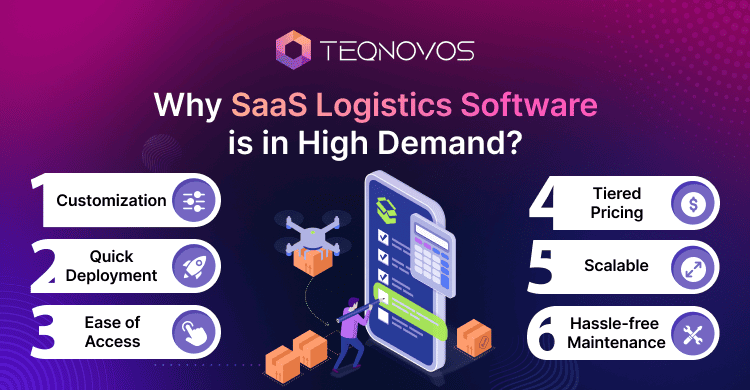
Here are some more practical advantages of SaaS logistics software.
1. Customization
With most SaaS solutions, logistics companies get the flexibility to select features that best meet their needs. SaaS companies offer several customization options so that their software can meet the varying needs of customers. These custom SaaS logistics solutions can also support unique workflows, user roles, and reporting needs.
Additionally, logistics firms have the option to develop a fully customized and dedicated SaaS software for their businesses.
2. Quick Deployment
SaaS companies can instantly deploy their applications on the cloud, thus making them readily accessible directly via the internet.
There is no need for end users to set up an IT infrastructure to deploy SaaS or cloud-based apps at their end. A SaaS company needs to deploy its software once, and it becomes a ready-to-use solution for end users. Businesses can also use offshore software development services to speed up development and delivery.
3. Ease of Access
SaaS logistics applications are accessible from anywhere. Contrary to the on-premise model, the application and user data are not stored locally on a device but in the cloud.
This allows users to retrieve their application data and configuration on any device. Users do not need to use the same device to access a SaaS application. This makes cloud-based logistics software more useful for teams that manage operations across multiple locations.
4. Tiered Pricing
Most SaaS software follows a tiered pricing strategy to target businesses with different budgets. Under the tiered pricing strategy, a SaaS solution is available at different price plans.
While the plan at the lowest level of the tier gives access to basic features, the plan at the uppermost level unlocks all the features offered by a SaaS application. This allows users to choose a plan that meets their needs.
5. Scalable
As SaaS applications are deployed in the cloud, they are easily scalable. Whether the need is to integrate more features or accommodate the increase in the number of users, a vendor can get more IT resources for their application almost instantly. Cloud service providers allow software vendors to scale up or down with ease. This is a major reason for vendors to focus more on logistics management software development.
6. Hassle-free Maintenance
One more notable advantage of SaaS software is that they are easy to maintain compared to on-premise software. As the application is hosted centrally on a cloud server, the vendor can roll out security updates or new versions quickly. The end users will access the updated version of the application without the need to put in any significant effort.
Also, vendors can perform a rollback easily in case there’s an issue with the updated version of the application.
Why Develop Logistics SaaS Software?
Logistics businesses need better control over orders and delivery updates. A custom SaaS platform helps them manage these workflows through one connected system. It also reduces manual work and improves visibility across daily operations.
For software vendors, custom logistics software development creates a strong product opportunity. Vendors can build focused platforms for transportation teams and supply chain companies. These products can support subscription based growth and serve customers across different locations.
Logistics companies can also build SaaS products around their exact workflow needs. This includes route planning and reporting. Businesses can hire dedicated developers to speed up their product launch in the market.
Launch a Logistics SaaS Platform Built for Faster Operations. working on your project
Schedule a CallKey Types of SaaS Logistics Software for Modern Businesses
Whether you want to start a SaaS business or create a SaaS-based application for your logistics business, it’s important to get familiar with the popular types of SaaS logistics software. These solutions also show how SaaS logistics software can support different parts of business operations.
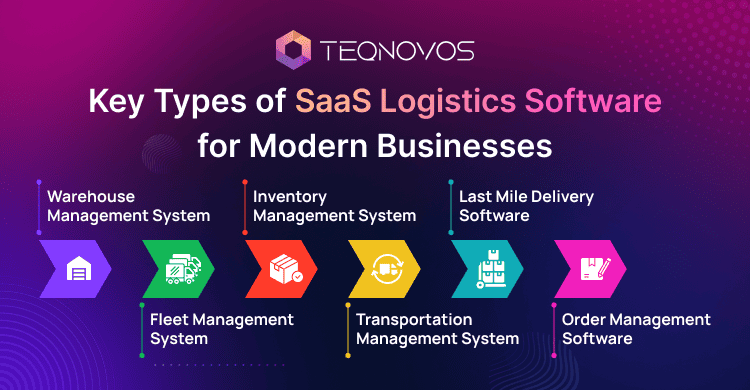
1. Warehouse Management System (WMS)
A WMS, or warehouse management system, assists in streamlining various warehouse operations. It allows a logistics company to track all the goods stored within a warehouse and automate invoice and bill generation. Locating goods even in a large warehouse becomes quite convenient with a warehouse management system.
2. Fleet Management System (FMS)
For companies looking to manage their fleet effectively from a single location, a fleet management system is the best bet for them. Fleet management involves various tasks, such as vehicle tracking, route planning, driver schedule creation, regular vehicle maintenance, and vehicle diagnostics.
A fleet management system makes use of GPS technology to track the live locations of vehicles and share real-time data with the fleet manager. Businesses can also use mobile app solutions for logistics management to improve fleet visibility.
3. Inventory Management System (IMS)
An inventory management system provides a business with a high-level overview of the whole inventory. A company can fully rely on IMS to track its stocks. Such a system provides all the data needed to make well-informed decisions when it comes to buying, restocking, and selling the stocks of raw materials, unfinished goods, and finished goods.
This type of logistics SaaS software is useful for companies that manage large product volumes across warehouses and customer locations.
4. Transportation Management System (TMS)
With the help of a transportation management system, companies can book and schedule shipments, ensure the timely delivery of products, manage multiple carriers, and manage transportation expenses. SaaS TMS is widely used by many companies to improve the efficiency of shipping goods.
Transportation management system software development is useful for logistics businesses that need better shipment planning and delivery visibility.
5. Last Mile Delivery Software
Last mile delivery software helps businesses manage the final delivery stage. It supports driver assignment and customer alerts. The platform also assists with proof of delivery route updates and live delivery status.
This works well for courier companies, retail delivery brands, food delivery platforms, and logistics providers that need faster customer communication.
6. Order Management Software
Order management software helps logistics teams track orders from request to delivery. It connects order status and delivery records in one platform. This helps businesses reduce manual follow ups and improve service quality across each order stage.
Read our blog on SaaS for supply chain management. This complete guide will help you get an overview of how it works and why it is considered the future of business.
Key Features to Integrate into Your Logistics SaaS Software
Following is a list of the most important features of SaaS logistics software development. These features help businesses build a more useful and scalable logistics SaaS application.
1. Real-time Notifications
For any company, information is the key to making better business decisions and achieving better growth. Also, the information must be available promptly; otherwise, even a small delay can snatch a good opportunity.
So, the real-time notification feature becomes a crucial part of any logistics software. Whether it’s about the delivery of a shipment, wrong delivery, or stock refilling, the business should get updates in real-time as app notifications.
2. Price Calculation
To generate accurate invoices, price calculation is critical. A business may need to consider various expenses to generate the final invoice. Additionally, businesses may have to calculate overall expenditure and profit margins, and for that, an in-built price calculator proves highly useful for SaaS-based logistics solutions.
3. GPS Tracking
GPS tracking is an essential feature that allows a business to track shipments or vehicles directly from the SaaS application. Staying updated about moving goods can help in better work management and customer satisfaction. Also, GPS tracking makes it possible for businesses to know if there’s an emergency, such as a vehicle breakdown or an accident.
4. Record Keeping
Documentation and record-keeping are among the most crucial tasks for any logistics company. However, both of them require a lot of time and effort. There are several records related to bills, invoices, customers, products, transportation vehicles, etc., that are not easy to manage.
A logistics SaaS application can easily automate the process of record-keeping. Companies can scan physical documents and store their digital copies within the software. They can also add records directly in digital form and analyze them easily to extract useful insights through logistics software.
5. Third-Party Integrations
Due to the complexity of the logistics business, companies may need to use multiple applications to streamline their work. However, jumping from one tool to another is not only time-consuming but also hampers the productivity of employees. Thus, a SaaS solution that integrates with other apps is what logistics companies prefer these days.
Third-party integration is an essential feature of any SaaS logistics software. Also, the more supported third-party apps, the better it is for a SaaS solution. Some of the most popular third-party tools available for integration include Google Drive, Gmail, Zendesk, and Ship Hawk.
6. Admin Dashboard
An admin dashboard gives managers a clear view of warehouse revenue and pending tasks. It helps decision makers track platform activity from one place. This feature is important in logistics management software development because it gives businesses better control over daily performance.
7. User Role Management
User role management helps businesses control access for admins and customers. Each user can view only the tools and records linked to their role. Improves the platform security and keeps sensitive business data protected.
Turn Your SaaS Idea Into a Scalable Digital Product. —Book Your Call
Schedule a CallHow AI Improves SaaS Logistics Software
AI logistics software improves SaaS platforms by helping businesses predict delays, plan better routes, automate dispatch tasks, and track delivery performance in real time. It gives logistics teams faster insights and reduces manual work across shipment operations.
AI adds smarter decision support to daily logistics workflows. It can review delivery patterns and driver activity. This helps managers act faster before small delays affect customers.
Key AI use cases include:
- Predicting delivery delays before they happen
- Suggesting better delivery routes
- Automating dispatch decisions
- Forecasting demand and stock movement
- Tracking driver and fleet performance
- Sending real time customer alerts
- Detecting repeated delivery issues
- Supporting faster billing and document checks
AI powered logistics software helps businesses reduce manual checks and improve delivery accuracy. It also supports better customer communication through real time updates and smarter exception alerts.
For larger platforms, AI can also connect with AI workflow automation software development to automate dispatch and task routing. This makes the platform more useful for logistics companies that manage high order volume and complex delivery workflows.
How Much Does SaaS Logistics Software Development Cost?
The cost of SaaS logistics software development depends on the integrations and automation needs. A basic tracking platform costs less than an enterprise system with AI routing and carrier integrations.
| Platform Type | Estimated Cost |
| Basic MVP | USD 30000 to USD 80000 |
| Mid level platform | USD 80000 to USD 200000 |
| Enterprise logistics platform | USD 200000 to USD 500000 plus |
| AI enabled platform | USD 250000 to USD 500000 plus |
The final cost also depends on the type of logistics software required. A fleet tracking tool has a different budget than a full platform with transport planning and customer portals.
Businesses that need AI powered logistics software may need a higher budget. As AI features need logic automation rules and testing.
How to Secure Logistics SaaS Software
Logistics SaaS platforms manage customer data and business reports. A secure system needs access control and safe API connections.
Key security controls include:
- Role Access Control: Limit access for admins and customers based on user roles.
- Data Protection: Protect shipment records and delivery files with secure storage and encryption.
- Activity Tracking: Use audit logs to track user actions and sensitive data activity.
- Secure Integrations: Protect API connections with maps and third party tools.
- Backup Support: Keep backup and recovery systems ready to protect business continuity.
- Login Security: Add multi factor login for admin dashboards and sensitive platform areas.
Security planning helps logistics companies protect billing data and customer communication. Businesses can also review cross industry security practices, such as Insurance app security solutions, when building platforms that manage sensitive user data.
Conclusion
SaaS-based logistics solutions help logistics businesses manage daily operations with better access and lower software maintenance needs. They also support key workflows such as tracking inventory and shipment updates.
Software vendors can use this demand to build focused SaaS products for logistics companies. The goal should be to solve real operational gaps and deliver software through a cloud based model.
Teqnovos helps businesses build SaaS logistics platforms around real workflow needs. The focus stays on scalable architecture and secure integrations to support logistics growth.