

























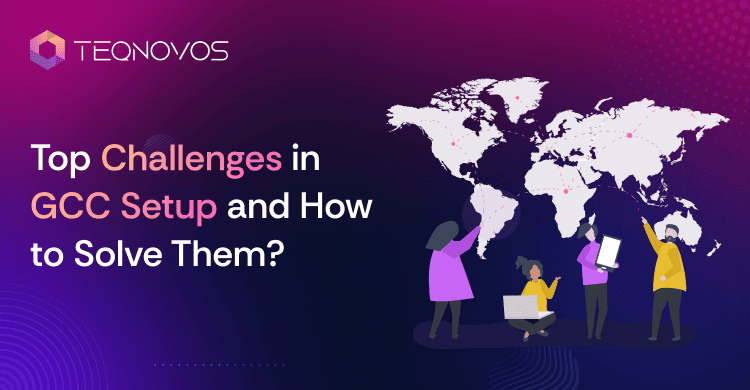
Top Challenges in GCC Setup and How to Solve Them?
Enterprises around are building Global Capability Centers to gain stronger control over talent, technology operations, and innovation. This model helps companies scale skilled teams while keeping product ownership closer to the business. It also supports cost efficiency and long-term capability building across data cloud automation and support functions.
Still, many companies face Global Capability Center setup challenges when planning lacks clear direction. Weak governance can affect delivery quality. Cost planning can also become difficult when legal infrastructure and leadership needs are not mapped early.
Enterprises that plan each layer early can reduce risk and build a GCC that supports growth beyond cost savings.
What Makes the Global Capability Center Setup Complex?
A Global Capability Center setup involves many moving parts. It is not limited to hiring a remote team. Enterprises need a clear business goal, legal structure, talent plan, secure systems, and local leadership before the center starts scaling.
Key areas that make the GCC setup complex include:
Business Purpose: The GCC needs a clear role from the start. It must support defined business functions such as cloud operations, customer support, data analytics, or automation.
Legal Setup: Entity formation and employment rules need early planning. Any gap at this stage can delay launch and increase risk.
Talent Planning: The company needs the right mix of engineers and local expert managers. Hiring without a phased plan can affect quality and cost.
Technology Infrastructure: Secure access and data controls need to be ready before teams begin delivery. This helps protect business operations.
Governance Structure: The parent company needs clear reporting lines and performance tracking. Local teams also need authority to manage daily execution.
Long Term Scalability: A GCC works best when it can grow with business demand. Working with a Global Capability Center setup company can help enterprises align strategy and operations before the center expands.
Key Global Capability Center Setup Challenges
Every GCC needs clear planning before it moves into hiring and delivery. Many enterprises face Global Capability Center setup challenges because early decisions are not aligned with business goals. These issues can affect cost control and value.
1. Unclear Business Goals
A GCC can lose direction when the business purpose is not clear. Some companies start with broad goals and no defined function ownership. This creates confusion around hiring budgets and success metrics. The GCC needs a clear mandate before teams scale.
2. Talent Hiring Delays
Hiring skilled teams can take longer than expected. Enterprises often need engineers, product managers, cloud experts, data teams, automation specialists, and security talent at the same time. A phased hiring plan helps reduce delays. Companies can also hire dedicated developers to fill urgent skill gaps and build delivery capacity faster.
3. Weak Operating Structure
A weak structure slows daily execution. Teams need clear reporting lines and decision rights. Parent company leaders also need full visibility into delivery progress. Without this structure, the GCC may face repeated delays and poor accountability.
4. Compliance Gaps
Legal and compliance planning needs attention from the start. Companies need to review contracts, payroll tax, employment rules, data privacy, and IP protection. Small gaps can lead to launch delays and a higher risk during scale.
5. Rising Setup Cost
A GCC can become expensive when hidden costs are not mapped early. These costs may include legal support, office setup, and hiring tools. It also includes payroll systems and security audits. Clear cost planning helps enterprises avoid budget pressure.
6. Data Security Risk
A GCC handles sensitive business systems and customer data. It needs secure access controls, cloud governance, and regular security reviews. Weak security planning can expose the business to data loss and compliance risk.
7. Poor Company Alignment
A GCC needs strong alignment with the parent company. Business leaders must define priorities and review cycles. Poor coordination can affect delivery quality and long term business outcomes.
Overcome GCC Setup Challenges with Expert Support. —Talk to an Expert!
Schedule a CallHow to Solve GCC Setup Challenges
Enterprises can reduce GCC risks when they move with a clear plan. Strong Global Capability Center solutions focus on strategy and leadership. Each area needs attention before the center moves into full scale delivery.
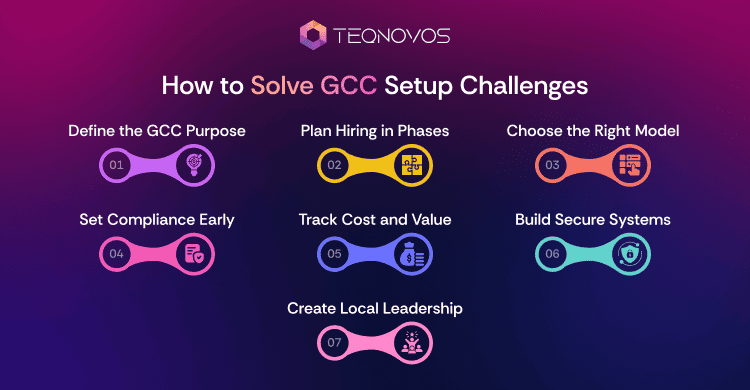
1. Define the GCC Purpose
A GCC needs a clear purpose before hiring begins. The company must define which functions the center will support. This can include product engineering and cloud operations. It can also include automation or finance operations. Clear goals help leaders plan budgets and success metrics.
- Define the main business reason behind the GCC
- Select the functions the center will support first
- Set clear delivery goals for each team
- Align the GCC roadmap with the parent company priorities
2. Plan Hiring in Phases
A phased hiring plan helps control cost and quality. The company can start with core leadership and key technical roles. It can then expand by function as demand grows. This approach reduces rushed hiring and improves team stability.
- Start with leaders and critical technical roles
- Add teams based on business demand
- Use skill mapping before recruitment begins
- Review hiring quality before each scale phase
3. Choose the Right Model
The right model depends on business control speed and cost goals. Some enterprises prefer a captive model for full ownership. Others choose a hybrid model or build-operate-transfer model for faster setup. A clear model helps avoid confusion around decision rights and delivery ownership.
- Compare the control cost and speed before selection
- Define ownership between local and global teams
- Set reporting lines before operations begin
- Choose a model that supports future scale
4. Set Compliance Early
Compliance planning must start at the beginning. Legal payroll tax contracts and IP protection need proper review. Early controls help prevent delays and reduce risk during expansion.
- Review local legal requirements before setup
- Create clear payroll and employment processes
- Protect business data and intellectual property
- Set compliance checks for every growth stage
5. Track Cost and Value
A GCC must show measurable value. Leaders need to track hiring cost, productivity, and business impact. Clear KPIs help the parent company understand return on investment.
- Track setup cost and ongoing expenses
- Measure team output and delivery speed
- Review savings against local hiring costs
- Connect GCC performance with business outcomes
6. Build Secure Systems
Security needs to be part of the setup plan. Access controls, cloud governance, and regular security reviews help protect data and systems.
- Set role based access for all teams
- Use secure cloud and collaboration tools
- Document security policies for daily work
- Run regular audits to reduce risk
7. Create Local Leadership
Local leaders help manage delivery culture and escalation. They also connect the GCC with the parent company’s goals.
- Hire leaders with domain and delivery experience
- Give local teams clear decision authority
- Build a strong feedback loop with global leaders
- Create ownership for hiring quality and delivery
Enterprises can also review our guide on how to set up a Global Capability Center in India for a deeper setup process.
GCC Operating Model for Enterprise Success
The right GCC operating model helps enterprises control costs and leads to long term growth. It defines how the center works with the parent company. It also sets clear rules for leadership reporting decisions and accountability.
1. Captive Model
A captive model gives the enterprise full ownership of the GCC. The parent company controls hiring systems and delivery standards. This model works well for companies that need strong control over sensitive work, data security, and core operations.
2. Build Operate Transfer Model
A Build-Operate-Transfer model helps companies launch faster with expert setup support. A partner builds and operates the center first. The company takes full control once the team process and infrastructure become stable. This model works well when speed and local execution support matter.
3. Managed Team Model
A managed team model gives access to skilled teams without heavy setup pressure. The partner manages hiring and team operations. This model works well for companies that need flexible capacity and faster delivery without building a full entity at the start.
4. Hybrid Model
A hybrid model combines internal control with partner support. The enterprise keeps ownership of strategy and key decisions. The partner supports hiring and scale. This model works well for companies that want flexibility and controlled growth.
A successful model needs clear reporting lines and delivery accountability. These controls help the GCC operate with speed and business focus.
GCC Governance Model Best Practices
Strong governance helps a GCC stay aligned with business goals. It balances parent company oversight with local decision making. A strong Global Capability Center strategy also helps leaders manage compliance costs and team growth with more control.
Dual Leadership: A GCC needs leadership from both sides. A senior executive sponsor from the parent company keeps the center aligned with global goals. A local GCC head manages daily execution and delivery quality. This model improves accountability and business alignment.
Ownership Mapping: Each role needs clear ownership. The company must define who makes decisions, who executes work, who gives input, and who receives updates. This prevents overlap between global and local teams. It also reduces delays during hiring and operations.
Strategy Reviews: Regular reviews keep the GCC connected with parent company priorities. Leaders can review hiring progress, budget use, and business value. Quarterly reviews work well for long term planning. Monthly reviews can support faster issue resolution.
Outcome Based Metrics: A GCC should not be measured only by cost savings. Leaders also need to track innovation, automation rate, product ownership, and intellectual property contribution. These metrics show the real business value of the center.
Compliance Controls: It needs to be part of daily operations. Teams need standard checklists and data privacy reviews. Automated compliance dashboards can help leaders track risk faster. This is especially important for companies managing sensitive data across borders.
Data Governance: A GCC needs clear rules for data access and security. These controls help reduce risk around privacy and AI model training. Strong data governance also protects customer trust and business continuity.
Talent and Culture: Governance also depends on people. Local leaders need the right authority, training, and support. Cross cultural alignment helps teams follow global standards while adapting to local work practices. Strong retention plans also help GCCs keep skilled talent in AI cloud data and engineering roles.
Explanation of Legal and Compliance Costs for GCC Setup
Legal and compliance costs are a core part of the GCC setup in India. These costs help enterprises build the right structure before hiring and delivery begin. They also reduce risk around contracts and business ownership.
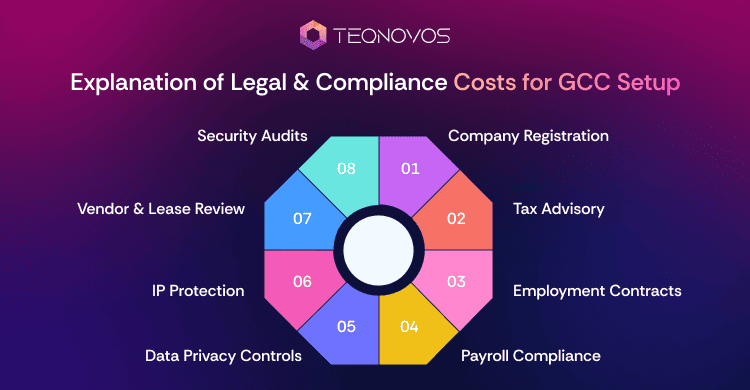
1. Company Registration
Company registration is usually the first cost area. It covers entity formation, legal documentation, and local advisory support. This step helps the GCC operate with the right business structure.
- Prepare entity formation documents
- Review local business registration rules
- Set the right ownership structure
- Complete legal approvals before hiring starts
2. Tax Advisory
Tax planning needs early attention. The GCC must follow local rules for corporate tax, payroll vendor payments, and cross border billing. Proper tax advisory helps reduce future financial risk.
- Review corporate tax requirements
- Plan payroll tax obligations
- Check vendor payment rules
- Manage cross border billing risks
3. Employment Contracts
Employment contracts add another cost layer. Companies need clear terms for confidentiality notice periods and IP ownership. Strong contracts help protect both the business and the employees.
- Define role terms and responsibilities
- Add confidentiality and IP clauses
- Set clear notice period rules
- Align benefits with local laws
4. Payroll Compliance
Payroll compliance needs proper setup from the start. Salary tax benefits and statutory payments must stay accurate. This helps the GCC avoid penalties and employee disputes.
- Set accurate salary structures
- Manage tax deductions properly
- Track benefits and statutory payments
- Keep payroll records ready for audit
5. Data Privacy Controls
A GCC may handle customer records and business information. Secure access rules and privacy reviews help protect this data. These controls also support safer daily operations.
- Define who can access sensitive data
- Create rules for data storage
- Review data transfer processes
- Run privacy checks at regular stages
6. IP Protection
IP protection needs early planning. It helps the parent company keep ownership of code and technical documentation. This is important for product engineering data teams and technology operations.
- Protect source code and product assets
- Define ownership of technical work
- Add IP terms in contracts
- Keep documentation under company control
7. Vendor and Lease Review
Office leases, vendor agreements, and service contracts need legal checks before signing. This reduces risk around data access service quality and contract exits.
- Review lease terms before signing
- Check vendor service obligations
- Define data access limits
- Add clear exit terms in contracts
8. Security Audits
Security audits and ongoing compliance reporting add recurring cost. These checks help the GCC stay ready for scale. Finagling the cost to set up a GCC in India helps with deeper and better cost planning.
- Review system access controls
- Check unresolved security risks
- Audit data handling practices
- Track compliance reports regularly
GCC ROI Calculator for Enterprises
A GCC ROI calculator helps enterprises estimate the business value before setup begins. It gives leaders a clearer view of cost savings and extended impact. This also helps teams compare setup investment with future value. Businesses can also use Global Capability Center consulting to assess hiring needs and expected returns with more accuracy.
| Cost or value factor | What to include | Why it matters |
| Setup cost | Legal setup, registration, and advisory support | Shows the first stage of investment |
| Hiring cost | Recruitment screening and onboarding | Helps estimate team-building expense |
| Salary cost | Monthly pay benefits and incentives | Gives a clear view of recurring costs |
| Office cost | Workspace utilities, systems, and admin support | Helps plan location based expense |
| Technology cost | Cloud tools, software licenses, and security systems | Supports smooth and secure delivery |
| Compliance cost | Tax payroll contracts and data privacy checks | Reduces legal and operational risk |
| Productivity gain | Faster delivery, better output, and process improvement | Shows how the GCC adds business value |
| Cost saved | Difference between local hiring and GCC hiring | Helps compare financial benefits |
| Time to value | Months needed to reach stable delivery | Helps leaders plan realistic returns |
| Long term innovation value | Product ownership automation and IP contribution | Shows value beyond cost savings |
A strong ROI view helps leaders make better setup decisions. It also helps them track the GCC as a value center instead of only a cost-saving unit.
Build a Scalable GCC with the Right Strategy. —Schedule a Call!
Schedule a Call
How Fortune 500 Companies Use GCCs
Fortune 500 companies use GCCs to build stronger control over talent and business operations. They no longer treat these centers as basic support units. Many now use them as strategic hubs for product work and digital transformation.
A Global Capability Center in India helps large enterprises access skilled teams across AI analytics and enterprise operations. These teams support global products and improve delivery speed across business functions.
- Product Engineering: GCC teams help build modern platform applications and internal systems. They also support product updates and release cycles.
- AI and Data Analytics: Large companies use GCCs to manage AI project data platforms and business reporting. This helps leaders make faster decisions.
- Cybersecurity: GCCs support threat monitoring and risk tracking. This helps protect global systems and customer data.
- Cloud and Digital Transformation: GCC teams help modernize cloud systems and customer support operations. This turns the center into a long term value driver.
Overcome GCC Setup Challenges with Teqnovos
Setting up a GCC needs a strategy and technical depth. Teqnovos supports enterprises with structured planning and scalable delivery support. This helps companies reduce risk while building stronger long term capability.
1. Strategy Planning
Strong Global Capability Center solutions begin with the right strategy. The team helps define the GCC’s purpose and growth plan. This gives enterprises more clarity before hiring and operations begin.
2. Dedicated Team Setup
Dedicated team setup is another key area. Companies need the right mix of developers and automation specialists. A planned team model helps improve delivery speed and hiring quality.
3. Offshore Delivery Support
Offshore delivery support helps companies scale with better cost control. Enterprises can connect GCC planning with offshore software development services to support technical operations.
4. Compliance Focused Execution
Compliance focused execution adds another layer of value. The setup needs secure processes and strong reporting. These controls help reduce operational risk during scale.
5. Flexible Growth Model
Flexible engagement models help companies start small and scale as demand grows. This gives enterprises better control over team size and cost planning.
A well planned GCC gives enterprises better control over technology teams and business outcomes. It also creates a stronger base for automation and long term expansion.
Industry Specific GCC Setup Models
Every industry needs a different GCC structure. The right Global Capability Center strategy depends on compliance needs and technology goals.
Healthcare GCC Setup in India
Healthcare GCCs support digital health platforms and data operations. These centers need a strong compliance secure infrastructure and trained domain teams. Companies can also hire healthcare app developers to support building secure care platforms and patient focused applications.
- Compliance: Follow healthcare data privacy rules and internal audit controls
- Security: Protect patient records with access control and secure systems
- Team structure: Build teams with healthcare developers and data specialists
- India advantage: Access to skilled healthcare technology talent with better cost control
- Engagement model: Start with a managed team or hybrid model before scaling
- Technology capabilities: Build health apps and automation workflows
Fintech GCC Development Center
A fintech GCC needs secure systems risk control and compliance led delivery. Teams often support payment products and onboarding flows. Companies can also hire fintech developers to support when they need domain focused talent for financial products.
- Compliance: Manage financial rules and risk reporting
- Security: Protect transactions and payment workflows
- Team structure: Include fintech developers and product specialists
- India advantage: Access fintech engineering talent for payment lending and banking products
- Engagement model: Use a hybrid or dedicated team model for faster delivery
- Technology capabilities: Build payment platforms and fraud control tools
Retail GCC Operations
Retail GCCs support digital commerce and supply chain tools. These teams help brands improve shopping journeys and customer support. A strong retail GCC can improve customer experience and operational speed.
- Compliance: Manage customer data privacy and digital commerce rules
- Security: Protect payment data and retail systems
- Team structure: Build teams with commerce developers and automation experts
- India advantage: Access skilled teams for ecommerce analytics and support operations
- Engagement model: Use a scalable team model to support seasonal demand
- Technology capabilities: Build ecommerce platforms and analytics dashboards
Insurance GCC in India
Insurance GCCs support claims automation, policy systems, and risk operations. These centers need clean data workflows and strong governance. A structured insurance GCC helps companies reduce manual work and improve service speed.
- Compliance: Follow insurance rules and policy data standards
- Security: Protect customer records and internal systems
- Team structure: Include insurance software teams and process specialists
- India advantage: Access to skilled talent for claims policy systems and analytics work
- Engagement model: Use a dedicated team model for long term operational support
- Technology capabilities: Build claims tools and document automation systems
SaaS Companies Using GCCs
SaaS companies use GCCs for product engineering and release management. These teams help maintain product quality and support faster feature delivery. Companies can connect this with AI workflow automation software development to improve product operations and internal workflows.
- Compliance: Manage product security standards and platform audits
- Security: Protect cloud systems and APIs
- Team structure: Build teams with product engineers and support specialists
- India advantage: Access SaaS product talent with strong cloud and automation skills
- Engagement model: Use a dedicated or hybrid model for continuous product delivery
- Technology capabilities: Build SaaS platforms and automation tools
Automotive GCC Expansion
Automotive GCCs support connected vehicle platforms and engineering operations. These teams can also manage ERP integration and digital product development. A strong automotive GCC helps companies improve software led mobility and manufacturing support.
- Compliance: Support product safety rules and data governance
- Security: Protect connected vehicle data embedded systems and enterprise platforms
- Team structure: Include embedded engineers and system integration experts
- India advantage: Access to engineering talent for mobility software and industrial systems
- Engagement model: Use a phased model for engineering support and technology scale
- Technology capabilities: Build connected platforms and engineering tools
Manufacturing GCC Strategy
Manufacturing GCCs support ERP systems and operational software teams. These teams help companies improve plant level data and process control. A clear model helps manufacturers improve efficiency and scale digital operations.
- Compliance: Manage operational standards and process documentation
- Security: Protect plant data and production workflows
- Team structure: Build teams with ERP specialists and software engineers
- India advantage: Access to technology talent for industrial automation and enterprise systems
- Engagement model: Use a hybrid model for process support and software delivery
- Technology capabilities: Build ERP tools and supply chain platforms
Banking GCC Transformation
Banking GCCs support fraud controls and digital banking platforms. These centers need strong governance and reliable delivery teams. Companies can also work with a blockchain development company when banking solutions need secure transaction systems and stronger data integrity.
- Compliance: Follow banking rules, audit needs, and reporting standards
- Security: Protect financial systems and transaction data
- Team structure: Include banking developers and compliance support teams
- India advantage: Access to skilled banking technology talent for secure digital transformation
- Engagement model: Use a dedicated or captive model for better control
- Technology capabilities: Build core banking tools and secure transaction platforms
Conclusion
A successful GCC needs more than a strong hiring plan. It needs strategy and talent planning to move together. Many enterprises face Global Capability Center setup challenges when these areas are planned in isolation. This can slow execution and increase cost risk.
The right structure helps companies build stronger control over delivery quality and business value. Clear leadership also helps local teams work with the parent company’s goals. Compliance planning protects the business as the center scales. Secure systems also support safe product development and operations.
A well planned GCC can become a long term value center. It can support innovation and faster digital execution. Enterprises that plan early can reduce risk and build stronger capability.