
- Hire a Developer
 Android Developers
  iOS Developers
  Angular Developers
  DevOps Developers
  Laravel Developers
  MEAN Stack Developers
  MERN Stack Developers
  NestJS Developers
  NodeJS Developers
  NextJS Developers
  NuxtJS Developers
  Python Developers
  ReactJS Developers
  VueJS Developers
  WordPress Developers
  Shopify Developers
  BigCommerce Developers
  Salesforce Developers
 - AI Development
- Industries











Get in Touch


Why AI-Powered Sports Prediction Is Changing Betting Platforms
Sports betting platforms are facing high competition with users expecting faster insights. They also expect better accuracy in predictions. Traditional systems often fail to meet these expectations. This creates a strong need for smarter solutions.
Develop AI-powered sports betting prediction software to deliver better results. It processes large datasets in real time. This helps find the patterns often missed through missed judgments. Thus, improving decision-making and building user trust.
How AI Sports Betting Prediction Software Works
Sports betting prediction software development services help build software to generate insights. The platform studies past and live match data to predict possible outcomes. This helps users make better decisions.
Data Analysis
AI systems collect large volumes of sports data. They process this data to find useful patterns. This forms the base of accurate predictions.
Key Features:
- Collect match data from multiple sources
- Process structured and unstructured datasets
- Identify patterns in team and player performance
- Clean and filter data to improve prediction quality
Model Training
Artificial intelligence learns from data over time. ML improves prediction accuracy with experience. These models adapt as new data flows in.
Key Features:
- Train models using historical match data
- Improve accuracy through continuous learning
- Adjust predictions based on new inputs
- Test models regularly to ensure reliable outputs
Pattern Detection
AI detects trends that humans often miss. It studies team form and player stats. This helps in generating reliable predictions.
Key Features:
- Analyze player performance trends
- Evaluate team history and match outcomes
- Detect hidden patterns in large datasets
- Compare multiple data points to refine predictions
Real-Time Updates
Modern systems process live data instantly. This allows users to access updated insights. It improves decision-making during live betting.
Key Features:
- Integrate live sports data feeds
- Update predictions in real time
- Support in play betting scenarios
- Ensure fast data refresh for live match accuracy
Continuous Learning
AI systems keep evolving after deployment. They learn from new matches and outcomes. This improves long-term accuracy.
Key Features:
- Refine models with fresh data
- Reduce prediction errors over time
- Adapt to changing sports dynamics
- Improve system performance with ongoing updates
Business Value
Companies that develop AI-powered sports betting prediction software focus on scalability. They aim to deliver consistent results. These systems improve engagement and trust.
Key Features:
- Build scalable prediction systems
- Deliver reliable AI betting predictions
- Enhance user experience across platforms
- Support business growth with data driven insights

Better Accuracy
AI systems analyze large datasets quickly. They reduce human error, leading to more reliable outcomes. Users can depend on consistent insights. This improves confidence in betting decisions.

Faster Decisions
AI processes data in real time. This helps users receive instant updates, allowing quicker actions during matches. It supports better timing in betting scenarios.

Improved Engagement
Personalized insights keep users active on the platform. AI adapts to user behavior over time. This creates a more interactive experience. It also increases platform retention.

Scalable Growth
AI systems handle large data loads with ease. Platforms grow without performance issues. This supports long-term expansion. It allows businesses to serve users more efficiently.

Data-Driven Strategy
AI provides deep insights into user activity. It helps businesses understand trends. This improves decision-making across the platform. It also supports smarter growth strategies.

Competitive Advantage
AI-powered platforms stand out in the market. They offer better user experience and smarter predictions. This attracts more users and builds trust over time.

1

2

3

4

5

6

7

8
Scalable AI Sports Betting Prediction Software Development USA
Develop AI-powered sports betting prediction software to support real-time insights and scalable performance. Create a platform designed for accuracy and user engagement.
Technology Stack Required for AI Betting Predictions Development
A strong technology stack supports performance and accuracy. Each layer of the system plays a key role. The right combination helps build a stable and scalable platform.


Frontend Layer
The frontend handles user interaction and display. A UI/UX design interface improves user experience. Clean design helps users access insights easily.
Modern frontend frameworks support fast rendering. They ensure responsive layouts across devices. This creates a seamless experience for users.

Backend Layer
The backend manages data flow and system logic. It connects the interface with prediction models. A robust backend ensures smooth processing.
Efficient architecture helps handle large datasets. It also supports real-time updates to keep the platform reliable during peak usage.

AI Model Layer
The AI layer powers prediction capabilities. Models analyze sports data and identify patterns. Continuous learning improves output quality.
ML models adapt to new data to enhance prediction performance over time. A strong model design improves system accuracy.

Data Management
Data management ensures proper storage and access. Structured databases improve processing speed. Clean data improves prediction results.
Systems must handle large volumes of sports data. Efficient storage methods support faster queries. This improves overall system performance.

API Integration
APIs connect the platform with external data sources. They provide live match data and updates. This keeps predictions current and relevant.
Reliable API connections ensure uninterrupted data flow. This supports real-time insights across the platform.

Cloud Infrastructure
Cloud services support scalability and system stability. They allow flexible resource management. Platforms can handle growing demand without disruption.
These systems also improve deployment speed to support secure and reliable operations across regions.
Why Businesses Trust Teqnovos for AI Development
Businesses look for reliable development partners. Strong execution and clear process matter. A skilled team helps build stable platforms that deliver real value and consistent performance.
Experienced teams handle complex AI-based projects
Strong understanding of betting platform requirements
Focus on scalable and performance-driven solutions
Ability to deliver reliable system architecture
Solutions built based on business needs
Flexible approach for different platform types
Focus on tailored features and workflows
Support for both app and web platforms
Platforms designed for high traffic handling
Strong backend architecture for smooth operations
Systems built to grow with user demand
Focus on long-term platform stability
Covers planning, design, and deployment stages
Continuous updates and maintenance support
Dedicated team for issue resolution
Smooth project execution with clear communication
Launch Your AI Powered Sports Betting Platform
Develop betting app solutions that combine data intelligence with a smooth user experience for modern betting platforms.
Different Types of AI Sports Betting Apps
AI sports betting apps are built for different sports. Pool betting software development for sports predictions allows users to place bets across multiple sports. This increases the need for diverse platforms. Businesses now focus on building apps for specific sports categories.

Football Betting
Football betting apps focus on league and tournament matches. They study team form and player stats to track live match updates to generate predictions.
Why choose this solution?
- Analyze team performance and match history
- Track player stats and injuries
- Provide live match-based insights

Basketball Betting
Basketball apps focus on fast-paced games. They analyze player movement and scoring patterns. It also studies match conditions to improve predictions.
Why choose this solution?
- Track player stats and scoring trends
- Track player stats and scoring trends
- Track player stats and scoring trends

Baseball Betting
Baseball apps rely on detailed statistics. They focus on pitching and batting data. These insights help generate accurate outcomes.
Why choose this solution?
- Study pitching performance and batting averages
- Analyze past game results and trends
- Evaluate in-game conditions

Tennis Betting
Tennis betting apps analyze individual performance. They focus on player form and match history. The app also considers surface conditions for predictions.
Why choose this solution?
- Track player performance across tournaments
- Analyze the head-to-head match records
- Evaluate court and weather conditions

Horse Racing Betting
Horse racing apps focus on race-specific data. They study horse history and jockey performance to analyze the track conditions.
Why choose this solution?
- Analyze horse performance records
- Track jockey statistics and trends
- Study racetrack conditions

Cricket Betting
Cricket betting apps are popular across multiple regions. They examine match formats and player roles to check the pitch and weather conditions.
Why choose this solution?
- Study player stats across match formats
- Study player stats across match formats
- Track live match performance
How to Maximize Revenue Opportunities with an AI Sports Betting App?
Revenue generation depends on the right strategy. A betting platform must offer clear value to users. At the same time, it should create multiple income streams. A balanced approach helps improve earnings without affecting user experience.
Subscription Model
These plans create a stable source of income. Users pay to access premium features and deeper insights. Advanced tools and detailed predictions attract serious users. A strong subscription model increases platform value and user retention.
In App Ads
Advertising generates consistent additional revenue. Ads should be placed carefully within the platform. A clean user experience must always be maintained. Relevant ads improve engagement without affecting usability.
Commission Model
Charging a small percentage on user winnings builds a steady income stream. This model grows as user activity increases. A transparent structure helps maintain user trust. This approach aligns platform earnings with user success.
Affiliate Partnerships
Partnerships with other platforms expand revenue channels. Users can be directed to related services through the app. This helps generate referral-based income. Strong collaborations also help increase the platform’s reach.
Paid Insights
Advanced predictions and expert insights can be offered as premium services. Users looking for better results are willing to pay for high-quality analysis. This adds another layer of value to the platform. It also strengthens user engagement.
Future Trends in AI Sports Betting and Prediction Apps
AI in sports betting is moving beyond basic predictions. Platforms focus on deeper insights and faster execution. New capabilities are changing how users interact with betting systems. These trends are already shaping next-generation platforms.

Micro Predictions
Platforms are shifting toward micro-level predictions. Instead of match outcomes, systems are even predicting small events. These include the next goal, next over, or next play.
This creates more engagement during live matches. Users stay active throughout the game. This also increases betting frequency across sessions.
- Predicts real-time micro events
- Covers actions like next goal/play
- Drives continuous engagement
- Boosts in-play activity

Live Model Adaptation
AI models are updating during live matches. Systems adjust predictions based on current game flow. Player performance and match momentum impact outcomes instantly.
This allows platforms to deliver dynamic predictions. Users receive insights to reflect real match conditions. This improves accuracy during live betting.
- Adapts instantly to game flow
- Uses real-time performance data
- Updates probabilities dynamically
- Enhances live prediction accuracy

Multi-Sport Intelligence
Modern platforms are building unified prediction systems. One engine supports multiple sports with different data patterns. This reduces development effort and improves scalability.
Users can switch between sports without changing experiences. This increases cross-sport engagement on the platform.
- Unified engine across sports
- Scales efficiently across formats
- Ensures consistent UX
- Encourages cross-sport engagement

Behavioral Prediction
AI tracks user behavior along with sports data. Systems understand betting patterns and preferences. This helps in predicting user actions.
Platforms use this insight to offer targeted suggestions. This increases engagement and improves conversion across features.
- Analyzes user activity patterns
- Anticipates user decisions
- Enables personalized insights
- Improves retention and conversion

Edge-Based Processing
Edge computing means processing data closer to the source. This reduces the delay in data updates, allowing platforms to deliver faster predictions during live events.
This is important for in-play betting scenarios. Faster response improves user experience and platform reliability.
- Computes data at the edge
- Minimizes latency delays
- Enables real-time responsiveness
- Strengthens platform reliability

Hybrid AI Models
Platforms are combining different AI models for better results. This includes statistical models and deep learning systems. Each model handles a specific type of data.
This improves prediction quality across complex scenarios. It also makes systems more reliable under changing conditions.
- Blends statistical and AI models
- Leverages diverse data sources
- Delivers higher accuracy
- Adapts to dynamic conditions
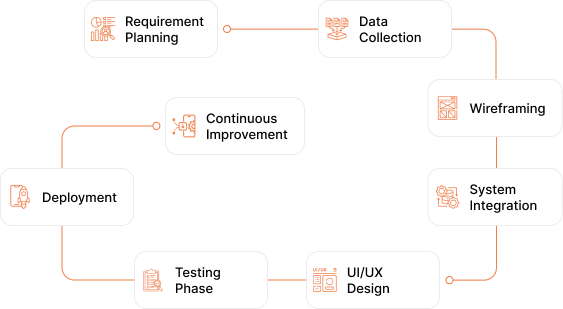
Requirement Planning
The process starts with clear goals. Teams define features and user needs. This step sets the foundation for development.
- Identify platform goals and user needs
- Define core features and prediction scope
- Plan data sources and system flow
Data Collection
Data is the backbone of any AI system. Platforms collect large volumes of sports data. This includes both historical and live match data.
- Gather data from sports APIs and feeds
- Collect player and team statistics
- Store structured and raw datasets
Wireframing
AI models are built using collected data. On the other hand, ML helps improve accuracy over time. Models are trained to detect patterns.
- Train models using sports prediction AI algorithms
- Test model performance on sample data
- Improve accuracy through iterations
System Integration
The AI model is integrated into the platform. This connects data flow and prediction output. It ensures smooth system operation.
- Connect backend systems with AI models
- Integrate APIs and data pipelines
- Enable real-time prediction flow
UI/UX Design
User experience plays a key role in platform success. A clean UI/UX design interface helps users access insights easily. It also improves engagement.
- Design simple and clear dashboards
- Display predictions in a readable format
- Ensure smooth navigation across features
Testing Phase
Testing ensures system stability and accuracy. Teams check performance under different conditions. This helps identify issues early.
- Test prediction accuracy and system speed
- Validate data flow and API performance
- Fix bugs and improve reliability
Deployment
Once testing is complete, the platform goes live. Systems are monitored closely after launch. This ensures stable performance.
- Deploy the platform on the cloud infrastructure
- Monitor system performance in real time
- Optimize based on user activity
Continuous Improvement
AI systems improve with new data. Platforms update models regularly. This keeps predictions relevant and accurate.
- Update models with new sports data
- Improve prediction quality over time
- Enhance features based on user feedback
Challenges in AI Betting Software Development
Developing AI-based betting software comes with multiple challenges. Systems must handle large data volumes. They must also maintain accuracy and speed. These challenges affect performance and reliability.

Data Quality
Poor data reduces prediction accuracy
Inconsistent datasets create processing issues
Large datasets increase system complexity
Frequent data updates require strong validation

Model Accuracy
Models require frequent retraining
Changing sports trends affect accuracy
Complex models demand more resources
Model tuning requires continuous monitoring

Real-Time Processing
High latency affects prediction updates
Live data streams require strong systems
Peak traffic increases processing load
System delays can impact live betting experience

Security Risks
Data breaches harm platform reputation
Weak systems increase the risk of attacks
Secure transactions require advanced protocols
User data protection requires continuous testing

Regulatory Compliance
Laws vary across countries and states
Non-compliance leads to penalties
Licensing requirements add complexity
Frequent regulation changes require updates

System Scalability
Traffic spikes slow down systems.
Scaling requires strong infrastructure
Poor planning affects platform stability
Growing data volume increases system load
What makes Teqnovos different
Scalable Digital Solutions To Power Business Growth
Business success is our benchmark. At Teqnovos, we design and develop custom mobile applications that solve real operational challenges. Our solutions enhance customer experiences and support long-term scalability. By aligning technology with your workflows and market needs, we ensure every solution delivers lasting value.
About Teqnovos
Teqnovos’ team provides custom mobile app solutions to gain a competitive advantage in a growing market. Digital readiness helps businesses build loyalty and scale sustainably. Businesses are moving toward digital experiences that support convenience and speed. Mobile app development plays a key role in meeting these expectations. A well-planned app helps improve customer engagement and repeat purchases. It also gives businesses better control over branding, operations, and data. Book a free consultation with us to become a powerful growth channel in the market.

Frequently Asked Questions
Development time depends on project scope. A basic platform may take a few months. Advanced systems with real-time features require more time. Clear planning helps speed up the process.
Cost depends on features and data complexity. AI model development also impacts the budget. Team size and platform type play a major role in the cost. On the other hand, using advanced systems requires higher investments.
AI improves prediction quality using data. However, no system can guarantee outcomes. Predictions depend on multiple changing factors; AI helps reduce uncertainty but cannot eliminate risk.
Platforms use AI and ML models for sports AI dev predictions. APIs help provide live sports data to the model. Thus, having a strong technical stack improves the performance of the system.
The legality in question depends on the regional laws. Each country and state has its own different regulations that one must follow. An AI sports betting prediction software development company needs to follow these licensing rules. Proper compliance helps to ensure smooth operations.
Platforms can use subscriptions and premium features to earn money. Advertising and partnerships also generate revenue for businesses. On the other hand, paid insights and commissions add additional income streams. Businesses can use a balanced strategy to enhance their earnings from the app.
AI improves prediction accuracy and user engagement. It helps platforms deliver better insights. This attracts more users and increases platform value. Strong systems also support growth.
Teqnovos provides custom software development solutions. Our company is focused on providing businesses with scalable and data-driven platforms. The team works on AI model integration and UI/UX design development. We help businesses launch reliable betting solutions in the USA and other regions.
Teqnovos supports the complete development process. This includes planning, design, and deployment. Hire dedicated developers for handling the complete development with ongoing support for the app. We ensure a smooth platform performance.