



















How Real Estate Tokenization Works: A Step-by-Step Guide for Property Businesses
For property businesses, the real challenge is not only owning valuable assets. The bigger challenge is making those assets easier to fund and distribute among investors.
Traditional real estate investment often depends on large capital and limited investor access. This can slow fundraising for developers, asset managers, and real estate firms. It can also make ownership tracking and investor reporting harder as portfolios grow.
Real estate tokenization introduces a digital ownership model for property assets. It converts property value into blockchain-based tokens. These tokens can represent ownership income rights or investment shares.
This blog breaks down how real estate tokenization works for property businesses that want to understand the model before planning a digital investment structure. It covers the process, legal planning, technology needs, and risks in a practical way.
What Is Real Estate Tokenization?
Real estate tokenization converts property value into digital tokens. These tokens can represent ownership rights or investment shares in a real estate asset.
What It Means for Property Businesses
For property businesses, this creates a structured way to divide and manage property ownership. A single asset can be split into smaller digital units. Investors can buy these units based on the approved investment model.
This makes property investment easier to access. Real estate tokenization platform development enables businesses to manage ownership records and asset performance through a digital system.
What Tokens Can Represent
Tokens in real estate asset tokenization can represent different rights based on the property structure. These may include:
- Ownership share
- Rental income share
- Profit share
- Future resale value
- Asset-related rights
Where It Can Be Used
This model can apply to residential projects, commercial buildings, rental assets, and real estate development projects. The goal is to make property investment more transparent and easier to manage.
Property businesses often study the asset tokenization process before planning a tokenized model. It helps them understand how investor access to ownership terms and asset management can work in a digital format.
Build End-to-End Property Tokenization Workflows. Explore Real Estate Tokenization Solutions.
Schedule a CallWhen Tokenization Makes Sense for Property Businesses
Property businesses do not treat tokenization as a trend. The model works best when there is a clear asset use case and legal readiness. A practical understanding of how real estate tokenization works helps teams decide if the model fits their funding and ownership goals.
1. Unlocking Liquidity
Commercial properties can hold strong value but limited liquidity. Selling an entire asset may take months. Tokenization allows property businesses to divide asset value into smaller digital units. This can make partial ownership easier to offer without selling the full property.
2. Raising Capital
Developers often face long funding cycles through banks or institutional routes. Tokenization can create another capital access model for selected projects. It allows businesses to structure digital investment rights for a wider investor base while keeping the project ownership model clear.
3. Revenue Distribution
Income-based properties need accurate payout management. Rental income and settlement-related payments must reach investors on time. A tokenized structure can support automated distribution based on defined ownership terms. This reduces manual work and improves investor reporting.
4. Expanding Investor Access
High-value real estate often stays limited to large investors and institutions. Tokenization can lower the entry barrier by allowing smaller investment units. This helps property businesses reach a broader group of qualified investors while keeping ownership records structured.
5. Supporting Digital Portfolio
Tokenization makes more sense when a business plans to manage property investment through a digital system. Investor onboarding, asset dashboards, ownership tracking, payout records, and compliance workflows can work together through one platform.
What Can Be Tokenized in Real Estate?
Tokenization can apply to more than full property ownership. Property businesses can structure digital tokens around the rights that fit the asset model investor terms and legal framework. This makes real estate asset tokenization useful for income assets development projects and managed portfolios.
1. Full Property Ownership Rights
A business can tokenize rights linked to a complete property. This may suit commercial buildings, rental assets, and premium residential projects. The legal structure defines what token holders receive before the offering goes live.
2. Fractional Investment Rights
A property can be divided into smaller digital units. This supports property tokenization for businesses that want to open investment access without selling the full asset. Each token may represent a defined share in the approved ownership model.
3. Rental Income Rights
Income-based properties can use tokens to represent a share of rental returns. This can help property businesses manage investor payouts and performance records through a digital system.
4. Development Project Participation
Developers can tokenize investment rights linked to planned or active projects. This model can support capital planning for selected developments. It can also help structure investor participation around project milestones and expected returns.
5. Equity-Based Rights
Some real estate projects use tokens linked to debt. Others use tokens linked to equity. The right model depends on the asset type, funding goal, investor rights, and regulatory requirements.
Step-by-Step Real Estate Tokenization Process
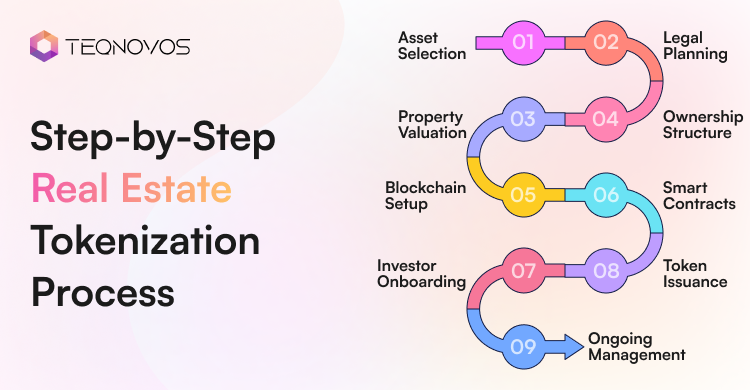
A clear process helps property businesses reduce legal risk and technical gaps. The process starts with asset selection and moves through legal planning and reporting. This structure makes real estate asset tokenization easier to plan and manage.
1. Asset Selection
Property businesses begin by selecting an asset that fits the investment model. The asset needs clear ownership, strong value, and market demand. Commercial buildings and development projects often work well because they show defined business value.
- Review property ownership records
- Check income potential and market demand
- Study asset condition and location value
- Match the asset with investor expectations
2. Legal Planning
Legal planning shapes the full tokenization model. The business defines investor rights, ownership transfer rules, and local regulatory needs. This step also helps decide if the token will represent income rights or another approved structure.
- Define investor rights clearly
- Review local real estate rules
- Prepare asset and offering documents
- Align the model with security token development needs
3. Property Valuation
A professional valuation sets the financial base of the token model. Businesses decide the total asset value, token supply, and revenue share structure. This also helps estimate the real estate tokenization platform cost at an early stage.
- Set the property valuation
- Decide the token supply
- Define the minimum investment size
- Build the revenue sharing model
4. Ownership Structure
The property needs a clear ownership structure before token issuance. Many property businesses create a separate legal entity to hold or manage the asset. This helps define who owns the property, who manages it, and what investors can claim.
- Set the ownership model
- Define payout rights and transfer rules
- Clarify exit options for investors
- Support compliant security token development
5. Blockchain Setup
The business then chooses the blockchain and platform architecture. The system should support secure wallet access and transaction tracking. Real estate asset tokenization connects the asset model with investor operations.
- Choose a suitable blockchain network
- Set up secure wallet support
- Connect token records with investor profiles
- Plan for future asset expansion
6. Smart Contracts
Smart contracts manage the core rules of token ownership and transactions. They can support transfer investor rights and trading logic. The rules match the legal documents and the backed token model.
- Build ownership transfer logic
- Add payout rules for investors
- Test transaction and reporting flows
- Review code before launch for security token development
7. Investor Onboarding
Investor onboarding helps businesses verify users before they buy tokens. A digital real estate investment platform collects documents and gives investors access to asset information. This improves trust and reduces friction during the investment process.
- Verify investor profiles
- Collect required documents
- Show asset details and token terms
- Provide access to reports and holdings
8. Token Issuance
After the technical and investor setup, the business can issue tokens. The offering includes asset details and token rights. It also includes the pricing and risk information. A tokenized real estate platform records every purchase and ownership change.
- Launch the token offering
- Record investor purchases
- Track ownership activity
- Store payment and document records
9. Ongoing Management
The process continues after launch. Property businesses need to manage income distribution and compliance records. Strong property tokenization platform development can support long term asset operations.
- Track asset performance
- Manage investor payouts
- Share reports and updates
- Monitor ownership transfers and compliance records
Traditional Real Estate vs Tokenized Real Estate
Traditional real estate models depend on direct ownership and long transaction cycles. Tokenized real estate uses digital units to structure ownership and investment rights. This does not remove legal or compliance needs. It changes how property businesses manage records and investor participation.
| Comparison Area | Traditional Real Estate | Tokenized Real Estate |
| Capital Entry | Investors need higher capital to enter most deals | Smaller digital units can reduce the entry barrier |
| Deal Speed | Transactions often take weeks or months | Digital records can support faster ownership updates |
| Liquidity | Selling a full asset can take time | Partial transfers can support better liquidity if allowed |
| Transparency | Records often sit across contract files and systems | Ownership activity can stay visible through a digital platform |
| Paperwork | Manual documents slow the process | Digital workflows can reduce repeated administrative work |
| Investor Access | Access often stays limited to large investors | A wider group of qualified investors can participate |
| Reporting | Updates may depend on manual communication | Dashboards can show holdings, payouts, and asset updates |
For property businesses, property tokenization creates a more flexible way to structure investment access. The value lies in better record control and more organized asset management. The outcome still depends on asset quality and market demand.
Real Estate Tokenization Benefits for Modern Property Firms
Real estate asset tokenization helps property businesses create a more flexible investment model. It gives asset managers and real estate firms a better way to structure ownership and income distribution.
Broader Capital Access: Tokenization helps property businesses reach a wider investor base. This can support funding for commercial assets rental portfolios and new development projects.
Lower Entry Barriers: A property can be divided into smaller digital units. This makes investment access easier for qualified investors who may not enter large property deals directly.
Improved Liquidity: Traditional property sales often take time. Tokenized models can support partial transfers when the legal structure and platform rules allow it.
Reduced Paperwork: Digital workflows can reduce repeated manual tasks. This includes investor onboarding and document access.
Better Ownership Tracking: A digital real estate investment platform can keep ownership activity in one place. It helps businesses track token holders and asset updates.
Transparent Reporting: Investors need clear updates on asset performance and returns. Tokenized platforms can support dashboards and payout history in a more organized way.
Stronger Portfolio Control: Property businesses can manage multiple tokenized assets through a structured system. This helps teams monitor investor activity and compliance records across different projects.
Core Features of a Real Estate Tokenization Platform
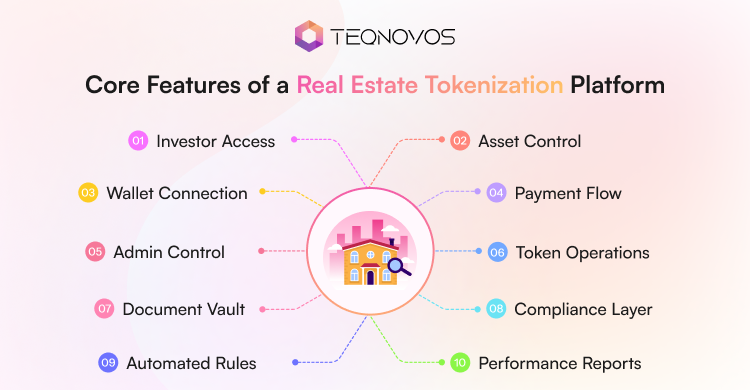
A tokenized real estate platform connects asset records and compliance workflows in one system. The feature set depends on the asset model and operating structure. For property businesses, the right platform creates better control and investor reporting.
1. Investor Access
A clean dashboard reduces manual updates and improves visibility across the investment lifecycle. Give investors a clear account area to review property details and key documents. A real estate app development company assists in improving the investor experience.
- View token holdings
- Review asset details
- Track payment activity
- Access key documents
2. Asset Control
Keep property data organized across valuation and performance updates. Property teams can manage assets with cleaner records and fewer scattered files.
- Store property data
- Update valuation records
- Track income activity
- Monitor asset performance
3. Wallet Connection
Connect investor accounts with secure wallet access for digital token storage and approved transfers. This creates a direct link between token ownership and investor profiles.
- Connect investor wallets
- Record token balances
- Manage approved transfers
- Track ownership activity
4. Payment Flow
Process token purchases and settlement activity through a structured payment system. This reduces manual payment handling and gives teams clearer financial records.
- Process token payments
- Record payout history
- Manage settlement activity
- Reduce manual payment work
5. Admin Control
Centralize user management, asset records, token activity, and reports. Internal teams can manage platform activity through one backend instead of separate tools.
- Manage user profiles
- Control asset records
- Review approval requests
- Track platform activity
6. Token Operations
Manage token issuance status and transfer records with accuracy. Strong property tokenization platform development keeps token activity aligned with asset rights and investor terms.
- Issue digital tokens
- Update token status
- Track ownership changes
- Monitor token activity
7. Document Vault
Store asset papers and compliance records in one secure space. Organized documents make audit reviews and internal checks easier to manage.
- Store asset papers
- Keep investor agreements
- Organize disclosure files
- Open reports securely
8. Compliance Layer
Control investor checks and audit records through built-in compliance tools. This creates stronger oversight for regulated property investment models.
- Check investor eligibility
- Manage approval flows
- Track transfer limits
- Keep audit records
9. Automated Rules
Run ownership transfer payout and token activity rules through smart contracts. The logic follows the legal structure and investor terms linked to the property.
- Automate transfer rules
- Run payout logic
- Record token actions
- Match investor terms
10. Performance Reports
Turn asset performance, investor holdings, and platform activity into clear reports. Strong reporting builds trust across the full investment lifecycle.
- Show asset performance
- Track investor holdings
- Record payout history
- Share platform reports
Also, read our blog on how AI is enhancing tokenized asset valuation and liquidity.
Risks and Compliance Challenges to Consider
Real estate tokenization can improve access to ownership and transaction visibility. The model also brings legal and operational risks. Property businesses need clear planning before token issuance. A weak structure can affect investor trust and platform stability.
1. Regulatory Risk
Regulatory risk depends on local property laws and the token structure. The business must align token rights with approved legal terms. Clear disclosures reduce confusion around ownership and exit options. A qualified real estate tokenization solution provider can guide the structure without weakening compliance control.
2. Valuation Risk
Accurate valuation sets the base for token pricing and future returns. Weak valuation can create pricing gaps and investor disputes. Property businesses need updated asset records and income projections before finalizing the token model. This gives investors a clearer view of the asset value.
3. Platform Security
Secure architecture protects investor accounts and asset documents. A tokenized model depends on trust across every transaction layer. Strong access control and system testing reduce exposure. Reliable property tokenization platform development keeps platform operations safer after launch.
4. Smart Contract Risk
Contract logic controls transfers and token activity. Any error can affect ownership records or investor distributions. Property businesses need careful testing before token issuance. The contract rules must match the legal structure and asset model.
5. Liquidity Risk
Tokenization can create more flexible ownership movement. Active liquidity still depends on investor demand and market conditions. Property businesses need realistic expectations before offering secondary transfers. Clear exit terms protect both the asset owner and investors.
6. Investor Clarity
Investors need simple and complete information before they buy tokens. Unclear terms can create confusion around rights and timelines. Property businesses need clear asset details and report access. Strong communication builds confidence across the investment lifecycle.
7. Data Compliance
Tokenized platforms collect investor documents and asset data. Poor data handling can create legal risk and trust issues. Property businesses need secure storage and privacy reviews. These controls protect investor information and platform credibility.
Build Digital Property Investment Flows. Start Planning Your Tokenization Platform!
Schedule a CallPre-Launch Readiness for Property Businesses
A tokenized real estate model needs strong preparation before any platform work begins. Property businesses need clear asset data and operating plans. Weak preparation can delay valuation compliance review and investor onboarding.
Asset Records: Ownership papers and performance data create the base for token planning. Clean records make the asset easier to structure and review before token issuance.
Legal Terms: Investor rights need a clear definition before the token model moves forward. The business must document ownership terms and risk disclosures.
Investor Rules: A clear investor approval process reduces confusion during onboarding. Property businesses need to define eligibility document checks and access rules before launch.
Build Scope: Feature planning decides how simple or advanced the platform becomes. A single asset model may need investor onboarding and reporting. A multi-asset model may need deeper controls for payout compliance and asset performance tracking.
Operating Control: Post-launch management needs the same attention as token issuance. Property teams need a process for reports and investor communication.
The role of a real estate tokenization solution provider becomes clearer after these details are documented. This keeps the project focused on structure compliance and management instead of only platform delivery.
Conclusion
Real estate tokenization gives property businesses a structured way to manage ownership and asset records through digital systems. The process begins with asset selection and moves through various steps.
A strong model depends on clear asset rights and careful compliance planning. Property businesses also need realistic expectations around liquidity and operating control.
For asset managers and real estate firms, the next step is not rushing into a token launch. The right move is to review asset readiness and investor terms before building a tokenized property model.
Book a free consultation with Teqnovos to get started today!