- Hire a Developer
 Android Developers
  iOS Developers
  Angular Developers
  DevOps Developers
  Laravel Developers
  MEAN Stack Developers
  MERN Stack Developers
  NestJS Developers
  NodeJS Developers
  NextJS Developers
  NuxtJS Developers
  Python Developers
  ReactJS Developers
  VueJS Developers
  WordPress Developers
  Shopify Developers
  BigCommerce Developers
  Salesforce Developers
 - AI Development
- Industries








Get in Touch


Why Faster Claims Operations Matter
Claims are the point where policyholders judge whether an insurer is reliable. Slow reviews create frustration, repeat follow ups, and weaker trust. Faster claims operations help insurance teams collect details sooner, review documents faster, and update customers without confusion.
They also improve internal control because managers can see pending claims, workload, settlement delays, and approval status in one place. For growing insurers, speed is not only a customer experience benefit. It also supports scalable operations, cleaner reporting, and better decisions across the claims lifecycle without adding extra manual steps daily.
Core Features of Claims Management Software
The right features decide how well a claims product works in daily insurance operations. A strong insurance claims management software platform connects policy checks, automation, and reporting in one workflow.
Claim Registration
Structured claim registration helps insurers collect the right information at the first step. The platform can manage claim forms, policyholder details, incident records, supporting files, and submission status.
- Claim form setup
- Policyholder details
- Incident information
- Submission tracking
Document Management
Centralized document management keeps claim files organized during review. The platform can support file uploads, document tagging, and missing file alerts. They also verify notes and secure storage.
- File upload
- Document tagging
- Missing file alerts
- Verification notes
Policy Verification
Policy verification helps teams check claim eligibility before deeper review. The platform can review active policy status, coverage rules, and claim limits.
- Policy status check
- Coverage rules
- Claim limit review
- Exclusion tracking
Workflow Automation
Workflow automation helps claims move through each review stage with less manual follow up. The platform can manage case routing, reviewer assignment, and approval steps. They can also handle escalation rules and closure actions.
- Case routing
- Reviewer assignment
- Approval steps
- Escalation rules
Customer Portal
A customer portal gives policyholders clear access to claim actions and updates, similar to the digital experience needed in health insurance app development. The platform can support claim submission, document upload, and status tracking.
- Claim submission
- Document upload
- Status tracking
- Customer messages
Agent Dashboard
An agent dashboard helps brokers and agents support customers with controlled claim visibility. The platform can show claim progress, pending actions, and customer files. They can manage communication history and assigned cases.
- Claim progress
- Pending actions
- Customer files
- Assigned cases
Fraud Detection
Fraud detection helps insurers identify suspicious claim activity before settlement. The platform can flag duplicate claims, unusual patterns, and mismatched details. They can also show edited documents and high-risk behavior.
- Duplicate claim flags
- Pattern review
- Detail mismatch
- Risk alerts
Settlement Workflow
Settlement workflow improves control after claim approval. The platform can manage payout requests, finance approvals, and payment status. They also handle settlement records and transaction references.
- Payout request
- Finance approval
- Payment status
- Settlement records
Reporting Dashboard
A reporting dashboard helps insurance teams track claim performance and operational delays. The platform can show claim volume, pending cases, and approval time. They also show rejection reasons, workload, and settlement progress.
- Claim volume
- Pending cases
- Approval time
- Rejection reasons

1

2

3

4

5

6

7

8
Build a faster claims management platform that improves review speed and team control.
Help policyholders move from claim submission to settlement with a smoother digital experience.
Benefits of Claims Automation Software for Insurance Teams
Claims automation software helps insurance teams move claims through review, approval, and settlement with better speed and control, especially when connected with AI-powered insurance app development. It reduces repetitive work, improves claim visibility, and gives customers clearer updates during the claims journey.


Faster Reviews
Automated workflows help claims teams review submissions faster by routing cases, documents, and approval tasks to the right users without manual delays.

Better Tracking
Teams can track claim status, pending actions, missing documents, reviewer notes, and settlement progress from one connected dashboard.

Fewer Errors
Structured claim workflows reduce missing information, duplicate entries, wrong status updates, and inconsistent records during review and approval.

Improved Updates
Policyholders get clearer claim updates through portals, alerts, and status messages without repeated calls or manual follow ups.

Stronger Control
Managers can monitor workloads, delayed claims, approval stages, settlement activity, and team performance with better operational visibility.

Scalable Operations
Insurance teams can manage higher claim volumes without depending on extra manual work, scattered files, or disconnected review steps.
Smart Capabilities for Better Claims Control
A strong insurance claims management software platform can support smarter reviews without making the process fully dependent on automation. These capabilities help teams detect risks, improve decisions, and keep human review in control.
Claim detail review for faster coverage checks
Document matching support for cleaner validation
Policy rule checks for better review accuracy
Case priority signals for quicker team action
Duplicate claim alerts for early risk detection
Suspicious pattern tracking for safer settlements
Document mismatch checks for stronger fraud review
Claim history review for better investigation support
Settlement trend insights for better cost control
Delay tracking for faster workflow improvement
Rejection reason analysis for cleaner claim decisions
Team workload insights for balanced case handling
Automation support without removing reviewer judgment
Approval checkpoints for sensitive claim decisions
Escalation rules for complex claim handling
Audit records for transparent decision tracking

Manual Claim Tracking
Manual tracking makes claim status difficult to manage. Teams lose time checking spreadsheets, emails, and separate tools instead of moving cases forward.

Slow Document Review
Without a connected system, documents often sit across inboxes and folders. Reviewers struggle to find files, confirm updates, and close pending actions.

Limited Visibility
Managers cannot easily see pending claims, approval delays, team workload, or settlement progress. This creates weaker control over daily insurance operations and outcomes.

Poor Customer Updates
Policyholders expect clear claim updates. Without structured tracking, support teams handle repeated calls, unclear requests, and avoidable customer frustration during review.

Higher Error Risk
Disconnected processes increase the risk of missing details, duplicate records, wrong status changes, and inconsistent approval steps across the claims lifecycle.

Weak Audit Control
Claims management system development helps solve audit gaps by keeping actions, approvals, documents, user roles, and settlement records traceable in one platform.
Without a structured claims system, insurers often face slower reviews, unclear ownership, and weak process visibility. This is where claims management system development becomes important because it helps teams replace disconnected work with a controlled digital workflow.
Stop letting manual claims slow your insurance operations.
Build a smarter claims system that improves tracking, control, and customer updates.
Build vs Buy: Which Claims Software Approach Fits Your Insurance Business?
Choosing between ready made software and custom development depends on workflow complexity, claim volume, integration needs, and long term control. Insurance claims software development works better when insurers need flexible rules, custom portals, and secure system connections.

Workflow Fit
Ready-made tools can support standard claim processes. Custom software gives insurers more control when workflows include multiple claim types, approval levels, documents, and settlement rules.
- Custom workflow setup
- Multi-stage claim review
- Approval level control
- Claim type configuration

Integration Needs
Disconnected tools slow down claim handling. A custom platform can connect policy systems, customer records, payment gateways, document storage, and reporting tools in one flow.
- Policy system integration
- Payment gateway connection
- Document storage sync
- Reporting tool setup

Automation Control
Automated checks speed up the review stage. The final decision still needs business rules and human oversight. This keeps the process faster while giving teams control over approval and risks.
- First review automation
- Rule-based checks
- Exception handling
- Human approval control

Customer Experience
Ready made tools may limit customer experience options. Custom software lets insurers design claim submission, document upload, status tracking, and communication around real policyholder needs.
- Claim submission flow
- Status tracking portal
- Document upload journey
- Customer message center

Compliance Readiness
Claims data needs secure handling and clear traceability. Custom development helps insurers build access control, audit logs, approval records, and data protection rules into the product.
- Role-based access
- Audit log tracking
- Approval records
- Secure data handling

Long Term Scalability
Insurance operations change as claim volume grows. Custom claims software can support new products, new workflows, new integrations, and advanced automation over time.
- Scalable system design
- New product support
- Future module expansion
- Advanced automation options
Why Teqnovos Is the Right Fit for Claims Management Software Development
Teqnovos helps insurance businesses build claim platforms that match real operations instead of forcing teams into fixed software limits. The focus stays on faster workflows, secure data handling, better visibility, and scalable product growth. Businesses can also hire InsurTech developers to extend claims platforms with custom modules and integrations.
Insurance Workflow Understanding
Teqnovos builds around real claim journeys, user roles, approval stages, document needs, and settlement steps. This helps insurers create software that supports daily operations instead of adding more complexity.
Custom Product Planning
Every insurance business has different claim rules and service models. Teqnovos plans the product scope around claim types, team workflows, customer needs, integrations, and future automation goals.
Secure Architecture
Claims platforms handle sensitive customer, policy, document, and payment data. Teqnovos focuses on secure architecture with controlled access, audit trails, encrypted workflows, and reliable system foundations.
Automation Focus
Teqnovos helps insurers automate repetitive claim tasks without removing human review. This supports faster routing, cleaner checks, better status updates, and stronger control over complex claim decisions.
Portal Development
A strong claims product needs separate experiences for customers, agents, admins, and managers. Teqnovos can build role based portals that improve visibility, communication, and task completion.
Integration Support
Claims software often needs to connect with policy systems, payment tools, document storage, CRM platforms, and reporting dashboards. Teqnovos supports integration planning to reduce disconnected workflows.
Scalable Delivery
Teqnovos builds claims platforms with long term product growth in mind. Insurers can start with core workflows and later add analytics, AI support, advanced automation, and new claim modules.
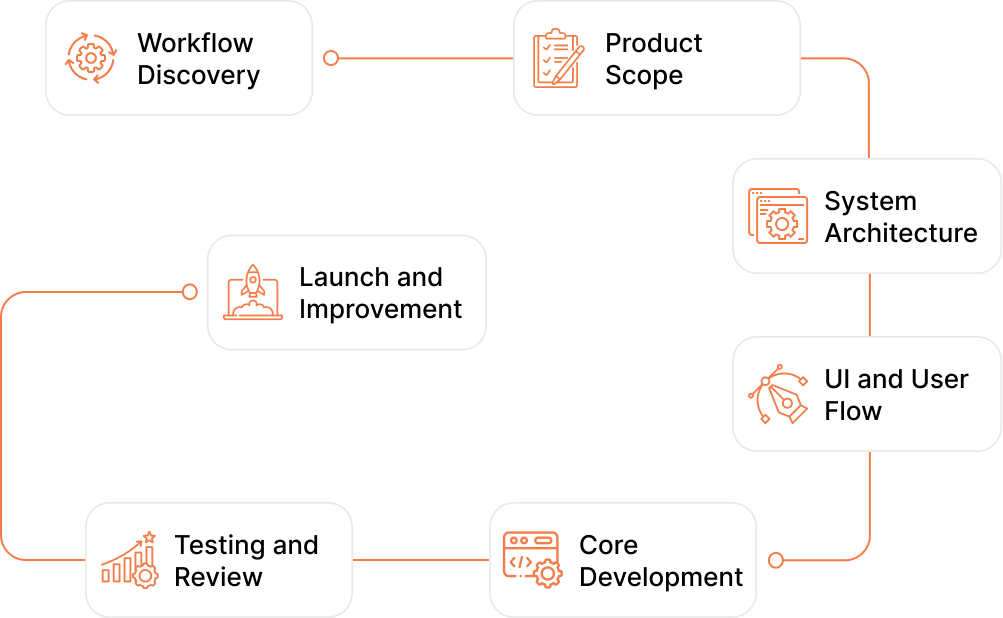
Workflow Discovery
The process starts with understanding current claim journeys, user roles, approval stages, document needs, settlement rules, and reporting gaps. This creates a clear base before product planning begins.
Product Scope
The team defines the first version with core modules such as claim intake, document review, status tracking, admin control, customer portal, and reporting. This keeps development focused and practical.
System Architecture
Architecture planning covers database structure, APIs, access control, hosting, security layers, integrations, and future scalability. A strong foundation helps the platform support growing claim volume.
UI and User Flow
Design focuses on simple flows for customers, agents, reviewers, admins, and managers. Each user gets clear actions, fewer clicks, and better visibility across claim stages.
Core Development
Developers build the main modules, workflows, dashboards, portals, notifications, document handling, and approval logic. Each feature is tested against real insurance claim scenarios.
Testing and Review
Testing checks functionality, security, user roles, integrations, claim status rules, document flows, payment steps, and reporting accuracy before launch. This reduces operational risk.
Launch and Improvement
The platform can launch in phases to reduce disruption. After release, teams can improve automation, analytics, AI support, integrations, and new claim modules over time.
Cost Factors in Claims Software Development
The cost of insurance claims software development depends on product scope, workflow depth, automation needs, security planning, and integration requirements. A simple claim tracking tool costs less than a full claims platform with portals, dashboards, payment workflows, and fraud review support.

Workflow Complexity
Number of claim types the platform needs to support
Review the stages required before approval or rejection
Approval levels for different claim values
Escalation rules for complex or high-risk claims

User Roles
Customer access for claim submission and tracking
Admin access for review and workflow control
Agent or broker access for claim visibility
Manager access for reports and performance tracking

Portal Requirements
Customer portal for document upload and status updates
Agent portal for assigned claim visibility
Admin portal for case review and approval
Finance portal for payout and settlement tracking

Automation Level
Automated claim routing based on rules
Missing document alerts and status reminders
Rule-based checks for early claim review
Human approval control for final decisions

Integration Needs
Policy system integration for coverage checks
Payment gateway integration for settlements
CRM integration for customer records
Document storage integration for secure file handling

Reporting and Analytics
Claim volume and pending case reports
Approval delay and settlement tracking
Rejection reason and fraud signal reports
Team workload and performance dashboards
What makes Teqnovos different
Scalable Digital Solutions To Power Business Growth
Business success is our benchmark. At Teqnovos, we design and develop custom mobile applications that solve real operational challenges. Our solutions enhance customer experiences and support long-term scalability. By aligning technology with your workflows and market needs, we ensure every solution delivers lasting value.
About Teqnovos
Teqnovos’ team provides custom mobile app solutions to gain a competitive advantage in a growing market. Digital readiness helps businesses build loyalty and scale sustainably. Businesses are moving toward digital experiences that support convenience and speed. Mobile app development plays a key role in meeting these expectations. A well-planned app helps improve customer engagement and repeat purchases. It also gives businesses better control over branding, operations, and data. Book a free consultation with us to become a powerful growth channel in the market.

Frequently Asked Questions
Claims management software development is the process of building a custom digital system to manage claim intake, document review, and policy checks. They also handle approvals, customer updates, and reporting.
Insurance companies need custom claims software when ready made tools cannot match their claim rules, customer journeys, reporting needs, or integration requirements.
A claims management system should include claim registration, document management, and policy verification. Other important features include workflow automation, customer portal, agent dashboard, and reporting dashboard.
Claims automation software reduces repetitive tasks, routes cases faster, and sends status updates. They also help in tracking missing documents, support approval workflows, and give managers better visibility across claim activity.
Yes. Claims software can support fraud review by flagging duplicate claims, mismatched documents, and unusual claim patterns. They can detect edited files and high risk behavior for further human review.
The timeline depends on workflow complexity and integrations. User roles, security requirements, and automation needs are other important aspects that must be considered. A basic version takes less time than a full enterprise platform.
Cost depends on claim types, workflow stages, and customer and agent portals. Automation level, integrations, and post-launch support also increase the overall development cost.
Custom claims software is better when insurers need flexible workflows, unique approval rules, and legacy system integration.
Yes. A custom claims platform can integrate with policy systems, CRM tools, and payment gateways. They can also be integrated with document storage, accounting platforms, and other third party verification services.
Teqnovos helps insurers plan, design, and build custom claims platforms with secure workflows and integration needs. They help you build role based portals, reporting dashboards, and scalable product architecture.