



















How AI is Transforming SaaS Product: Development Guide, Cost, and Features
SaaS buyers now expect smarter products that save time, guide decisions, and reduce manual work. They want platforms that support faster actions and better user experiences. This shift has made AI enriched SaaS development a strong choice for startups, enterprises, and product teams.
AI now helps SaaS platforms automate workflows and personalize user journeys. This also helps in turning the raw data into useful actions. It supports smarter dashboards, faster support for predictive insights, and an AI automation workflow. These capabilities help businesses build products that feel more useful and easier to scale.
This AI-powered SaaS development guide explains how AI is transforming SaaS products. It covers features, cost development steps, key challenges, and future growth opportunities.
Quick Insight
AI in SaaS product development helps software platforms become more intelligent and useful. It allows SaaS products to automate routine work and deliver faster insights by studying user behaviour. This helps businesses create tools that do more than manage tasks.
A strong AI-powered SaaS product can support smarter workflows, better user journeys, and improved decision-making. It can also connect AI automation workflow with daily business operations. This makes the platform more valuable for users and easier to scale over time.
What Is AI Enriched SaaS Development
AI enriched SaaS development focuses on building SaaS products that use intelligence inside the main product experience. It helps a platform understand data, support users, and improve daily workflows without heavy manual effort.
This approach goes beyond adding a chatbot or simple automation tool. It connects AI with product features, user actions, and business rules. This helps the platform respond faster and support better decisions.
A SaaS product can use AI to analyze customer behavior and offer better suggestions. It can also make dashboards more useful by transforming complicated data into clear insights.
For businesses, this creates stronger product value. Users get faster answers and smoother workflows. Teams get better control over operations. Product owners get more ways to improve retention and long-term growth.
This is why AI is becoming part of modern AI SaaS platform development. It helps companies build products that feel smarter, more useful, and ready for scale.
Turn product ideas into intelligent platforms with smart features, workflow automation, and scalable architecture.
Schedule a CallWhy AI Is Changing SaaS Products
SaaS products are moving beyond basic tools and fixed workflows. Users now expect platforms that understand intent to support faster action and improve with every interaction. This shift has made the AI-powered SaaS product more valuable for modern businesses.
AI helps SaaS platforms respond to user needs in a smarter way. It can study usage patterns, suggest actions, and detect process gaps. It can also reduce repeated work through an AI automation workflow. This helps users complete tasks with less effort.
Key takeaways:
- Smarter product experiences help users act faster.
- Automated workflows reduce manual effort across daily tasks.
- Better reporting supports faster business decisions.
- Personalized journeys improve engagement and product value.
- Stronger product intelligence helps improve retention and growth.
This change matters because SaaS buyers now compare products by value and speed. They do not only look at features. They look for platforms that save time, reduce effort, and support growth. AI gives SaaS products that extra layer of intelligence.
How AI Adds Value to SaaS Products
AI SaaS development gives businesses a stronger way to build software that feels useful and easy to scale. It helps SaaS products support users with smarter actions and better workflow control.
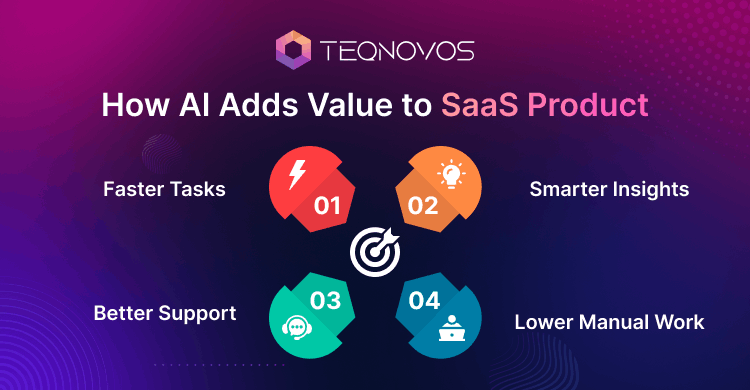
Faster Tasks
AI can reduce the time users spend on repeated actions. It can route tasks, send alerts, sort data, and support faster approvals. This helps users complete work with less delay.
Smarter Insights
SaaS platforms use AI to transform product data into useful business insights. This lets teams discover patterns, monitor user behavior, and make smart decisions without checking every report manually.
Better Support
AI can help users get faster answers inside the product. Smart support tools can suggest next steps, answer common questions, and guide users toward the right feature.
Lower Manual Work
Businesses can connect AI workflow automation software with approvals, alerts, reporting, and support actions. This helps teams reduce admin pressure and focus on higher-value work.
These benefits make SaaS products more useful for daily operations. They also improve user satisfaction, product adoption, and long term retention.
Must Have AI SaaS Product Features
Strong AI SaaS product features make a platform more useful and easier to adopt. They help users act faster, understand data better, and finish work with less manual effort. Moreover, each feature should back a real product goal, not just be an add-on.
Smart Dashboards
Smart dashboards help users view key product data in a clear way. They can show trends, usage patterns, task updates, and business alerts. This helps teams understand what needs action first.
Predictive Analytics
Predictive analytics enables SaaS platforms to analyze past data and forecast likely results. This helps product users plan for demand, cut risk, and boost decision-making, too.
AI Chat Support
AI chat support gives users faster help inside the product. It answers FAQs, guides users to the right feature, and cuts down support workload for internal teams.
AI Automation Workflow
AI automation workflow helps SaaS products manage repeated tasks with less manual effort. The platform can trigger alerts, route approvals, and update records. Businesses that want to understand this layer in more detail can explore this AI workflow automation software development guide before planning advanced SaaS automation features.
User Personalization
Personalization helps the product adjust to each user’s journey. The platform can suggest content, features, actions, or next steps based on user behavior.
Businesses that want to build these capabilities often need expert AI software development services to plan the right feature scope, data flow, and product architecture.
How the AI SaaS Development Process Works
A strong SaaS application development process begins with a clear goal. The team must know what problem the platform solves, who will use it, and how AI will make their journey better. This step helps avoid random AI features that do not support business value.
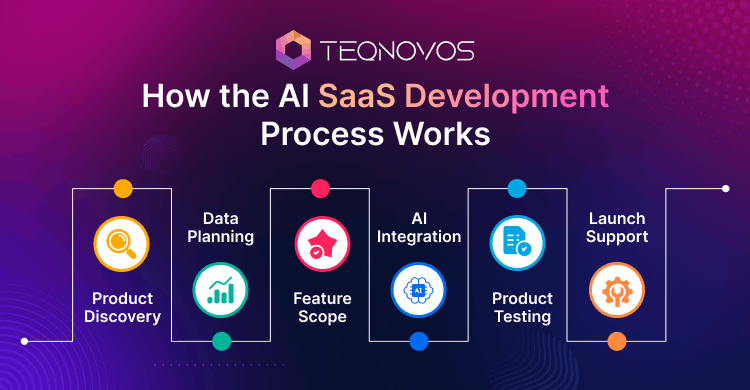
Product Discovery
Product discovery defines the user problem, business model, feature scope, and product flow. It also helps teams decide where AI can improve speed, accuracy, and user experience.
Data Planning
AI needs clean, useful, and well-structured data. Data planning covers source access rules, storage quality, and privacy needs. This step helps the product deliver more accurate insights.
Feature Scope
The feature scope defines what the first version needs to include. A lean scope helps businesses launch faster and test real user demand. It also keeps costs under control.
AI Integration
AI integration connects models with the core SaaS product. This can support smart dashboards, predictions, and chat support.
Product Testing
Testing checks product performance, user actions, AI output security, and workflow accuracy. It helps teams find gaps before users face them.
Launch Support
After launch, the AI SaaS platform development continues with usage tracking, feedback review, and feature improvement. Expert AI software development services help businesses refine the platform as user needs grow.
AI SaaS Development Cost Breakdown
The AI SaaS development cost relies on its scope, integrations, and security needs. Basic products are cheaper because they have fewer AI features, whereas enterprise platforms with predictive analytics, workflow automation, and advanced user roles cost more.
| AI SaaS Product Type | Estimated Cost Range | Best For |
| Basic AI SaaS MVP | $30k to $80k | Startups testing one core idea |
| Mid-Level AI SaaS Platform | $80k to $150k | Growing businesses with more users and workflows |
| Advanced AI SaaS Product | $150k to $300k | Products with analytics automation and multiple integrations |
| Enterprise AI SaaS Platform | $300k plus | Large platforms with compliance scale and complex AI logic |
Key cost factors include:
- Feature scope and product complexity
- AI model type and integration depth
- Data quality, storage, and processing needs
- Third-party tool and API integrations
- Cloud hosting security and compliance needs
- Team size, location, and delivery model
Cost planning needs to start before development begins. However, companies can also manage costs through offshore software development services when they need skilled teams and flexible delivery support.
Get expert support for feature planning, cost control, automation, and long-term product growth. Plan Your AI SaaS Product With Clarity!
Schedule a CallAI SaaS Development Key Challenges
Building an intelligent SaaS product brings strong value. It also needs careful planning. Businesses need to solve product data security and user trust issues before the platform reaches real users.
Data Quality
AI needs clean and useful data to deliver reliable results. Poor data can create weak predictions, wrong suggestions, and confusing user experiences. Data planning needs to start early.
Model Accuracy
The AI layer needs testing before launch. Product teams need to check how the model responds to real user actions. This helps reduce errors and improves trust.
Security Control
SaaS platforms often handle user data, payment details, business records, and private workflows. Strong security controls help protect data access, storage, and system actions.
Scaling Cost
AI features can increase cloud usage, storage needs, and processing costs. Businesses need a clear scale plan before adding advanced features. This keeps product growth under control.
User Trust
Users need to understand how AI supports their work. Clear outputs, simple actions, and helpful suggestions build confidence. A product that feels confusing can slow adoption.
Workflow Logic
An AI automation workflow needs clear rules. The platform needs to know when to trigger alerts, route approvals, update records, or suggest actions. Weak logic can create process gaps.
These challenges do not block growth. They show why planning matters. A strong AI SaaS product needs the right data structure, security model, and feature scope before development starts.
How to Choose a Development Partner
Choosing the right development partner can shape the success of an AI SaaS product. The partner needs more than basic software skills. A strong SaaS application development team needs SaaS experience, AI knowledge, cloud planning, and product strategy.
A reliable partner studies the business model before writing code. This helps define the right features, user roles, data flow, and automation logic. It also helps avoid AI features that look advanced but do not solve real user needs.
Businesses that need custom AI SaaS development should look for these strengths:
- Proven SaaS product experience
- Strong AI integration skills
- Clear understanding of user workflows
- Secure data handling process
- Scalable cloud architecture knowledge
- Experience with AI automation workflow
- Strong testing and launch support
- Clear post-launch improvement plan
The right partner also understands how SaaS products grow after launch. User feedback feature updates and performance tracking need regular attention. This keeps the product useful, stable, and ready for scale.
Businesses can also hire dedicated developers when they need focused technical support for AI features, workflow updates, and long term product growth.
Conclusion
AI enriched SaaS development is changing how modern software products create value. It makes SaaS platforms smarter and more helpful for daily business tasks. AI boosts product features, smooths user experiences, and automates workflows. Moreover, it lets companies create SaaS that saves time, cuts down on manual labor, and supports expansion.
A successful AI SaaS product needs clear planning. The team needs to define the right features, cost, and scope before development starts. This helps the product stay practical, secure, and ready for scale. Businesses that invest in the right AI strategy can build SaaS platforms that users trust and continue using.