



























Anti Money Laundering Software Development Guide for Fintech Businesses
Money laundering has become a persistent and widely evolving menace. It threatens the integrity of global financial systems. Financial crime is becoming harder to detect as fintech platforms handle faster payments and high user activity. Every transaction can carry risk when checks are slow or scattered. A weak compliance system can expose a business to fraud penalties and loss of customer trust.
Anti-money laundering software development helps fintech businesses build stronger user checks and reporting workflows. It also reduces manual work for compliance teams. A modern AML system supports safer onboarding and clearer audit records for business growth.
The right system creates a stronger foundation for security and customer trust. This guide will help businesses to explore the key mechanics of AML fraud detection and the role of modern tech in it.
What is Anti Money Laundering Software?
Anti-money laundering software helps fintech businesses detect and control financial crime risk inside digital products. It reviews user activity across payments and account changes. The system checks customer data against risk rules and external watchlists. It then flags activity that needs review before it creates larger business exposure.
What It Helps Teams Manage
- Customer identity checks
- Risk scoring
- Transaction alerts
- Case reviews
- Sanctions checks
- Audit records
- Compliance reports
A strong AML compliance software setup gives teams one clear place to monitor alerts and record decisions. It helps them move faster without losing control over sensitive workflows.
Why It Matters for Fintech Platforms
KYC and AML compliance becomes stronger when onboarding data connects with transaction behavior. A user may pass the first check but still show risky activity later. The software keeps reviewing patterns after signup. This gives fintech businesses better visibility across the full customer journey.
Growing platforms often struggle with manual checks. They slow down operations and increase missed alerts. A custom system helps teams build rules that match their market product type and risk level.
Build AI-driven anti-money laundering software with smarter compliance workflows. Launch Secure AML Compliance Software!
Schedule a CallWhy Fintech Businesses Need AML Software Development
Fintech businesses move money at high speed. They manage payments and digital account activity every day. Manual review cannot control this risk at scale. One missed alert can lead to fraud or regulatory action.
1. Control User Activity
AML software development helps financial platforms build better control across user actions. It supports risk checks and transaction rules. This gives compliance teams a clearer way to detect suspicious patterns before they become larger threats.
2. Better Platform Security
A secure compliance setup also protects the wider platform architecture. It helps teams manage user data access logs and review workflows with better structure. This is why fintech platforms also need fintech app security solutions that support safer data handling and stronger audit readiness.
3. Compliance Management
Modern businesses need fintech compliance software because regulations keep changing. A fixed manual process can slow reviews and create gaps. On the other hand, scalable systems help teams update rules and track decisions with accuracy.
4. Stronger Fraud Detection
Strong AML fraud detection improves customer trust. Users expect secure onboarding and fast payments. They also expect safe account activity. The right system helps businesses reduce false alerts, speed up reviews, and keep risky activity under control.
Key Business Benefits
- Faster risk review
- Better transaction visibility
- Stronger fraud control
- Cleaner audit records
- Safer customer onboarding
- Better compliance team productivity
Fintech businesses need AML systems that support growth. A well-planned platform helps them stay secure while serving users across more financial products.
Core Features of Anti Money Laundering Software
Strong AML systems need connected features that help fintech teams monitor activity and manage compliance records with clarity. Each feature supports faster detection and cleaner reporting. This helps businesses reduce risk without slowing platform growth.
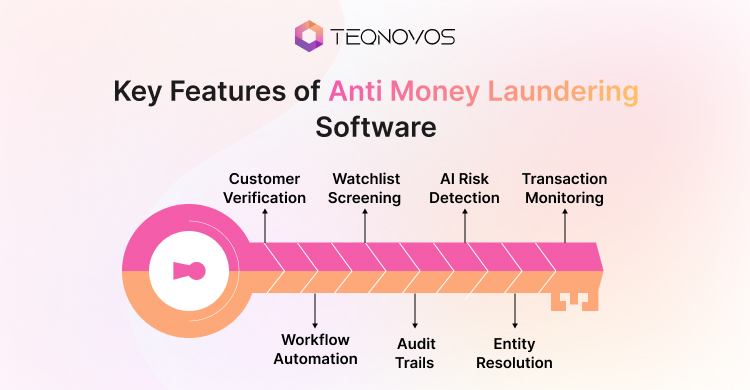
1. Customer Verification
Customer checks create the first layer of protection. KYC and AML compliance help fintech businesses review user identity risk level and account behavior before users access sensitive financial services. A strong fintech compliance software setup also keeps onboarding checks connected with later activity.
- Verifies users during onboarding
- Reviews customer risk levels
- Supports periodic profile checks
- Flags users with stronger risk signals
2. Transaction Monitoring
Financial platforms need clear visibility into payment transfers and account activity. Transaction monitoring software tracks user behavior as it happens and highlights patterns that need review. This improves AML fraud detection and helps teams respond before risk grows.
- Tracks payment and transfer activity
- Spots unusual behavior patterns
- Flags rapid or repeated transactions
- Helps teams review cases faster
3. Watchlist Screening
Fintech platforms must check customers and counterparties against restricted lists. Sanctions screening helps teams identify risky users before onboarding or during ongoing reviews. A strong AML compliance software system keeps these checks structured and easier to audit.
- Screens users against watchlists
- Checks vendors and counterparties
- Supports repeated screening cycles
- Reduces exposure to restricted users
4. AI Risk Detection
AI can improve how AML systems detect complex patterns. AI AML solutions can study user behavior and transaction history to reduce false alerts. They also help teams find hidden links between risky accounts and suspicious activity.
- Detects unusual behavior faster
- Reduces repeated false alerts
- Supports smarter risk scoring
- Improves alert accuracy over time
5. Workflow Automation
Compliance teams need one place to manage alerts, investigations, and decisions. A case management module helps teams collect notes and track each action. This gives managers better control over the full review process.
- Assigns alerts to team members
- Tracks the investigation status
- Stores notes and reviews actions
- Improves team response time
6. Audit Trails
Compliance teams need clean records for every alert review and decision. Anti-money laundering software helps store case history reports and audit logs in one place. Custom AML software development can also shape reporting workflows around each business model.
- Records alert review activity
- Stores case decisions clearly
- Creates audit-ready logs
- Supports faster compliance reports
7. Entity Resolution
Financial crime often moves through linked accounts and related users. Entity resolution helps teams connect these relationships and see wider risk patterns. This gives analysts a clearer view of customer networks and hidden exposure.
- Links related accounts together
- Detects connected risky users
- Shows wider customer networks
- Supports deeper investigation
These features help fintech businesses build safer systems. They also give compliance teams stronger visibility and better control across the customer journey.
Why AI Matters in AML Fraud Detection
AI helps fintech businesses detect risk faster than rule-based checks alone. It reviews user behavior and account activity. This gives compliance teams a clearer view of patterns that may not appear in a simple rule engine.
1. Smarter Risk Detection
AI AML solutions help fintech platforms study normal user behavior. The system can flag activity that looks unusual for that customer type. This helps teams find suspicious patterns earlier and review each alert with better context.
- Detects hidden behavior patterns
- Reviews large data sets faster
- Supports smarter alert scoring
- Improves review accuracy over time
2. Better Alert Quality
Manual rules can create too many false alerts. This slows compliance teams and adds pressure to daily reviews. AI can compare each alert with past activity and transaction behavior. This helps teams focus on alerts that need real attention.
- Reduces repeated false alerts
- Prioritizes high-risk cases
- Helps teams act faster
- Improves investigation quality
3. Compliance Automation
A strong AML system can use AI models to score alerts and support decision records. For fintech platforms that need model-based alerts and secure integrations AI software development services can support the technical setup behind these workflows. This keeps automation aligned with compliance logic and audit needs.
- Scores alerts by risk level
- Routes cases to the right team
- Supports clear decision records
- Reduces manual review load
How to Build a Financial Crime AI Agent for AML Workflows
Building a financial crime AI agent starts with one clear goal. The system helps compliance teams move from scattered alerts to structured risk review. It should read the right data score, suspicious activity, and support clear case decisions.
Step 1: Create a Clean Data Foundation
The agent needs reliable data before it can detect risk. This includes customer profiles and related transaction histories. It also includes login activities and past case outcomes. Clean data helps the system understand normal behavior. It also reduces weak alerts and improves risk scoring accuracy.
Step 2: Map Risk Logic to the Product
Each fintech product has a different risk pattern. A lending app may track repayment behavior and identity risk. The payment app focuses on transfer volume and account velocity. A crypto platform may need wallet activity review and source checks. The agent matches these risks with clear rules and review paths.
Step 3: Train Models for Smarter Detection
Modern AI AML solutions can identify patterns that fixed rules often miss. The model can learn from past alerts and analyst feedback. This helps the system improve alert quality over time. It also helps teams find complex behavior that may spread across accounts or transactions.
Step 4: Connect Alerts With Case Review
A financial crime agent should connect with transaction monitoring software so risky activity moves into one review flow. Each alert includes context notes and decision records. This helps investigators understand the issue faster and take the next action with more confidence.
Step 5: Build Reporting Into the System
Reporting should sit inside the workflow instead of being handled later. The agent can prepare case summaries and report inputs as teams review alerts. This keeps compliance work organized and easier to verify. Fintech platforms that need stronger data intelligence can also use AI solutions for fintech to support safer product workflows.
Custom AML Software Development Process
A clear process helps fintech businesses build AML systems to match product risk compliance needs and team workflows. Custom AML software development reflects how users move through the platform and how compliance teams review activity.
1. Risk Planning
The process starts with business and compliance planning. The team reviews user types and risk exposure. This helps define what the system should monitor and which actions need review.
This stage also shapes alert rules and reporting needs. It gives the project a clear structure before design begins.
2. Data Mapping
A strong AML platform needs clean and connected data. The team maps customer profiles and past case history. This gives the system a better view of user behavior.
Data mapping also connects onboarding with transaction review. Scattered data can hide risk signals. A connected setup helps compliance teams see the full customer journey.
3. Rule Design
The next step is building the rule engine and model logic. AML software development includes rules for transaction limits and suspicious patterns.
AI models support stronger risk scoring and better alert quality. They can review past behavior and detect patterns that fixed rules may miss. This helps teams focus on alerts that need attention first.
4. Alert Dashboard
A useful AML system needs a clear dashboard. Compliance teams should see alerts and decision records in one place. This reduces tool switching and makes reviews easier to manage.
Businesses that need secure payment workflows and fintech integrations can hire fintech developers. They help businesses to support the technical build with stronger product understanding.
5. Security Testing
The final stage checks system accuracy and performance. The team tests alert rules and audit logs. This helps confirm that the system works under real platform conditions.
Anti-money laundering software development also includes post-launch improvement. Risk patterns change over time. The system should improve with fresh data team feedback and new compliance needs.
AML Software for Banks, Payment Apps, and Crypto Platforms
Different fintech products face different financial crime risks. A digital bank may deal with account misuse, but a payment app may face rapid fund movement. On the other hand, crypto platforms may need deeper wallet checks. Anti money laundering software helps each platform build controls around its own risk model.
1. Digital Banking Apps
Digital banks need strong user checks and ongoing account review. They handle card activity and account changes. A smart AML setup helps teams detect unusual behavior before it becomes a larger issue.
- Review new account activity
- Track deposits and withdrawals
- Monitor account behavior changes
- Support case review workflows
2. Payment Platforms
Payment apps process fast transactions across users, merchants, and regions. This speed can create risk when monitoring is weak. Fintech compliance software helps payment businesses review transactions with better structure and stronger visibility.
- Track high-volume payments
- Flag unusual transfer activity
- Review merchant risk signals
- Support faster compliance checks
3. Lending Platforms
Lending platforms need strong checks across loan activity, repayment behavior, and user profiles. A custom AML setup can help teams connect borrower data with risk signals over time.
- Review borrower identity signals
- Track account behavior after approval
- Detect suspicious repayment patterns
- Keep clean audit records
4. Crypto Platforms
Crypto platforms need deeper monitoring because assets can move across wallets and networks. Strong wallet checks and sanctions screening reduce exposure to restricted users and risky asset flows. Businesses building blockchain-based financial products can also work with a blockchain development company to support secure platform architecture.
- Review wallet activity
- Detect risky asset movement
- Screen restricted users
- Support crypto compliance workflows
5. Investment Platforms
Investment apps need controls around deposits, withdrawals, portfolio activity, and user risk profiles. AML software can help teams monitor investor behavior and spot unusual account actions.
- Track funding activity
- Monitor withdrawal behavior
- Review investor risk levels
- Support compliance reporting
Key Challenges in AML Software Development
AML systems can improve compliance work. Yet the build process needs careful planning. Fintech platforms deal with sensitive data and changing risk patterns. A weak setup can create missed alerts and poor reporting.
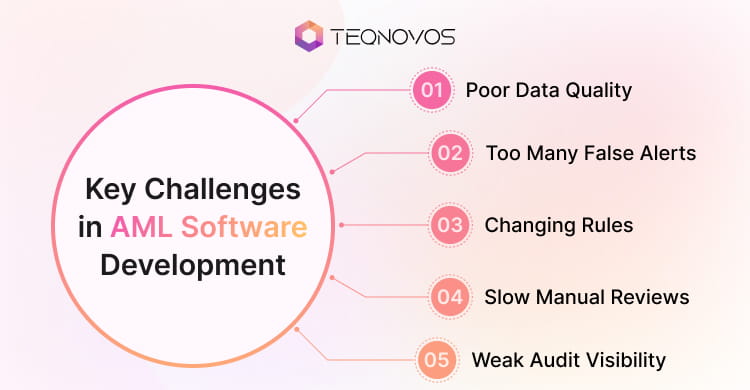
- Poor Data Quality: AML systems depend on clean data. Scattered customer records can affect risk scoring and alert accuracy. Duplicate profiles can also hide suspicious links between users. A strong data setup helps teams review activity with better context.
- Too Many False Alerts: False alerts can slow compliance teams. They also increase the manual workload. Transaction monitoring software should use clear rules and smart risk scoring. This helps teams focus on alerts that need real review.
- Changing Rules: Compliance rules can change across markets. A fixed system may become outdated fast. AML compliance software should allow teams to update rules and review flows without rebuilding the full platform.
- Slow Manual Reviews: Manual checks work at a small scale. They become harder as user activity grows. Fintech teams need structured case flows that support faster decisions. Better workflows help analysts review alerts and track actions.
- Weak Audit Visibility: Audit records matter during regulatory reviews. A system should store alert history and final decisions. KYC and AML compliance becomes stronger when onboarding checks and transaction reviews stay connected in one clear record.
These challenges show why AML software needs more than basic feature development. It needs strong data planning and clear reporting. This helps fintech businesses reduce risk while keeping compliance teams in control.
Also, read our blog on how we help businesses build AI systems to automate claim processing & fraud detection.
Cost Factors for AML Software Development
The cost of an AML platform depends on the depth of features and the level of compliance control a business needs. An advanced platform may include AI scoring user risk profiles and secure integrations. Anti-money laundering software development should be estimated after reviewing product goals and regulatory needs.
1. Feature Scope
Feature scope has a direct impact on cost. A system with onboarding checks and reporting needs more planning than a simple monitoring tool. More workflows also require testing and stronger admin control.
2. Data Sources
AML systems need data from many parts of the platform. This can include customer records and even past case history. More data sources increase setup effort because the team must clean the map and connect each source.
3. AI Model Complexity
AI risk scoring can add more value. It can also increase development time. The team needs clean training data model testing and ongoing improvement. This helps reduce weak alerts and improve detection quality.
4. Reporting Needs
Regulatory reporting can vary by market and business model. Custom AML software development may include custom reports and approval trails. These workflows need careful design.
5. Integrations and Security
Third-party tools can include identity checks and analytics tools. Each integration needs secure data handling. Security testing also adds cost because financial platforms must protect sensitive user and transaction data.
Conclusion
Financial crime risk grows as fintech platforms handle more users’ payments and digital transactions. Manual reviews cannot provide enough speed or visibility at scale. Anti-money laundering software development helps businesses connect user checks and audit records in one system. It helps teams respond to risk faster and maintain cleaner records for future audits.
Teqnovos can help fintech businesses build secure AML systems with custom workflows and scalable compliance features. Book a free call with us to understand how to build a financial crime AI agent. Connect with us today!