



























How to Build an AI Medical Voice Assistant for Secure Transcription
Healthcare professionals spend their valuable time documenting patient visits. This reduces direct interaction and delays record updates. An AI medical voice assistant supports by capturing doctor-patient conversations and turning them into structured clinical notes.
However, healthcare transcription needs more than basic speech recognition. The system must understand medical terms. It must identify each speaker correctly and protect patient data under HIPAA.
Businesses exploring how to build an AI medical voice assistant must plan for accuracy and security from the start. This guide explains the development process and the key features needed for real-time medical transcription. It also covers compliance risks, clinical testing, and common mistakes.
Key Takeaways
- An AI medical voice assistant needs more than standard speech recognition. It must understand clinical terms and identify each speaker correctly.
- HIPAA compliance must guide the full system design. It shapes data capture, storage, access, and deletion.
- Clinical notes always pass through human review. The system creates a draft rather than replacing medical judgment.
- Accuracy testing focuses on the medical meaning. It checks medications, diagnoses, and speaker attribution.
- Electronic Health Record (EHR) integration needs strict patient matching. This helps prevent duplicate notes and incorrect record updates.
- Custom development makes sense when healthcare teams need control over workflows and data security.
What Is an AI Medical Voice Assistant?
The tool listens to clinical conversations and converts spoken words into text. It can separate speakers and recognize medical terms. It can also arrange key details into a structured clinical draft. A clinician then reviews the draft before adding it to the patient record.
This technology supports faster documentation without removing human control. It can capture symptoms, medications, and treatment plans during a consultation. A well designed healthcare voice assistant also follows secure data handling practices across every stage.
AI Medical Voice Assistant
This assistant supports various voice based tasks in a healthcare setting. It can capture conversations and create transcripts in parallel. It may also support appointment workflows and clinical searches.
The AI medical voice assistant works as a wider voice interface. Transcription can form one part of the complete system.
AI Medical Scribe
Focused on clinical documentation. The software stays active and listens during a conversation and identifies essential medical information. The AI medical scribe then moves on to arranging the information into a draft note.
The system can create common note formats such as SOAP. A clinician must still check the note for accuracy and completeness.
This tool helps reduce repeated typing. It can also help healthcare professionals complete records soon after a consultation.
Medical Dictation Software
Records speech spoken directly by a healthcare professional. The clinician describes the diagnosis and treatment after the consultation. They also discuss the follow-up plan after this.
The software assists by converting this speech into understandable written text. It does not always understand a complete conversation between several speakers. It may also require more manual editing before the note enters the medical record.
AI Medical Voice Tools Compared
| Tool | Main Purpose | Typical Input | Main Output |
| AI medical voice assistant | Supports voice-based healthcare workflows | Clinical conversations or voice commands | Transcripts and workflow actions |
| AI medical scribe | Creates draft clinical documentation | Doctor-patient consultation | Structured clinical note |
| Medical dictation software | Converts direct speech into text | Clinician dictation | Written medical text |
Each tool serves a different purpose. Medical dictation software records direct speech. An AI medical scribe focuses on note creation. An AI medical voice assistant can support both tasks as part of a wider medical voice AI system.
How Does Real-Time Doctor-Patient Transcription Work?
Real-time doctor-patient transcription follows a structured process. The system captures the consultation and converts speech into clear clinical text. Each stage must protect patient data and preserve medical meaning.
1. Audio Capture
The process begins when an approved device records the consultation. The system captures clear speech while limiting unnecessary background audio. It may process the audio on the device or within a secure cloud environment.
- Captures the complete consultation
- Uses approved recording devices
- Limits unnecessary audio storage
- Supports patient disclosure before recording
2. Speech Processing
The system prepares the audio before transcription begins. It reduces background noise and detects active speech. This helps the assistant produce a cleaner transcript in busy clinical settings.
- Removes background noise
- Detects active speech
- Filters long silent periods
- Improves audio clarity
3. Speaker Identification
The assistant separates the doctor and patient during the consultation. This process helps the system understand who reported each symptom and who suggested each treatment.
- Identifies each speaker’
- Labels doctor statements
- Labels patient statements
- Reduces incorrect attribution
4. Medical Speech Recognition
The audio moves through medical speech recognition software. The software converts spoken language into written text. It must recognize clinical terms, medication names, and medical abbreviations.
- Recognises medical terminology
- Captures medication names
- Handles different accents
- Supports specialty vocabulary
5. Clinical Text Analysis
The system reviews the transcript and identifies important medical details. It can detect symptoms, medications, and treatment plans. It must also understand context and negation.
- Detects clinical information
- Understands negative statements
- Identifies treatment details
- Supports accurate AI clinical documentation
6. Clinical Note Generation
The assistant converts the transcript into a structured clinical draft. The note can follow the format used by the healthcare organization. It only includes information discussed during the consultation.
- Creates structured draft notes
- Follows approved note formats
- Organizes key medical details
- Avoids unsupported information
7. Clinician Review
The clinician checks the draft before it enters the patient record. This step protects accuracy and patient safety. The clinician confirms that the note reflects the actual consultation.
- Verifies medication details
- Confirms diagnoses
- Checks speaker attribution
- Approves the final note
8. Electronic Health Record Submission
The approved note moves into the correct Electronic Health Record (EHR). The integration must match the right patient and appointment. It also prevents duplicate records and reports failed transfers.
- Matches the correct patient
- Connects the right appointment
- Prevents duplicate notes
- Reports transfer failures
This process allows real time medical transcription to support faster documentation. It also keeps the clinician in control of the final medical record.
Core Features of a HIPAA Compliant Medical Voice Assistant
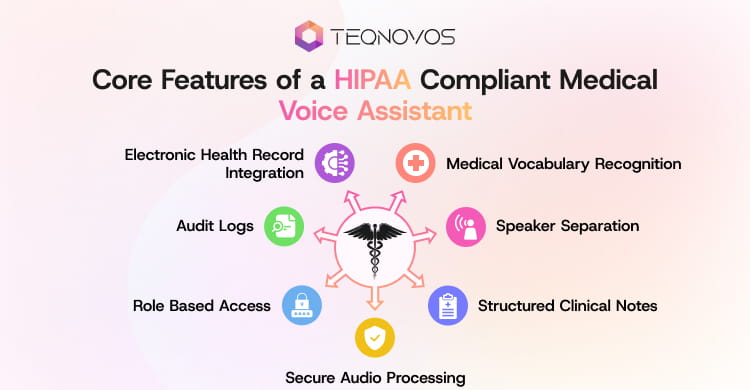
A HIPAA compliant medical voice assistant must support more than fast transcription. It must understand clinical language. It must protect patient data. It must also create reliable records that clinicians can review before approval.
1. Medical Vocabulary Recognition
The assistant must understand medical terms used across different specialties. It recognizes drug names, diagnoses, and procedures. Strong vocabulary recognition improves the quality of HIPAA-compliant medical transcription.
- Recognises specialty terms
- Captures medication names
- Understands clinical abbreviations
- Adapts to different accents
2. Speaker Separation
The system must identify who is speaking during the consultation. It separates the doctor from the patient. Clear speaker labels help prevent incorrect information from entering the clinical note.
- Identifies each speaker
- Labels doctor statements
- Labels patient statements
- Reduces attribution errors
3. Structured Clinical Notes
The assistant converts the transcript into an approved note format. It organizes details into symptoms, findings, and treatment plans. This feature supports clear AI clinical documentation.
- Creates organized draft notes
- Follows approved templates
- Highlights key clinical details
- Supports faster clinician review
4. Secure Audio Processing
The platform must protect audio during capture and processing. It encrypts patient information during transfer and storage. Audio must not be stored longer than the approved retention period.
- Encrypts recorded audio
- Protects data during transfer
- Limits temporary storage
- Supports secure deletion
5. Role Based Access
The system gives each user access based on job responsibility. A clinician may need full note access. An administrator may only need workflow details.
- Limits unnecessary access
- Assigns permissions by role
- Protects sensitive records
- Supports regular access reviews
6. Audit Logs
The platform records important actions within the system. These records can show who accessed a transcript and who edited a note. Audit logs also support security reviews and compliance checks.
- Records user access
- Tracks note changes
- Logs failed sign in attempts
- Supports compliance reviews
7. Electronic Health Record Integration
The assistant must send approved notes to the correct EHR. The integration matches the right patient and appointment. It also reports failed transfers.
- Matches the correct patient
- Connects to the correct appointment
- Prevents duplicate records
- Reports integration failures
These features help the assistant support secure transcription and reliable clinical workflows. They also keep the clinician in control of the final medical record.
How to Build an AI Medical Voice Assistant Step by Step
Businesses exploring how to build an AI medical voice assistant need a clear development plan. Each step must support clinical accuracy and secure data handling. The process matches the real workflow used by healthcare teams.
Step 1: Define the Clinical Use Case
The business first defines the exact problem the assistant will solve. It also identifies the clinical setting and the expected output.
- Select the consultation type
- Define the target medical specialty
- Choose the required note format
- Set clear workflow goals
Step 2: Map the Complete Data Flow
The development team documents how audio and text move through the system. This map includes every service that can access patient information.
- Identify where audio is captured
- Track where data is processed
- Review each external provider
- Define storage and deletion rules
A clear data map helps the team find privacy risks early. It also supports better planning for medical voice assistant development.
Step 3: Select the Speech Recognition Approach
The team must choose where speech processing will take place. Cloud processing supports easier scaling. Local processing offers greater control over sensitive audio. The right approach depends on the use case and security needs. It also depends on the expected user volume.
- Compare privacy requirements
- Review response speed needs
- Check provider compliance support
- Plan for service failure
Strong AI voice agent development can help connect speech recognition with secure healthcare workflows.
Step 4: Train the System for Medical Language
General speech models may struggle with clinical terms. The system needs training that reflects the target specialty and consultation style.
- Add medical terminology
- Include medication names
- Teach common abbreviations
- Test different speech patterns
The training data represent real clinical language. It also includes different voices, accents, and speaking speeds.
Step 5: Add Clinical Language Processing
The transcript must pass through clinical language processing. This step helps the system identify medical meaning within the conversation.
- Detect symptoms and diagnoses
- Identify medications and dosages
- Understand negative statements
- Capture treatment instructions
The system knows the difference between a confirmed condition and a denied condition. It also connects each clinical detail with the correct speaker.
Step 6: Generate Structured Draft Notes
The assistant converts the transcript into a format approved by the healthcare organization. The output remains a draft until a clinician reviews it.
- Follow approved note templates
- Organize important clinical details
- Remove unrelated conversation
- Avoid adding unsupported facts
The medical voice AI only uses details found in the consultation. It never creates diagnoses or treatment information on its own.
Step 7: Connect the Electronic Health Record
The assistant connects with the Electronic Health Record or EHR. This allows approved notes to move into the correct patient record.
- Match the correct patient
- Link the correct appointment
- Prevent duplicate note creation
- Report failed record transfers
The integration includes identity checks and error handling. Professional healthcare app development services can support secure EHR connections and clinical workflow planning.
Step 8: Add Security Controls
Security must remain part of every development stage. It must not appear as a final feature added before launch.
- Encrypt data during transfer
- Encrypt stored patient information
- Apply role based access
- Record important user activity
The team also reviews login security, session controls, and data retention. Every provider that handles protected patient data passes a compliance review.
Step 9: Test with Real Clinical Workflows
Testing reflects the environment where the assistant will operate. Quiet office testing alone cannot show how the system performs during real consultations.
Clinical testing also checks medications and dosages. Clinicians review the results and report errors that could affect patient records.
Step 10: Launch with Human Review
The assistant first launches within a limited clinical group. This controlled rollout helps the team identify workflow problems before wider use.
- Start with selected clinicians
- Review every generated note
- Record common transcription errors
- Improve the model before expansion
The assistant supports the clinician rather than replacing clinical judgment. Human review remains part of the workflow even after system performance improves.
A successful AI medical voice assistant needs careful planning across every stage. The product must combine accurate speech processing with secure architecture and reliable clinical review. This approach creates a system that supports real healthcare workflows without weakening patient data protection.
HIPAA Compliance Requirements for Medical Voice AI
HIPAA compliance must shape the complete product. One security feature cannot make a system compliant. The organization must protect electronic Protected Health Information (ePHI) across every workflow.
1. Business Associate Agreements
BAA defines how an external provider can handle Protected Health Information. Healthcare organizations review every vendor that creates or receives patient data. This may include cloud providers and AI model providers.
- Review every external provider
- Confirm which vendors handle ePHI
- Sign suitable Business Associate Agreements
- Check subcontractor responsibilities
2. Data Encryption
A HIPAA-compliant medical voice assistant protects patient data during transfer and storage. Encryption can reduce exposure when data is intercepted or accessed without approval. The organization selects encryption controls through a documented risk analysis. It also controls who can access the encryption keys.
- Encrypt audio during transfer
- Encrypt stored transcripts
- Protect encryption keys
- Review encryption controls regularly
3. Minimum Necessary Access
Users only access the information needed for their responsibilities. A clinician may need full access to a consultation note. A support employee may only need access to system status information. The HIPAA Privacy Rule requires reasonable efforts to limit access when the minimum necessary standard applies.
- Assign access by job role
- Remove unused permissions
- Review access at set intervals
- Block unnecessary data exposure
4. Data Retention and Deletion
The organization defines how long it keeps audio and transcripts. It does not store recordings without a clear clinical or legal purpose. HIPAA does not require healthcare providers to keep recorded oral communication after transcription. Other laws and record policies may still affect retention periods.
- Set clear retention periods
- Delete temporary audio securely
- Remove expired clinical data
- Document every deletion process
5. Audit and Risk Review
A healthcare organization assesses security risks before launch. It repeats the review after major product updates or workflow changes. Risk analysis covers every place where ePHI is created or transmitted.
- Identify possible security threats
- Test access and authentication controls
- Record changes to clinical notes
- Review risks after major updates
6. Patient Disclosure
Healthcare providers tell patients when a system listens to or records a consultation. The explanation states why the tool is used and how it handles patient information. The organization obtains legal guidance before deployment.
- Explain the purpose of recording
- Describe how patient data is used
- Provide a clear consent process
- Follow applicable recording laws
A HIPAA-compliant voice assistant depends on technology and policies. Secure HIPAA compliant medical transcription also requires vendor review and documented operating procedures. The organization validates the complete workflow before the system reaches real patients.
Businesses can also review data privacy and security in healthcare app development before planning system controls.
How to Measure Clinical Transcription Accuracy
Basic word accuracy does not show if a medical transcript is safe or useful. A transcript may look correct while still missing a dosage or diagnosis. Healthcare teams need to test clinical meaning as well as spoken words.
Word Error Rate (WER) measures how many words the system misses or replaces. This score can support technical testing. It has not become the only measure for real time medical transcription.
Medication Accuracy: The system captures the correct medication name and dosage. Similar drug names can create serious documentation errors. The test process includes common prescriptions and specialty medicines.
Clinical teams compare the transcript with the original conversation. They flag every missing or incorrect medication detail. The system also recognizes units such as milligrams and milliliters.
Negation Accuracy: Medical meaning can change through a single negative word. The system understands the difference between a present symptom and a denied symptom.
Strong negation testing supports reliable AI clinical documentation. It also reduces the risk of incorrect information entering the medical record.
Speaker Accuracy: The assistant must connect each statement with the correct person. A patient may describe a symptom. A clinician may then discuss a possible diagnosis. The system does not merge these statements.
Speaker accuracy becomes more difficult when people interrupt each other. It can also decline when family members or nurses join the conversation. Testing reflects these real clinical conditions.
Note Completeness: A transcript can contain correct sentences and still produce an incomplete note. The system must retain the clinical details needed for patient care.
The assistant removes unrelated conversations. However, it never removes information that affects the clinical meaning.
Specialty Performance: Medical language changes across specialties. A system trained for general consultations may struggle with cardiology or orthopedics.
Each healthcare organization tests the assistant within the specialty it plans to support. Specialty testing helps the AI medical voice assistant deliver consistent results. It also shows where further model training may be required.
Electronic Health Record Integration Considerations
An AI medical voice assistant sends approved notes to the EHR. The integration must protect patient data and prevent record errors.
- Patient and Appointment Matching: The system must connect each note with the correct patient and consultation. It verifies the patient ID and appointment details before submission. Notes with mismatched details remain under review.
- Duplicate Prevention: The platform prevents the same note from entering the EHR more than once. A unique reference can help identify each approved note before transfer.
- Failed Transfer Handling: A transfer may fail due to network or access issues. The platform alerts the right user and keeps the note in a secure review queue.
- Structured Data Exchange: FHIR supports structured healthcare data exchange. It can help systems share patient details and clinical notes with the EHR.
- Secure Integration: The connection uses secure authentication and controlled access. It also records key actions for future review.
A reliable EHR integration confirms the patient and visit before submission. It also prevents duplicate records and keeps clinicians in control.
Common Mistakes in Medical Voice Assistant Development
Small design errors can reduce accuracy and increase security risks. Healthcare teams address these issues before launch.
- The team selects medical speech recognition software that supports healthcare language. It also tests the system with real clinical conversations.
- Every provider meets the required privacy standards. The healthcare organization should also confirm how each vendor stores and deletes patient data.
- The AI medical scribe creates a draft only. A qualified clinician reviews medication names and treatment plans before submission.
- Testing reflects the actual work environment. The team should include different voices, accents, and speaking styles.
- Testing measures medication accuracy, speaker identification, and note completeness. It should focus on clinical meaning rather than word count alone.
- The organization should define a retention period before launch. Temporary audio should be deleted when it no longer supports the approved workflow.
Avoiding these mistakes can improve medical voice assistant development. It can also support safer documentation and stronger patient data protection.
Custom Development Versus an Existing AI Medical Scribe
| Factor | Custom Development | Existing AI Medical Scribe |
| Launch Time | Needs more planning and testing | Supports faster deployment |
| Initial Investment | Requires a higher upfront budget | Usually costs less at the start |
| Workflow Control | Supports full control over each workflow | Offers limited workflow changes |
| Specialty Customisation | Can match specialty terms and note formats | May support only standard templates |
| Data Control | Gives greater control over data storage | Depends on vendor policies |
| Integration Flexibility | Supports custom EHR and system connections | May offer limited integrations |
| Maintenance Needs | Requires regular technical support | The vendor manages most updates |
| Best Fit | Suits large healthcare organizations with complex needs | Suits smaller practices with standard needs |
Custom development makes sense when a business needs unique workflows and strict data control. It also supports deeper system integration. Businesses can use AI medical dictation software development for a more tailored approach.
An existing AI medical scribe may suit smaller practices. It can support a faster launch with fewer technical demands.
Technology Stack for Medical Voice Assistant Development
A reliable AI medical voice assistant needs a secure and connected technology stack. Each layer supports a specific part of the transcription and documentation workflow.
| System Layer | Purpose |
| Audio Capture | Collects clear clinical speech |
| Speech Recognition | Converts spoken words into text |
| Speaker Identification | Separates the doctor and patient |
| Clinical Language Processing | Finds medical terms and context |
| Note Generation | Creates structured clinical drafts |
| Security Layer | Protects audio and patient data |
| Integration Layer | Connects with EHR platforms |
| Monitoring Layer | Tracks errors and system performance |
The development team selects each technology based on clinical needs and data security requirements. Professional AI software development services can support system architecture and performance testing.
Practical Use Cases for Healthcare Organizations
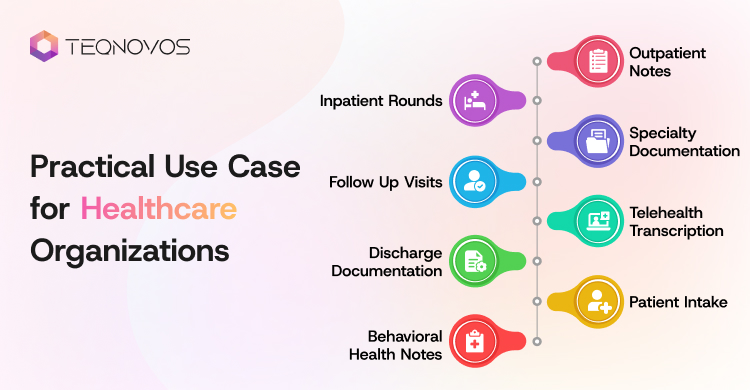
A healthcare voice assistant can support different clinical settings. It can capture conversations and prepare structured draft notes. The clinician still reviews every record before approval.
1. Outpatient Notes
An AI medical scribe can capture routine consultations and organize the discussion into a clear clinical draft.
- Captures patient symptoms
- Records treatment details
- Creates structured notes
- Supports faster review
2. Specialty Documentation
The system can support the terms and note formats used in a specific medical field.
- Recognises specialty vocabulary
- Supports custom note templates
- Captures clinical abbreviations
- Improves documentation consistency
3. Telehealth Transcription
The assistant can provide real-time medical transcription during virtual consultations.
- Records remote consultations
- Separates each speaker
- Creates review ready drafts
- Supports virtual care workflows
4. Patient Intake
The assistant can capture basic patient information before the consultation begins.
- Records reported symptoms
- Captures medical history
- Notes current medications
- Organizes intake details
5. Inpatient Rounds
The system can support documentation during daily hospital rounds. It can capture clinical updates at the point of care.
- Records patient progress
- Captures care plan changes
- Tracks treatment responses
- Prepares daily note drafts
6. Follow Up Visits
The assistant can document progress during follow up consultations. It can compare current details with the earlier care plan.
- Captures symptom changes
- Records treatment outcomes
- Notes medication updates
- Supports continuity of care
7. Discharge Documentation
The system can help prepare draft discharge notes after the clinician completes the final assessment.
- Summarises the hospital stay
- Records discharge instructions
- Captures medication guidance
- Notes follow up requirements
8. Behavioral Health Notes
A medical voice assistant can support structured documentation during mental health consultations. Strong privacy controls remain essential.
- Captures patient concerns
- Records care observations
- Organizes therapy notes
- Supports secure documentation’
Conclusion
An AI medical voice assistant combines speech recognition with clinical language processing and secure data handling. It captures doctor patient conversations and turns them into structured draft notes. Accurate transcription and human review keep the workflow reliable across clinical settings.
Teqnovos helps healthcare businesses plan and improve custom medical voice solutions. The team aligns each product with real workflows and growth. Contact Teqnovos to discuss your project today.