




























The Role of Generative AI in Transforming Content Creation and Marketing Strategies
Generative AI in content creation has moved far beyond basic text generation. Marketing teams now use it for research and ideation. They also use it for personalization and content production.
The technology can create text and images. Modern systems can also work with audio and video. Some models can even generate code.
Adoption has also grown across marketing teams. Businesses with complex requirements often use Generative AI development services to create custom workflows. These systems can connect approved business data with existing marketing tools.
Generative AI now supports much more than content creation. It can assist with research and campaign planning. It can also help teams understand performance data and adapt content for different channels.
Generative AI: What is it?
Generative artificial intelligence creates new content based on patterns learned during training. It can produce text and images. It can also work with audio and video. Modern systems can even generate software code. Many generative AI systems rely on foundation models. A foundation model learns from a large collection of data. It can then support many different tasks.
Deep learning also supports many generative AI systems. Deep learning is a form of machine learning. It uses neural networks with several layers to identify complex patterns in data. Generative AI in content creation no longer depends only on text prompts. Multimodal AI can understand more than one type of information. A model may work with text and images within the same task.
This gives marketing teams more options. They can create different types of content within one workflow. A Generative AI development company can also create systems around approved business information. This gives organizations more control over the data and content used by the model.
Build Smarter Content With Generative AI —Talk to Our AI Experts Today!
Schedule a CallROI for Generative AI Adoption
Return on investment (ROI) helps businesses understand if an AI system creates measurable value. Early discussions about generative AI focused heavily on speed. Speed still matters. Yet businesses now need stronger ways to measure the real impact of AI.
Adobe reported in 2026 that many organizations saw improvements in content ideation and production. The same research found that many businesses still lacked a clear framework for measuring AI returns. This makes measurement an important part of AI powered content generation.
1. Content Production Efficiency
Generative AI can reduce the time required for research and first drafts. It can also support editing and content variations. Businesses can measure production time before and after AI adoption. They can also track the amount of useful content that reaches publication.
Human review time also matters. Fast generation creates little value when teams spend too much time correcting poor outputs. Production cost can provide another useful measure. A business can compare the cost of traditional content workflows with AI supported workflows.
These factors help show the real advantage of using generative AI in content creation.
2. Content Quality and Engagement
Faster production does not guarantee better content. AI generated material still needs to match audience needs. It also needs accurate information and a consistent brand voice. Marketing teams can track engagement based on the goal of each campaign. They may review qualified leads or conversions. They may also review user interaction with the content.
AI-powered content generation can make testing easier. Teams can create different concepts and then select the strongest option through human review.
3. Marketing Campaign Performance
Generative AI can assist with campaign planning. It can also create content variations for different audiences. The technology does not guarantee stronger conversions. Campaign performance still depends on the audience and the offer. The chosen platform also matters.
Reliable data play an important role as well. Businesses can connect generative AI development solutions with analytics systems. This can help marketing teams understand how content activity relates to campaign performance.
4. Effective Adoption Creates More Value
Early adoption no longer creates a strong advantage on its own. Generative AI already forms part of many marketing workflows. The stronger advantage now comes from effective implementation.
A useful AI implementation strategy connects the technology with clear business goals. It also defines data access and human review. Good measurement also forms part of the process.
Adobe reported in 2026 that many businesses still faced problems with data quality and AI readiness. This shows that access to AI does not guarantee useful results.
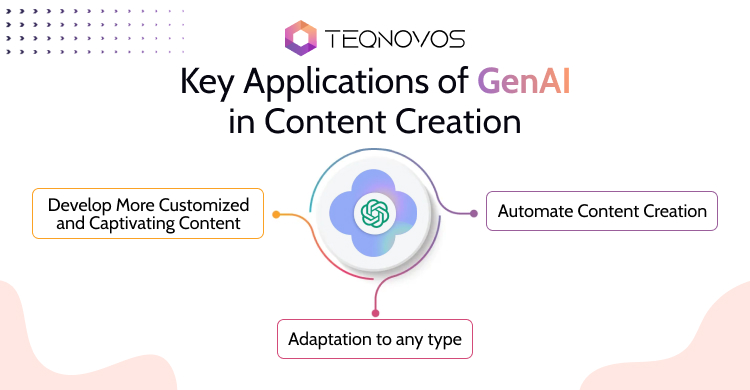
Key Applications of Generative AI in Content Creation
Generative AI in content creation can support several stages of the content process. It can help before production begins. It can also assist during content creation. Teams can use it after publication as well.
1. Create More Relevant Content
Generative AI can help marketing teams understand audience interests when the system has access to reliable data. Teams can use these insights to shape content for different customer needs. They can also adapt messaging for different stages of the customer journey.
Personalization still depends on good data. Weak customer information can lead to poor recommendations and irrelevant content.
2. Automate Repetitive Content Tasks
AI powered content generation can help with repetitive tasks. A marketing team may use it to create first drafts. It may also use AI to generate headline ideas or summarize research.
Generative AI can also adapt existing material for another platform. This allows marketers to spend more time on strategy and creative judgment.
The question of how generative AI can be helpful in content creation goes beyond faster writing. Its real value comes from reducing repeated work while keeping people involved in strategy and final approval.
3. Support Different Content Formats
Modern generative AI can support several content formats. A single campaign idea can support written content and visual concepts. It can also support video scripts and creative briefs.
This multimodal capability gives marketing teams more flexibility than earlier text focused systems. Businesses with specialized requirements may use Generative AI development services to connect these capabilities with existing content systems.
4. Repurpose Existing Content
Generative AI can help teams gain more value from existing content. A long article can support shorter social content. A webinar transcript can become the base for an article. And a product guide can support email content.
AI can also assist with localization. Human review still matters because language and cultural meaning can change across markets.
Integration of Artificial Intelligence Into Marketing Technology
Generative AI now works across a broader marketing technology environment. Content management systems can connect with AI tools. Analytics platforms can provide performance data. Customer data platforms can support personalization.
Campaign tools can also use approved content variations. These connections are changing how marketing teams manage content workflows.
A Generative AI development company can create custom integrations when standard tools cannot support the required process. Custom generative AI development solutions can also control which business information the model can access.
Process Simplification
AI can assist with audience research and content planning. It can also support editing and content adaptation. This reduces repeated manual work across common marketing tasks.
Content Creation
Generative AI can produce first drafts and campaign concepts. It can also create content variations. Human teams can then review the material for quality and accuracy.
Personalization
AI can use approved customer information to adapt content for different audience groups. The quality of the result depends on the quality of the available information.
Performance Analysis
AI can support the analysis of campaign results. It can identify patterns in performance data. It can also help teams find content that needs further review.
Agentic AI Workflows
Agentic AI refers to systems that can plan and complete actions toward a defined goal. These systems go beyond producing a single answer. Marketing teams are starting to explore AI agents for research and content operations. They are also using them for connected workflow tasks.
The technology is still developing. Many organizations still face challenges related to data and system integration. Businesses exploring these systems can review agentic AI development services for a deeper understanding of connected AI workflows.
Risks of Using Generative AI for Content and Marketing
Generative AI creates useful opportunities. It also creates risks that marketing teams need to manage. IAB reported in 2025 that many marketers had already experienced problems related to AI generated advertising. These included inaccurate outputs and bias. Brand inconsistency also appeared as a concern.
Inaccurate Information
A generative AI model can produce information that sounds correct even when it is false. This problem is known as an AI hallucination. Human review remains important for statistics and claims. Technical information also needs careful verification.
Brand Inconsistency
AI generated content may not always match an approved brand voice. Businesses can reduce this risk with clear content rules and approved information sources.
Sensitive Data
Employees may expose confidential information when they place business data into an unapproved AI tool. Companies need clear rules for data access and AI usage.
Bias
Training data can contain bias. A generative model may reproduce some of those patterns in its output. Marketing teams need stronger review processes when content affects sensitive topics or important customer decisions.
AI Governance
AI governance defines how an organization controls the use of artificial intelligence. Businesses can use AI guardrails to place limits around certain AI outputs and actions. Transparency has also become more important. Article 50 of the European Union AI Act became applicable in August 2026. It includes transparency requirements for certain types of AI generated content. Businesses operating across different markets need to understand the rules that apply to their content.
Scale Content Creation With Generative AI —Start Your AI Project Today!
Schedule a CallHow Generative AI Is Changing Content Discovery
Generative AI now affects content production and content discovery. People increasingly use AI systems to research products and services. They also use these tools to understand complex topics. Adobe reported in 2026 that a growing share of customers used AI platforms as a primary research tool.
Google Search has also expanded its generative AI experiences through AI Overviews and AI Mode. Google continues to state that standard search engine optimization or SEO practices still matter. Useful content remains important. Original information also matters. Content still needs to serve the reader first.
Large volumes of weak AI generated material do not create useful search value. This means AI powered content generation cannot replace good content strategy. Generative AI in content creation can improve production. Yet strong research and human judgment still determine the value of the final content.
Conclusion
Generative AI has changed the way marketing teams plan and create content. It can improve production speed. It can support personalization. It can also reduce repetitive work. The technology still needs clear direction. Businesses need reliable data and human review. They also need clear business goals and strong governance.
These controls can help teams use AI powered content generation without losing accuracy or brand quality. Teqnovos provides Generative AI development services for businesses that need custom AI workflows.
A Generative AI development company can support more than model integration. It can also help with workflow design and data planning. Governance and performance measurement can form part of the development process as well. The strongest generative AI development solutions connect technology with a clear business need.