






teqnovos-logo
  • Home
  • Services
    • Offshore Software Development
    • Mobile App Development
    • Web Development
    • UI/UX Design
    • Blockchain Development
    • Ecommerce SEO Services
  • Hire a Developer
    Android Android Developers iOS iOS Developers Angular Angular Developers Dev Ops DevOps Developers Laravel Laravel Developers mean-teqnovos MEAN Stack Developers MERN Stack MERN Stack Developers NestJS NestJS Developers NodeJS NodeJS Developers NestJS development Icon - Teqnovos NextJS Developers NuxtJS NuxtJS Developers Python Icon - Teqnovos Python Developers ReactJS ReactJS Developers VueJS VueJS Developers Wordpress WordPress Developers Shopify Shopify Developers Big-Commerce Icon - Teqnovos BigCommerce Developers Salesforce Salesforce Developers
  • AI Development
    Software Development AI Software Development Services AI Chatbot Development AI Chatbot Development chatgpt ChatGPT Integration Services llms Large Language Model Development generative ai Generative AI Consulting Langchain Development
  • Industries
    healthcare Healthcare App Real-Estate Real Estate App eCommerce eCommerce App FinTech FinTech travel Travel App on-demand app development On Demand App EdTech EdTech Developers insurance InsurTech
  • Resources
    • Portfolio
    • Case Studies
    • Blog
    • Build Your Team
    • Ebooks
Contact Us Schedule Consultation
teqnovos-logo
  • Home
  • Services
    • Offshore Software Development
    • Mobile App Development
    • Web Development
    • UI/UX Design
    • Blockchain Development
    • Ecommerce SEO Services
  • Hire a Developer
    Android Android Developers iOS iOS Developers Angular Angular Developers Dev Ops DevOps Developers Laravel Laravel Developers mean-teqnovos MEAN Stack Developers MERN Stack MERN Stack Developers NestJS NestJS Developers NodeJS NodeJS Developers NestJS development Icon - Teqnovos NextJS Developers NuxtJS NuxtJS Developers Python Icon - Teqnovos Python Developers ReactJS ReactJS Developers VueJS VueJS Developers Wordpress WordPress Developers Shopify Shopify Developers Big-Commerce Icon - Teqnovos BigCommerce Developers Salesforce Salesforce Developers
  • AI Development
    Software Development AI Software Development Services AI Chatbot Development AI Chatbot Development chatgpt ChatGPT Integration Services llms Large Language Model Development generative ai Generative AI Consulting Langchain Development
  • Industries
    healthcare Healthcare App Real-Estate Real Estate App eCommerce eCommerce App FinTech FinTech travel Travel App on-demand app development On Demand App EdTech EdTech Developers insurance InsurTech
  • Resources
    • Portfolio
    • Case Studies
    • Blog
    • Build Your Team
    • Ebooks
Contact Us Schedule Consultation

Electronic Medical Record (EMR) Modernization

Legacy EMR platforms often create delays for clinical teams when patient records remain trapped in disconnected systems and outdated workflows. This electronic medical record modernization initiative focused on building a secure and scalable foundation for connected care operations.
The solution aimed to streamline data migration and improve EMR interoperability. This created more reliable access to patient information across key healthcare workflows. It also prepared the platform for future integrations without placing unnecessary pressure on frontline teams.

Read Case Study Contact Us

99%

Project Impact at a Glance

80%

Faster patient record access

65%

Less manual workflow effort

90%

Reduction in duplicate patient records

Client Overview

The healthcare provider relied on a legacy EMR platform to manage patient records and daily care activities. Clinical and administrative teams worked across disconnected modules. This slowed record access and made routine follow ups harder to manage. The client needed electronic medical record modernization that could improve workflows without disrupting ongoing care or risking historical patient data.

Teqnovos delivered a legacy EMR modernization approach built around structured records, connected workflows, and controlled user access. The new foundation gave teams clearer visibility across patient activity. It also prepared the business for future healthcare integrations and service growth.

The Gaps Behind Delayed Care Workflows

EMR modernization services involve more than replacing an outdated interface. The development work must protect patient data while improving the workflows that clinical and administrative teams use every day. Legacy systems often contain inconsistent records and rigid processes that make change difficult.

  • Inconsistent Patient Data

    Historical records can contain duplicate profiles, missing fields, and different data formats across modules. The modernization work needed a clear data review process to map records correctly and reduce errors before migration.

  • Disconnected Care Workflows

    Clinical teams often move between separate tools to review patient details, update treatment information, and manage follow ups. This creates delays and makes it harder to maintain a complete view of each patient's journey.

  • Complex System Integrations

    Lab platforms, billing systems, patient portals, and other healthcare tools may use different formats and connection methods. Building reliable EMR interoperability required a structured approach to data exchange and workflow alignment.

  • Limited User Access Controls

    Older EMR platforms may not provide clear access levels for clinicians, administrators, and support staff. The new system needed defined permissions so each user could access the right information without exposing sensitive records.

  • High Migration Risk

    Moving historical patient data without disrupting ongoing care creates a major delivery challenge. The process needed validation checks, controlled migration stages, and careful testing to maintain data quality throughout the transition.

  • Rigid Legacy Architecture

    Outdated system structures can make new feature development slow and costly. The modernization effort needed a flexible foundation that could support future integrations, workflow changes, and platform growth.

How We Modernized the EMR Experience

Teqnovos redesigned the electronic medical record modernization solution around clearer patient access, structured records, controlled migration activity, connected data exchange, and flexible system growth. Each capability supported a more reliable day-to-day care environment.

Unified Patient View

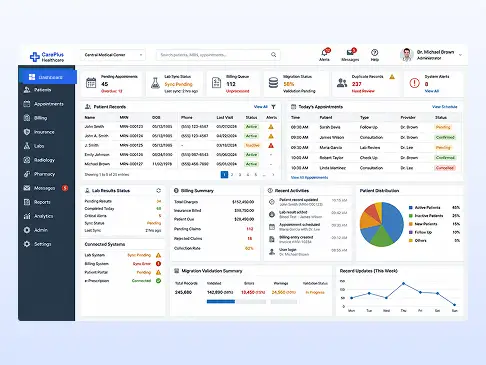
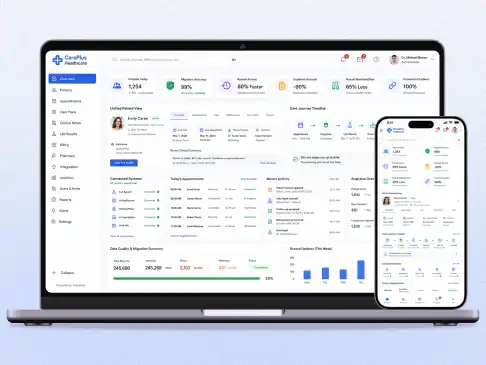
The modernized platform brought clinical notes, appointment history, care updates, and relevant operational details into one patient view. Authorized users could review essential information without moving between disconnected EMR modules.

Structured Patient Records

Patient information followed a more consistent record structure across clinical and administrative workflows. This gave teams a clearer way to create, update, and review approved patient details throughout the care journey.

Controlled Migration Workspace

Authorized teams could review mapped legacy records, identify exceptions, and track migration status through a controlled workspace. This created clearer visibility across historical data moving into the modernized EMR.

Connected Healthcare Data Flow

The platform connected approved lab systems, billing tools, and patient portals through defined data exchange workflows. Teams could manage relevant updates with less reliance on manual transfers between separate systems.

Governed User Access

Role-based permissions limited patient record access according to each user’s responsibilities. Clinicians, administrators, and support users could work within defined access boundaries across the platform.

Modular Service Foundation

The modernized EMR used a flexible foundation that supported new workflow modules, integrations, and platform improvements. Healthcare teams could adapt individual areas without replacing the full system.

Connected Foundation for Patient Data and Care Workflows

Teqnovos designed the electronic medical record modernization architecture around controlled data migration, connected workflows, secure access, and future-ready integrations. Each layer supported a defined part of the modern EMR environment.

01
Legacy Data and Migration Layer

The modernization workflow collected approved patient records, appointment history, care updates, and operational data from legacy EMR modules. Source-to-target mappings helped teams move historical data into the new structure with clearer validation and record quality checks.

02
Core EMR Application Layer

React.js supported the user interface for clinical and administrative users. .NET Core supported backend services that managed patient records, workflow actions, care updates, and system rules across the modernized platform.

03
Patient Data Layer

PostgreSQL stored patient records, clinical workflow data, appointment activity, and approved operational information. The data model created a more structured foundation for record updates, duplicate record review, and connected care workflows.

04
Integration and Messaging Layer

FHIR APIs supported approved healthcare data exchange between the modernized EMR, lab platforms, billing tools, and patient portals. RabbitMQ supported asynchronous message handling across connected workflows and system events.

05
Access and Audit Layer

The platform used defined user roles to limit access across clinicians, administrators, and support teams. Audit activity created a clearer record of patient data access, workflow actions, and system updates.
06
Cloud and Scalability Layer

AWS Cloud supported the platform infrastructure and future service growth. The architecture allowed teams to add new integrations, workflow modules, and operational capabilities without rebuilding the full EMR environment.

Controlled Route From Legacy Systems to Connected Care

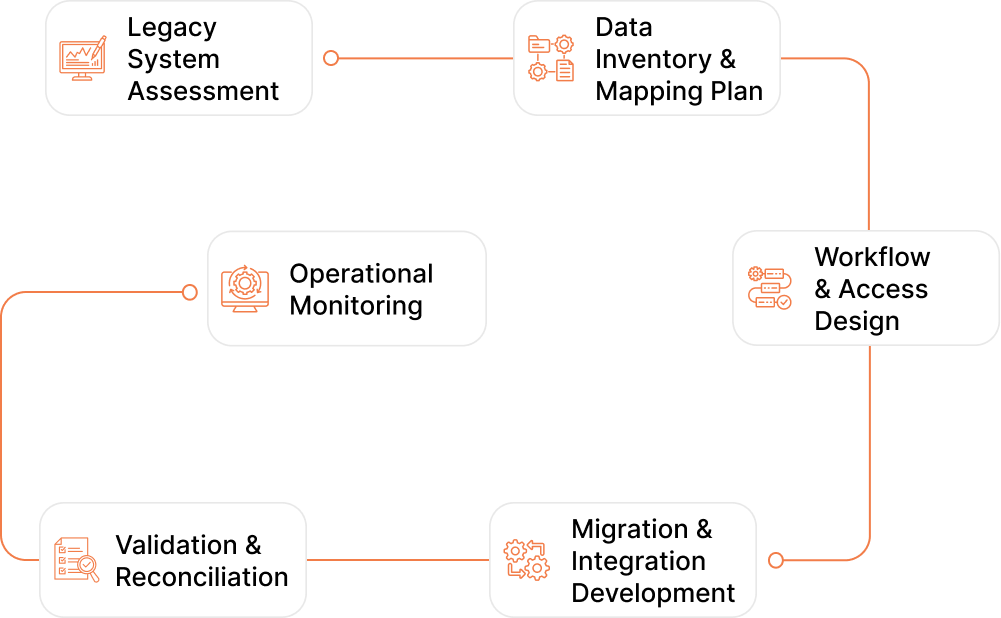
Teqnovos followed a structured delivery process that protected ongoing care operations while modernizing patient data, clinical workflows, and connected systems.

01

Legacy System Assessment

The team reviewed the existing EMR modules, patient record types, user workflows, system dependencies, and integration points. This helped identify the processes that created the greatest delays and migration risks.

02

Data Inventory and Mapping Plan

Teqnovos identified the patient data, care records, appointment details, and operational information that required migration. The team then created source-to-target mapping rules for the new EMR structure.

03

Workflow and Access Design

The team mapped how clinicians, administrators, and support users accessed records and completed daily tasks. This created a clearer plan for patient views, follow-up ownership, permissions, and workflow actions.

04

Migration and Integration Development

Teqnovos developed the modern EMR workflows and connected approved lab, billing, and patient portal systems through defined integration rules. The team also prepared the migration process for historical records and active workflows.

05

Validation and Reconciliation

The team tested migrated records against approved source data and mapping rules. Validation checks reviewed data quality, duplicate records, missing values, workflow behavior, and connected system activity before release.

06

Operational Monitoring

The modernization rollout followed controlled release stages. Teams monitored record access, workflow completion, system behavior, and integration activity as users moved into the new environment.

From Legacy Records to Reliable Patient Workflows

Successful electronic medical record modernization requires more than moving historical data into a new platform. Healthcare teams need a structured way to assess legacy workflows, protect patient records, validate migration quality, and maintain control after release.

Teqnovos used the EMR Modernization Assurance Framework to guide the transition from disconnected legacy systems to connected healthcare operations.

  • Legacy Workflow Discovery
  • Data Inventory and Quality Review
  • Source-to-Target Data Mapping
  • Duplicate Record Assessment
  • Controlled Migration and Validation
  • FHIR Integration Testing
  • Role-Based Access Review
  • Phased Release
  • Legacy Workflow Discovery

    Teams review the clinical, administrative, and operational workflows that depend on the existing EMR. This helps identify delays, duplicate work, access issues, and system dependencies before modernization begins.

    Data Inventory and Quality Review

    The modernization team identifies the patient records, clinical notes, appointment history, and operational data that need review. This stage also highlights duplicate profiles, missing fields, and inconsistent data formats.

    Source-to-Target Data Mapping

    Each approved source field is mapped to the new EMR structure. Teams define how patient data, care updates, appointment details, and workflow activity move into the modernized platform.

    Duplicate Record Assessment

    The workflow reviews patient profiles for repeated or conflicting records before migration. Teams can identify records that need validation or consolidation before they enter the new environment.

    Controlled Migration and Validation

    Historical data moves through defined migration stages with validation checks. Teams compare migrated records with approved source data and investigate exceptions before releasing the updated EMR workflows.

    FHIR Integration Testing

    Approved FHIR APIs connect the modernized EMR with lab systems, billing platforms, patient portals, and other healthcare tools. Teams test each exchange to confirm that the right data reaches the right workflow.

    Role-Based Access Review

    The platform assigns access based on user responsibilities. Clinicians, administrators, and support staff receive access to the records and actions relevant to their work.

    Phased Release

    The final release follows controlled rollout stages. Teams monitor patient record access, workflow completion, data quality, and integration activity to identify issues early and support ongoing platform improvement.

    Measured EMR Modernization Impact

    After launch, the client had a reliable healthcare software modernization platform. It helps with patient data, clinical workflows, and connected systems in a more structured environment. The modernized environment reduced migration risks while giving clinical and administrative teams better control over daily operations.

    Faster Patient Record Retrieval

    Clinical and administrative teams accessed relevant patient information through a unified record view. This reduced the time spent searching across disconnected EMR modules and improved patient record access by 80%

    Higher Migration Accuracy

    The migration process used source-to-target mapping, validation checks, and exception review before release. This helped the client maintain 99% data migration accuracy across the approved migration scope.

    Lower Duplicate Record Volume

    Data quality reviews identified repeated profiles and inconsistent patient details before records entered the new environment. This reduced duplicate patient records by 90%.

    Less Manual Workflow Effort

    Connected workflows reduced repeated updates across patient records, appointments, and follow-up tasks. Clinical and administrative teams spent 65% less effort on manual workflow activity.

    More Complete Follow-Up Ownership

    Care teams had clearer visibility into pending patient actions and assigned responsibilities. This made it easier to identify follow-up activity that still needed attention.

    Stronger Integration Visibility

    Teams gained a clearer view of data moving between the EMR, lab systems, billing tools, and patient portals. This helped them review connected workflow activity without relying on separate updates or manual checks.

    Tech Stack We Used

    Built for secure data flow. Ready for connected healthcare operations.

    • React.js
    • .NET Core
    • PostgreSQL
    • FHIR APIs
    • RabbitMQ
    • AWS Cloud

    Conclusion

    Success Story

    Turning Legacy EMR Challenges Into Connected Care Opportunities

    Teqnovos turns fragmented EMR workflows into secure, connected care operations. Healthcare teams gain clearer access to patient information. They can manage follow ups with stronger ownership and connect critical systems through reliable data exchange. The modernized platform also gives providers a flexible foundation for future service integrations and operational growth.
    Connected Care

    Unified patient records give clinical and administrative teams a clearer view of daily care activity.

    Better Workflow Control

    Assigned actions and structured processes reduce manual work across patient follow ups and record updates.

    Ready for Growth

    Modular architecture supports new integrations, workflows, and services as healthcare operations expand.

    72%

    Reduction in Duplicate Patient Records

    68%

    Faster Patient Record Retrieval

    55%

    Less Manual Data Entry

    Our Clients
    Are Our Pride

    Teqnovos has won the hearts of its customers through hard work and dedication. Our remarkable web and mobile services have made us an industry-leading IT company.

    From the first discovery call, they understood our space. The final app is sleek, bug-free, and our users love it. We’ve even received investor praise for the product quality.

    Brandon

    Co-Founder, Health & Wellness Startup

    Their developers were senior-level, communicated clearly, and integrated seamlessly with our in-house team. We extended the team twice and now consider Teqnovos a core development partner.

    Teresa

    CTO, Workforce Management Platform

    The HR chatbot now handles over 70% of repetitive queries and employee satisfaction scores have improved significantly.

    Jason

    CEO, HR SaaS Startup

    They are exceptional developers and will go above and beyond to deliver a quality app. If you are looking for a reliable team, excellent communication, and benchmark delivery – this is your team!

    Adam Adrello

    CEO

    They are professional and kind and very communicative They built for us an iOS and Android app along with app Web admin for user registration management and the job is completed as promised. Highly Recommended !!

    Karim Massoud

    Senior R&D Engineer

    This was a complex project. The communication and availability of their project manager Ankur was excellent. The team showed excellent technical skills and was able to code custom solutions as needed. If you’re considering a remote developer, I highly recommend Teqnovos.

    Yoram Lepair

    Tech Lead

    Teqnovos did a great job on setting up my technical training site focused on CRM and AdTech at adspiromarketing.com – They were very responsive, available every weekday for our calls and had written summaries of work done for review prior to any of our calls.

    Francisco Guerrero

    Sr. Partner

    Related Case Studies

    AI Manufacturing

    AI Smart Assistants revolutionized LED manufacturing with real-time vision, voice-driven workflows, and intelligent automation.

    Learn more

    PostGrid

    PostGrid provides a solution that enables businesses to enhance offline communication and establish more personal connections with their clients. It...

    Learn more

    1Climate

    The platform delivered practical, measurable benefits for clean energy project teams: 1Climate is an AI-enabled platform designed to meet all...

    Learn more

    STC

    STC (Saudi Telecom Company) is the top telecom provider in Saudi Arabia. The website operates as STC’s online platform, offering...

    Learn more
    View All

    Ready To Upgrade Your EMR System?

    Teqnovos helps healthcare businesses move beyond outdated workflows with secure data migration, reliable integrations, and a flexible platform foundation.

    Contact Us Discuss Your Project

    Frequently Asked Questions

    Electronic medical record modernization improves an existing EMR system without always replacing it completely. The process can update patient data structures, workflows, user access, integrations, and platform architecture.

    It helps healthcare teams move away from disconnected modules and outdated processes while protecting essential patient information.

    Healthcare organizations need to review patient profiles, clinical notes, appointment history, and historical workflow activity.

    Teams also need to identify duplicate profiles, missing fields, inconsistent formats, and incomplete source data before migration begins.

    Fast Healthcare Interoperability Resources (FHIR) APIs help connected healthcare systems exchange structured data. They can support approved data sharing between an EMR, lab platforms, billing systems, and other healthcare applications.

    FHIR APIs help teams reduce manual updates and create more connected workflows across clinical and administrative operations.

    Providers can reduce duplicate records by reviewing patient profiles before migration. The process can compare identity details, record history, and match data points to identify repeated or conflicting entries.
    Teams can then validate unclear records before they enter the new EMR environment. This helps maintain a more reliable patient data foundation after migration.

    EMR modernization improves selected parts of an existing platform. It can upgrade workflows, data structures, integrations, user access, and technical architecture while retaining useful parts of the current system.

    EMR replacement involves moving to an entirely new system. Modernization can offer a more controlled path when healthcare organizations need to improve legacy workflows without rebuilding every process at once.

    Healthcare organizations can reduce migration risk through data discovery, source-to-target mapping, duplicate record review, and post-launch monitoring.

    Teams need to test migrated records and connected workflows before each release. They also need a clear process for reviewing exceptions before users begin working in the modernized system.

    A modern EMR architecture can include a structured patient data layer, role-based access controls, and audit activity. It can also include integration APIs, workflow services, messaging support, and scalable cloud infrastructure.

    It also needs a clear way to connect approved lab systems, billing tools, patient portals, and other healthcare applications without creating disconnected data flows.

    teqnovos-logo

    Boost Efficiency With High-Performing Teams and AI Solutions

    • 1460 Broadway,  New York, 10036, USA

    • +16288000607

    • [email protected]
    • 5th Floor, Orbit Tower, D-256, Sector 75, Sahibzada Ajit Singh Nagar, Punjab 160062

    • +911725027568

    • [email protected]
    • #L4, 3499 Wyecroft Road, Oakville, Ontario, Canada

    • +18079070607

    • [email protected]
    • 128 City Road, London EC1V 2NX, United Kingdom

    • +441304807937

    • [email protected]
    • Office No-2310, CITADEL Tower, Marasi Drive,Business Bay,Dubai – Dubai

    • +971543580607

    • [email protected]

    Who We Are

    • Home
    • About Us
    • Services
    • Blog
    • Portfolio

    Hire Dedicated Developers

    • Android Developers
    • DevOps Engineers
    • MERN Stack Developers
    • Next.js Developers
    • ReactJS Developers
    • Shopify Developers
    • Hire Angular Developers

    Services

    • UI/UX Services
    • Web Development
    • Blockchain Development
    • Mobile app Development
    • Offshore Software Development
    • Global Capability Center
    • Healthcare App Development

    AI Development Services

    • AI Software Development
    • AI Chatbot Development
    • Bard Integration Services
    • LangChain Development
    • Generative AI Development
    • LLM Development
    • ChatGPT Integration

    Clients

    • Build Your Team
    • Case Studies
    • Testimonials
    • Schedule Consultation

    Industries

    • Healthcare App
    • Real Estate App
    • eCommerce App
    • On-Demand App
    • AI / ML

    Other Links

    • Privacy Policy
    • Contact Us
    • Development
    • Location
    • List Blogs

    Social Icons

    © 2026 www.teqnovos.com. All Rights Reserved.

    Hurry! Free Architecture Review Ends This Week

    Claim it with your first developer hire before it’s gone

    • 15+
      Years of experience
    • 900+
      International Clients
    • 7000+
      Solution Providers

    Trusted by Fast-Growing Companies

    Teqnovos Client Logo – Manchester
    Louis Vuitton Logo – Teqnovos Client Brand
    Teqnovos Design Tool – CorelDRAW Logo
    Teqnovos Client – Web4reality Logo
    Teqnovos Client – Castle Lite Logo
    Contact With Our Experts


      Teqnovos top rated software development company by SoftwareWorld

      Teqnovos top blockchain development company award by GoodFirms

      Teqnovos top web developers award by Wadline

      • Teqnovos top blockchain development company award by GoodFirms
      • Teqnovos – Fast-Growing AI Company – Featured by MobileAppDaily
      • Teqnovos top rated software development company by SoftwareWorld
      • Teqnovos featured on Business of Apps platform
      • Teqnovos top web developers award by Wadline
      • Teqnovos top mobile app development company award by Techimply
      Talk to our experts