























The Future Of Software Development: Trends Driving Smarter Growth
Software development has always remained at the center of digital innovation. It powers websites, mobile apps, and advanced systems. It goes on changing the way firms and people connect with technology.
But the industry keeps changing, and it is changing faster than ever.
The introduction of new tools, approaches, and technologies redefines application development and delivery. AI is now assisting developers to write clean code. Cloud-native and microservices have replaced the old all-in-one systems. Every new tech is pushing boundaries that once were impossible to scale.
At the same time, cybersecurity threats and user expectations are rising. With major issues growing, developers need to reconsider their approach. It is no longer enough to create software that works. Modern methods of providing services need to be safe and sustainable.
This shift raises some important questions. How will the future of software development evolve in the coming years? What skills and practices will be relevant? And which tech stack will be the most dominant one?
To explore these questions, let’s dive into the blog. Keep reading to learn more.
The Evolutionary Landscape
The development of software has never stood still, even from the early days of manual coding to today’s era of automation. It is continuously changing and adapting to the new user and industry demands. Well, every shift drives the need to deliver faster and provide a better experience.
Today, software development has reached another turning point. AI tools are changing how code is written and tested, making the process faster and smarter. At the same time, cloud-native systems are growing quickly, allowing businesses to scale their applications with ease.
With modern technology, a secure approach is essential. These changes reflect not just new tools, but also a shift in the role of developers.
The role of a developer is no longer limited to coding. It has evolved to guiding systems and ensuring permanent resilience. This sets up the foundation for the latest trends in software development.
What is the Future of Software Development?
The fate of software development is changing with new inventions and demands. Rising technologies and new methods are evolving application design, launch, and maintenance. Below are some of the new technologies driving this conversion.
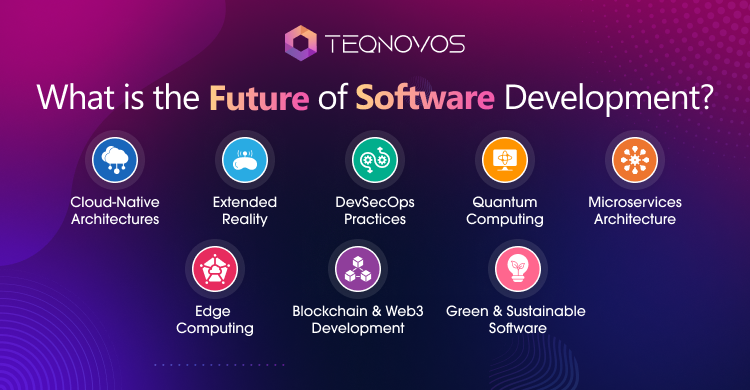
1. Cloud-Native Architectures
Cloud-native architecture is becoming a new standard for building new apps. Businesses could build adaptable systems that adapt to the user demands in real time. The use of containers, microservices, and pipeline integrations makes it easy.
This model reduces infrastructure costs and ensures faster deployments. For developers, cloud-native offers the flexibility to innovate. They could get innovative without tying themselves to legacy hardware.
Companies adopting this approach are able to respond faster and launch new features.
2. DevSecOps Practices
Security has moved to the leading edge of every phase of development. Security integration into the development cycle is considered the last checkpoint.
Automation tools help check for issues in the code. While the compliance framework runs side-by-side testing and deploys the code. This helps reduce the risks and ensure the app is safe.
With cybersecurity and hacking threats increasing, security has become more than an option. Following secure practices is essential for app success.
3. Microservices Architecture
Microservices are set to replace the standard system. By breaking applications into smaller, independent services, teams gain more flexibility and autonomy.
Roll out updates from one component to another without affecting the complete systems. This approach helps mitigate downtime and refine the scalability of the app.
This structure also allows diverse teams to work on different services. Thus, it rushes up the evolution process of the app.
Many global platforms now rely on microservices. It could handle millions of transactions every day.
4. Edge Computing
The rise of connected devices and IoT has made edge computing essential. Instead of sending all data to central servers, edge computing processes information closer to the source.
This helps reduce latency and assists in better decision-making. It is essential for healthcare monitoring and smart factory platforms.
Developers help build applications to balance the strengths of cloud resources.
5. Extended Reality
Extended reality combines virtual and augmented experiences. It is moving into business and education. Beyond fun, XR is useful for training simulations, medical processes, and remote partnerships.
It allows users to engage with digital content in new ways. For developers, the challenge is to create seamless and meaningful experiences that feel natural. XR applications are expected to reach mainstream adoption, making devices more affordable and easier to access.
6. Quantum Computing
Quantum computing is still in its initial stage. However, it holds enormous potential to scale. Unlike traditional systems, quantum computers could process large-scale data. Thus, it makes them an ideal choice to solve complex calculations.
Drug discovery and finance are among the most promising fields to benefit from breakthroughs in this technology.
While most developers aren’t coding directly for quantum systems yet, many are experimenting with hybrid approaches that combine classical and quantum computing. Preparing for this shift will be crucial as the technology matures.
7. Blockchain & Web3 Development
Blockchain is expanding beyond digital currencies. It has tapped into different areas. Healthcare and supply chain management platforms are making the most use of them.
Web3, built on blockchain, focuses on controlling user data. It also helps with the ownership of digital assets.
Developers are building tools that allow secure transactions. Thus, they could build a transparent system and automate contracts.
Industries are adopting blockchain to improve trust and transparency. It is set to become part of the latest software development trends in 2025.
8. Green and Sustainable Software
Sustainability has become a preference across industries, and software is no abnormality. Green software focuses on mitigating the energy uptake and enhancing business productivity.
Industries are adopting methods to lower the carbon cost impact of apps. It includes businesses adopting energy-aware practices, writing lean code, and using cloud storage.
Companies are now tracking the effects digital functions have on the environment. Developers play a direct role in this shift. As awareness grows, sustainable software will move from being a trend to a necessity.
Together, these improvements lead to the next generation of software development. A smarter, faster, and more responsible era. Those adopting these changes will be better prepared to take on challenges.
Next Generation of Software Development
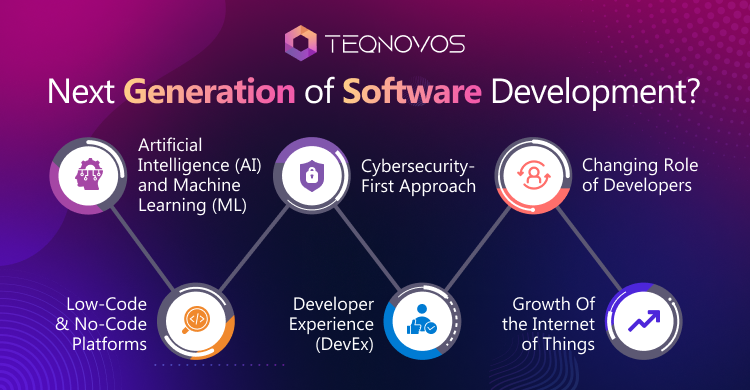
1. Artificial Intelligence (AI) and Machine Learning (ML)
AI and ML are now powering every other stage of coding. Developers use AI to generate code from plain-English prompts and suggest improvements. This is achieved through intelligent completions and testing automation.
Platforms built around AI are known as AI-native development platforms. They offer real-time help for bug fixing and code optimization. Yet, this shift does not end the need for developers. Instead, it elevates their role to focus on quality assurance and AI oversight.
2. Low-Code and No-Code Platforms
Low‑code and no‑code tools have started to gain a stronger grip in the market. Analysts expect that by 2026, 75% of new applications will stem from these platforms. They speed up prototyping, trim costs, and empower non-tech teams to launch solutions.
However, they still fall short for highly customized, complex systems. To address that, organizations often use a hybrid model. They combine low‑code for rapid development with traditional coding for complex tasks.
Learn how generative AI meets low-code and no-code development for faster apps to see how these platforms are evolving.
3. Cybersecurity-First Approach
Building secure software now means baking security in from the beginning. AI-integrated platforms automate issue detection and integrate static analysis into pipelines. Teams guard AI-generated code with governance layers. They enforce testing, compliance, and human oversight.
Tools such as Vibe coding have gained momentum. Companies need to embrace zero-trust architecture and dynamic threat surveillance to ensure endurance.
4. Developer Experience (DevEx)
Developer experience is becoming a top priority. Teams now use AI assistants to automate repetitive tasks, support documentation, and simplify knowledge retrieval. These tools improve app development, reduce cognitive load, and boost developer morale.
Platform engineering also plays a key role by creating self-service internal platforms. This centralizes best practices, streamlines workflows, and reduces friction, making development faster and more efficient.
5. Changing Role of Developers
Developers now function as strategic enablers, not coders. They drive innovation by framing solutions that align with business and user needs. Experts predict developers leveraging AI and low‑code tools to become business planners. Developers guide AI, ensure compliance, and shape how software serves real-world goals.
6. Growth Of the Internet of Things
IoT continues to reshape development. It helps with the demanding, scalable, secure software that integrates cloud services. Developers build applications that communicate with sensors. These apps could manage distributed data and harness edge computing for resilience.
The sudden rise of IoT ecosystems brings in new possibilities for engineers. Thus, they can specialize in domain knowledge edge development and sensor protocols.
This new era of software development blends automation with strategy. Developers become orchestrators relying on AI and no-code tools for efficiency. IoT further expands the frontiers of connectivity, while advanced DevEx tools empower developers to focus more on innovation.
Conclusion
The future of software development promises to be smarter, faster, and more sustainable. Emerging technologies like AI, ML, IoT, and blockchain are changing. They are set to bring evolution to application testing and deployment. However, security no longer remains an afterthought. It needs to integrate into every stage.
Low-code and no-code platforms are augmenting access. DevEx tools ensure that developers focus more on creativity than repetitive tasks.
At the same time, efficiency and viability are driving the industry toward greener practices. The developer’s role has shifted from pure coding to becoming a problem-solver. Organizations that adapt to these shifts will deliver future-ready solutions.
The next generation of software development is not only about technology. It is about responsibility and creating meaningful experiences.
Connect with Teqnovos to start your software development today!