
















How to Validate a Wellness App Idea Before Investing in Development
An idea may sound promising, but that does not mean that the product is ready to start. The founder can clearly identify the opportunity. Nevertheless, there are still risks in the development of the project based on assumptions. Thus, there is a loss of time and additional expenses.
Before going ahead with design and development, one needs to make sure of various aspects. In order to do that, testing the idea becomes a more effective strategy to implement. One should understand the problem and the audience affected by it. The existing applications may solve the problem. There should be an evident reason for suggesting such a solution.
Thus, learning how to validate a wellness app idea gives an entrepreneur a step by step approach to prove the assumptions about the product before its development. First, there is the analysis of the main problem. Next, there is the investigation of the target audience and market. Furthermore, it includes testing the solution and demand.
What Does It Mean to Validate a Wellness App Idea?
Wellness app idea validation is an evaluation of the idea prior to developing it. The team requires concrete evidence of the existence of the problem and the need for the product to be developed. Positive reviews are not sufficient.
Is the Problem Real?
Teams need to ensure that the users are facing problems on a regular basis for this product to matter. A weak problem rarely creates a strong product.
Who Faces the Problem?
Identification of an appropriate target user will enhance the relevance of the study. The researchers will thus understand the individuals who are affected by the problem and the reasons for its importance to them.
How Do Users Solve the Problem?
The users could be currently using an existing application or manually working around the problem.
Does the Solution Fit?
Is there any problem that should be addressed by the solution? Can the users easily perceive the benefits of the solution?
Will Users Take Action?
Strong app idea validation looks at behaviour. Signups show early interest. Repeat use shows stronger engagement. Payment gives even clearer evidence of value.
Can the Product Be Built?
The team also reviews technical feasibility. It is important to know about integrations and data requirements before development starts.
Businesses that confirm the problem and user demand can then move into wellness app development services to review product scope and technical feasibility.
How to Validate a Wellness App Idea Before Development?
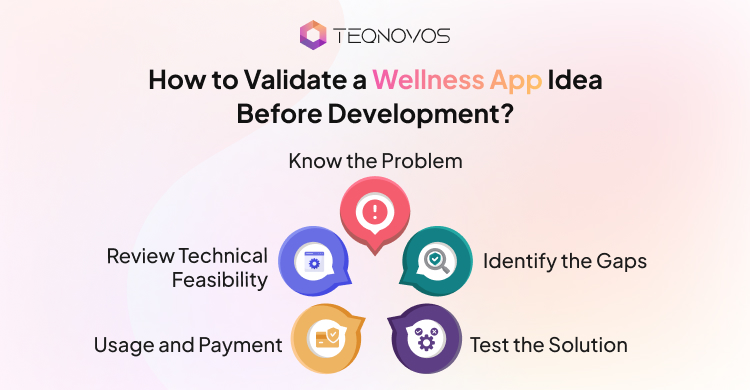
Using a structured way of doing things makes it easy for you to determine how to validate a wellness app idea. You only have to find the answer to one question in each stage without any extra costs and efforts in development.
1. Know the Problem and Target User
Step one involves understanding the environment prior to identifying the features. Understanding the target audience is important to understand the problem in relation to whom it impacts. Having an audience makes the research more meaningful.
An audience that is as general as individuals interested in well being provides little guidance. A specific audience can be remote workers who find it difficult to manage stress regularly. A focused mental wellness app also needs a clearly defined audience and a specific wellness outcome.
Review these before moving forward:
- Check how often the problem affects the user.
- Study the current user behavior with the issue.
- Note the time or effort already spent on solving it.
- Find out if users already pay for another solution.
This stage of wellness app market research should end with a clear user and a clear problem.
2. Identify the Gaps
Market Research is more than just comparing features. It is important to understand why consumers opt for the available products, along with their frustrations.
Product reviews on the App Store and Google Play show you what issues the users face. The value propositions on pricing pages give an understanding of the positioning of the product. Onboarding tells you where things are going wrong in the user experience.
- Before proceeding to the next step, analyze these:
- Determine the target audience that each competitor caters to.
- Find out the complaints raised by users in the reviews.
- Analyze the fee structure used by each product.
- Determine what makes the user switch to another product.
Strong wellness app competitor analysis should reveal an unmet need rather than a missing feature.
3. Test the Solution Before Building the MVP
The team can use UI/UX design services to turn the core idea into testable user flows before development starts. A landing page or clickable wellness app prototype shows how users respond before engineering begins.
The test focuses on the main product journey. It does not try to represent every future feature.
It is essential to test these before moving to the next step:
- Check if users understand what the product is meant to solve.
- See if users complete the main task without confusion.
- Check how quickly users onboard to the first useful section.
- Track if users take a real next step after seeing the concept.
This stage can test app demand before development and expose weak ideas before they become expensive features.
4. Usage and Payment
However, interest is not sufficient in itself. It needs to be established whether or not users take any meaningful actions once they come across the product. Downloads or hits may be an indication of their awareness, but it does not necessarily mean that they will use it.
Track these metrics:
- Measure how many interested users take the first step.
- Check if users reach the first useful action.
- Look for signs that users return after the first session.
- Test if users will commit money for the value offered.
This fitness app retention case study shows how progress visibility and engagement mechanics can be used to create stronger reasons for users to return.
A positive comment is weak evidence. A paid beta or real purchase action gives a stronger signal. The team also identifies who pays. The buyer may be the user or an employer or a wellness provider.
5. Review Technical Feasibility
An idea becomes tough to build if it only depends on complex tech. Reviewing happens long before those dependencies become part of the wellness app MVP. Developers identify the parts and features of the product that lead to increased costs.
Cover these:
- Find out whether the product requires HealthKit (Apple) or Health Connect (Google).
- Make sure that the necessary information about well-being can be acquired with the customer’s consent.
- Specify how the Artificial Intelligence is used within the product.
- The role of AI in fitness also needs to match a clear user task and an available data source.
This stage of wellness app development planning exposes technical risks early. The product may move to clinical workflows. In that case, the team may need planning around healthcare app development services and data requirements.
Validate Your Wellness App Idea Before Investing in Development. Plan Your Wellness App With Teqnovos!
Schedule a CallWhat Should Be Included in the First Wellness App MVP?
First step involves the verification of the initial product review from real users. The MVP does not have to include all features finalized for the final product. It only includes features required to gain core experience.
MVP Core Scope
This version focuses on one clear wellness journey. Every feature plays its role in testing that journey. Non-core features remain outside the system. A healthcare fitness app case study can also show how goals and progress tracking fit into a focused fitness product journey.
- Collect relevant data at the start of the experience.
- Inquire of the users about their goals regarding wellness.
- Use the key action that brings the value promised by the system.
- Show users the change in their activity through time.
Features to Defer
Some features may improve the product without being necessary for early validation. Adding them too soon increases scope and makes it harder to see what users actually value.
- Add social interaction after the core journey shows demand.
- Introduce deeper rewards after repeat behaviour becomes clearer.
- Expand integrations after users prove that the data adds value.
- Add advanced Artificial Intelligence or AI guidance after the basic experience works.
A useful rule guides wellness app development planning. If removing a feature does not prevent the team from testing the main product assumption, then it stays outside. A clear software product development strategy assists in connecting product assumptions with a practical MVP scope.
How Much Does It Cost to Validate a Wellness App Idea?
Early research is inexpensive if the founder performs the majority of the work. The expenses will grow when the concept requires professional validation and testing. The cost of wellness app idea validation depends on what the team still needs to prove.
These figures are the estimated planning rates.
| Validation Stage | Estimated Cost | Typical Timeline | What It Tests |
| User research | $0 to $500+ | 3 to 7 days | Problem strength and user behaviour |
| Landing page test | $50 to $500+ | 3 to 10 days | Early demand and signup intent |
| Clickable prototype | $1500 to $3000+ | 1 to 3 weeks | User flow and solution usability |
| Technical discovery | $1000 to $2500+ | 1 to 3 weeks | Product scope and technical risk |
| Technical proof | $4000 to $12000+ | 1 to 3 weeks | One critical integration or feasibility question |
Cost Drivers
The final validation budget depends on the amount of research and specialist work required. A simple wellness idea may just require user research and prototypes. However, an idea that involves the use of wearables or Artificial Intelligence may require more technical testing.
- Research depth: More user groups require more interviews and testing.
- Prototype scope: More screens increase design and testing effort.
- Integrations: Wearables and external systems can require technical discovery.
- Technical risk: AI or complex data flows may require a proof of concept.
Budget Approach
Good app idea validation does not require every test in the table. The team spends money on the assumption that creates the greatest risk.
A landing page may be enough to test early demand. A technical proof may be necessary when the entire concept depends on one difficult integration.
The aim is to answer the most important question before a much larger development budget is committed.
What Are the Biggest Mistakes When Validating a Wellness App?
Poor app idea validation creates false hopes. The team may collect feedback and still miss the signals that matter. These mistakes often appear when opinions replace real behaviour or when development starts too early.
- Developing the solution without verifying the assumptions will increase costs and risks.
- Questions have to capture true user behavior and not try to get a positive response from the user.
- It is important to involve the affected people in the research process.
- A positive response does not imply that there is any need for the product.
- The objective is to find an unmet need and not duplicate what exists.
- The first MVP for the wellness application should be based on the hypothesis.
- Installations indicate acquisition and not usage of the product.
- The willingness to pay for the product should be determined before developing it.
- The team has to look for reasons for returning to the application after the first usage.
- The privacy needs should be determined before integrating them into the solution.
Strong wellness app idea validation should reduce uncertainty. It should also show when the original idea needs to change.
Checklist to Validate a Wellness App Before Development Begins
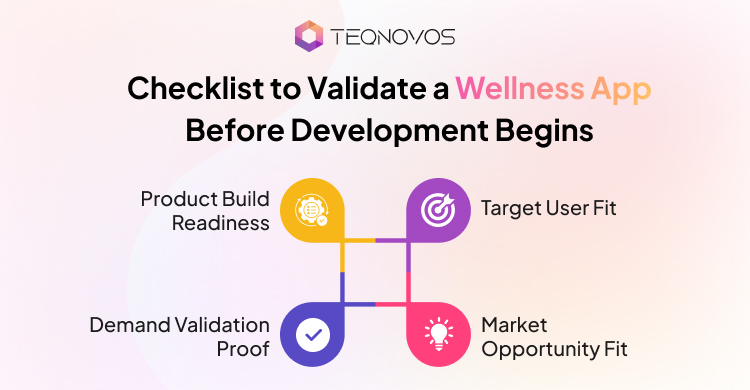
A useful validation checklist gives the team a clear view of what is known and what still needs proof. It also makes weak areas easier to spot before development begins. The goal is not to remove every risk. The goal is to reduce the risks that could affect the product most.
1. Target User Fit
The team first needs a clear picture of the people who face the problem. A broad audience makes research less useful. A specific user group gives the team better insight into daily habits and real needs. It also makes later testing more focused.
- Find out the target audience of the product.
- Ensure the problem exists and is significant
- Connect with the users experiencing the issue.
- Learn how people solve the problem.
2. Market Opportunity Fit
The next thing to do is to figure out what the users can currently pick. The available products indicate what the customers expect from the market. Also, user reviews may shed some light on the recurring frustrations. The gaps will help to find a niche for the new product.
- Review the existing applications and pricing.
- Identify recurring problems from user reviews.
- Identify needs that current products still miss.
- Test if users understand why the product is different.
3. Demand Validation Proof
Interest alone does not confirm demand. The team needs to see what users actually do after they discover the idea. Real actions give stronger evidence than positive comments. Repeat behaviour can reveal even more about the value of the product.
- Check if users take the first step after seeing the idea.
- Test the main journey with real users.
- Find out if users will pay for the value.
- Look for a clear reason for users to return.
4. Product Build Readiness
The last review considers whether the concept is ready for development, without any big uncertainties. The team must have a realistic understanding of the technology and data that will be used. Some dependencies should be checked beforehand too.
- Review key integrations and dependencies from a technological point of view.
- Check whether the needed data is accessible.
- Find sensitive wellness data and permissions.
- Stick to the key assumption while working on the wellness app MVP.
The checklist provides a team with a tool to evaluate the readiness of the wellness app idea validation prior to development. This checklist clarifies the next step businesses need to take. They may either continue their work or reconsider their ideas.
Turn Your Wellness App Idea Into a Validated Product Roadmap. Validate Your App Idea With Teqnovos!
Schedule a CallConclusion
Development goes well when there is some evidence that supports it. A good idea cannot be sufficient to proceed with development. One should have proof that the problem exists and users react positively to the idea.
Studying how to validate a wellness app idea will provide the business with an opportunity to assess risks prior to making decisions about allocating the budget. It will help to identify any flaws in assumptions and to redirect the idea in case it is needed.
After that, the business will proceed with developing an MVP. This makes the next investment more focused and easier to defend.
Connect with Teqnovos and start building your wellness application with us. Get started with us today!