
























Digital Transformation Solutions for Healthcare: Strategy, Integration & Modernization
Healthcare organizations often use separate systems for scheduling, patient intake, telemedicine, and reporting. When these systems do not exchange information correctly, staff may enter the same data several times. Patients may receive delayed updates, and providers may lack important information during care delivery.
Digital transformation solutions for healthcare address these operational gaps through better software and reliable data exchange. The goal is not to add more tools. It is to improve how patients, providers, administrative teams, and systems interact.
Teqnovos helps healthcare organizations assess their current technology, plan transformation initiatives, and build digital solutions. They also help integrate existing platforms and improve performance after launch through healthcare software development.
What Are Digital Transformation Solutions for Healthcare?
Digital transformation in healthcare is the use of technology to improve patient access, clinical processes, and administrative operations. They also help with data management, communication, and decision-making.
It involves more than purchasing a new application. The organization also needs to define data ownership, user permissions, integration rules, security controls, and the operational result it expects to achieve.
Digitization, Digitalization, and Digital Transformation
These terms describe different levels of change:
| Approach | Meaning | Healthcare example |
| Digitization | Converting physical information into digital form | Scanning paper records |
| Digitalization | Using technology to improve an existing task | Allowing patients to book appointments online |
| Digital transformation | Redesigning connected workflows around users and outcomes | Linking booking, telemedicine provider access, and EHR updates |
Example: Connecting Telemedicine With an EHR
A healthcare provider may use one platform for appointments, another for video consultations, and an electronic health record for clinical documentation.
A connected process can:
- Send appointment details to the telemedicine platform.
- Match the patient with the correct record.
- Provide the provider with approved information.
- Store the reviewed consultation note in the appropriate record.
- Create follow-up tasks for the responsible team.
This requires more than a basic API connection. The implementation team must define patient-matching rules, field ownership, access permissions, failed-message handling, and audit requirements. A telehealth platform with EHR integration provides a relevant example of this type of healthcare process.
Our Healthcare Digital Transformation Solutions
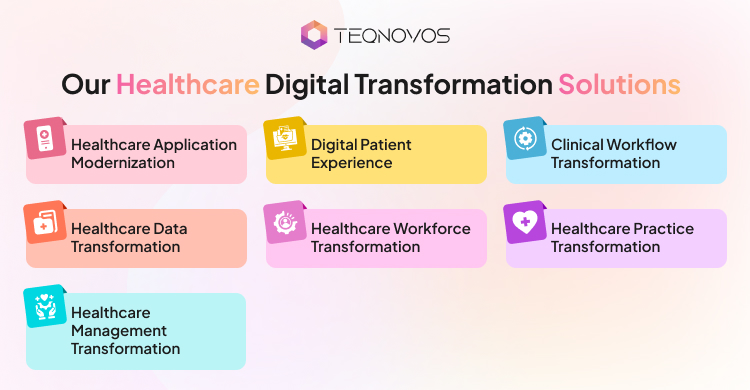
Teqnovos provides healthcare digital transformation services based on the organization’s existing systems, operational priorities, and technical constraints. The right solutions for healthcare digital transformation begin with the process under pressure and the systems already in use.
Healthcare Application Modernization
Healthcare application modernization begins with an assessment of the existing application architecture and database. Dependencies and integration points are also reviewed. The team then determines which components can be retained, refactored, replaced, or isolated.
For example, a provider may retain its scheduling module while replacing an outdated patient intake component. The new component can use defined APIs and controlled data mapping. This reduces disruption while addressing a specific technical limitation.
Migration validation, access testing, performance testing, and rollback planning are essential parts of the process. Organizations can review application modernization services when evaluating a legacy system.
Digital Patient Experience
Patient experience solutions improve the steps patients complete before, during, and after care. These may include provider search, appointment booking, and digital intake. This may also involve reminders, virtual visits, and follow up instructions.
A useful patient facing solution shows the current status of an appointment and identifies incomplete actions. It may also support identity verification, consent capture, and accessibility.
Because patient platforms often handle Protected Health Information (PHI), security needs to be included during design. This includes role based access, encryption, and audit logs through HIPAA-compliant software development.
Clinical Workflow Transformation
Clinical workflow transformation helps providers receive relevant information, document encounters, and assign follow up work without unnecessary searching across systems.
A redesigned process may provide approved intake information before a visit and allow structured clinical documentation during the encounter.
EHR and EMR integration solutions can connect clinical records with scheduling, telemedicine, patient portals, laboratory systems, or billing workflows. The integration design must define which information can be viewed, changed, and transferred.
Healthcare Data Transformation
Healthcare data transformation focuses on data quality, standardization, exchange, and governance. In digital transformation in healthcare, unreliable data can affect patient matching and reporting. Billing and clinical coordination may also be affected.
The implementation may include data mapping, validation rules, identity matching, record reconciliation, access controls, and audit tracking. Health Level Seven (HL7) messages and Fast Healthcare Interoperability Resources, or FHIR, APIs may support information exchange, depending on the systems involved.
Data quality checks can compare record counts, required fields, identifiers, rejected transactions, and duplicate profiles before and after migration.
Healthcare Workforce Transformation
Workforce transformation organizes staff work around tasks and responsibilities rather than separate applications.
A role based work queue can show the assigned user, due time, and supporting information. This can also show escalation status and unresolved issues. This helps staff manage patient requests, referrals, and follow up activities from a clearer operational view.
The implementation team can measure active usage, task completion, and reassignment rates. These measures reveal whether the new process reduces work or simply moves it to another screen.
Healthcare Practice Transformation
Practice transformation connects front office operations with clinical preparation and follow up. A typical process may include registration, insurance information, and scheduling. They may also involve digital intake, provider preparation, and patient communication.
The system can show whether intake is complete or whether the provider has reviewed the information. It can also account for rescheduled visits, canceled appointments, and duplicate profiles.
This approach allows each team to use the interface and information most relevant to its responsibilities.
Healthcare Management Transformation
Management solutions give leaders reliable information about access, operations, workforce activity, and system performance.
Useful measures may include:
- Appointment completion rate
- Patient access time
- Duplicate record rate
- Failed integration transactions
- Manual task volume
- Open follow-up tasks
- Staff adoption
- Support requests
Each metric requires a defined calculation method and data owner. For example, record access time must specify whether measurement begins when the provider opens the patient profile or when the appointment starts.
Healthcare digital transformation consulting can help connect these measurements with business priorities and improvement initiatives.
Digital Transformation Strategy for Healthcare Organizations
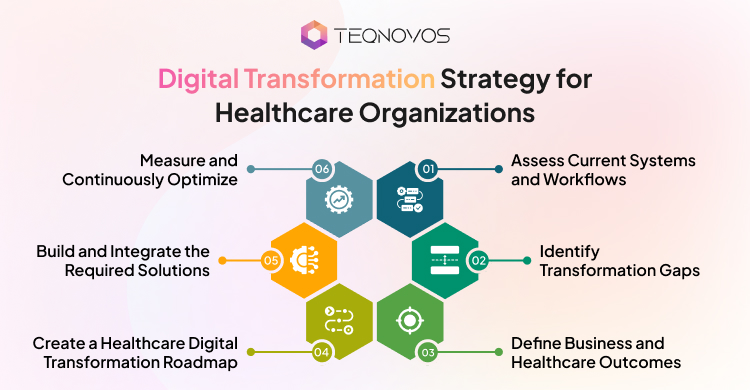
A healthcare digital transformation strategy connects operational problems with technical decisions and measurable outcomes. It gives leaders a structured way to decide what to modernize and what to build.
1. Assess Current Systems and Workflows
The assessment covers applications, databases, interfaces, users, manual handoffs, security controls, reporting processes, and data dependencies.
The team maps one complete process, such as referral intake or virtual care, from the first patient action to the final administrative or clinical update.
2. Identify Transformation Gaps
The team records where information is delayed, duplicated, unavailable, or incorrectly interpreted. Gaps may involve legacy software, inconsistent appointment statuses, weak patient matching, missing alerts, or unclear task ownership.
Each gap receives an operational impact rating and an implementation priority.
3. Define Business and Healthcare Outcomes
The organization defines measurable outcomes before selecting technology. These may include faster appointment scheduling, fewer duplicate records, and a more complete digital intake.
Each measure requires a baseline, target, owner, and review period.
4. Create a Healthcare Digital Transformation Roadmap
The roadmap follows this sequence:
Assessment → Prioritization → Architecture → MVP or Pilot → Integration → Deployment → Adoption → Optimization
A pilot may focus on one clinic, referral category, or telemedicine service. The team can test permissions, identity matching, notifications, documentation, and error handling before expanding the solution.
5. Build and Integrate the Required Solutions
The delivery team determines whether the organization needs configuration or application modernization. They might also require new development, integration, or data migration.
Testing covers normal transactions and failure conditions. They may include testing incomplete records, duplicate requests, and canceled appointments.
6. Measure and Continuously Optimize
After launch, the organization compares baseline data with post-launch performance. It also reviews user behavior, failed transactions, and workflow completion.
If staff continue using spreadsheets after a new work queue launches, the issue may involve missing features, poor information placement, or an unsuitable process. The next improvement should be based on this evidence.
A healthcare digital transformation strategy remains useful when it continues to guide prioritization after deployment.
Turn Disconnected Systems Into Connected Healthcare Workflows. Start Your Healthcare Transformation Plan!
Schedule a CallTechnologies Powering Healthcare Digital Transformation
Healthcare organizations do not need every new technology. They need the right technology for the process that causes the most problems.
The technology stack should support the workflow. It should not force staff to work around disconnected applications. This principle helps organizations choose practical digital transformation solutions for healthcare.
| Business problem | Technology | What it solves | Key decision |
| Systems do not exchange data | APIs with HL7 and FHIR | Structured information exchange | Which system owns each data element? |
| Patient records do not match | Master Patient Index and identity matching | Duplicate and mismatched records | Which identifiers and matching rules apply? |
| Staff use several platforms | Integration layer and workflow orchestration | Cross system task coordination | Where should the next task go? |
| Legacy software limits progress | Application modernization | Architecture and integration limits | Should the system be modernized or replaced? |
| Patients face disconnected steps | Portal mobile tools and telemedicine | Digital access and engagement | Which steps can move online safely? |
| Sensitive data needs protection | IAM encryption and audit logs | PHI security and access control | Who can access or change the data? |
| Leaders lack trusted reports | Data platform and analytics | Consistent operational reporting | What is the trusted data source? |
| Manual work is repetitive | AI and automation | Classification routing and assistance | Where is human review required? |
Interoperability and APIs
Interoperability allows healthcare systems to exchange usable information. Application programming interfaces support this exchange. Health Level Seven messages and Fast Healthcare Interoperability Resources APIs support different integration needs.
The team still needs to define field mapping and data ownership. It must also test rejected messages and duplicate records.
Patient Identity and Master Patient Index
Patient identity technology matches records that belong to the same person. A Master Patient Index applies defined rules to patient identifiers and demographic information.
This helps reduce duplicate records. It also lowers the risk of sending information to the wrong patient record.
Workflow Orchestration and Automation
Workflow orchestration coordinates tasks across applications. It assigns the next action to the right user or system.
A completed referral can trigger clinical review. The system can then route scheduling and patient notification to the correct queue.
Cloud and Application Architecture
Cloud architecture can improve scalability and availability. It can also support faster deployment and easier integration for new applications.
It does not fix poor workflow design or weak data governance. A legacy system may only need modernization when its business rules remain reliable. Replacement makes more sense when its architecture blocks required security or interoperability improvements.
Artificial Intelligence and Automation
Artificial intelligence is most useful when users can review the result. Suitable use cases include document classification and patient message routing. Information retrieval and administrative assistance can also benefit from automation.
Higher risk clinical use cases need stronger validation. They also need human oversight and audit records.
Security and Access Controls
Security controls protect Protected Health Information throughout its lifecycle. Important controls include identity and access management and encryption. Audit logs help track sensitive actions.
Access rules need to match each user role. A patient should not receive the same permissions as a provider or system administrator.
Analytics and Performance Monitoring
A dashboard cannot fix missing records or conflicting appointment statuses. Analytics is only as reliable as the data and definitions behind it.
The organization needs a clear source for each metric. It also needs a named owner and a review process.
How to Choose the Right Technology
Technology selection should follow the workflow problem. The organization needs to review interoperability and data ownership. It also needs to assess security requirements and implementation risk before selecting a platform.
Healthcare Digital Transformation by Organization Type
Digital priorities change with the way an organization delivers care and manages information. A hospital may need shared access across departments. A clinic may need better coordination between intake and scheduling. These differences matter in digital transformation in healthcare.
Hospitals and Health Systems
Hospitals manage many departments and clinical systems. Patient information moves through registration and care delivery. It may later reach laboratory services and discharge teams.
The main priority is cross department interoperability. Leaders need to review patient movement and system dependencies. They also need clear permissions for clinical and administrative users.
Clinics and Medical Practices
Clinics often collect patient information through forms and phone calls. Staff may then enter the same details into scheduling and record systems.
The priority is a simpler patient intake process. Connecting intake with scheduling lets staff see completed forms before the appointment. It also gives providers better preparation time.
Pharmaceutical and Life Sciences Organizations
Pharmaceutical organizations manage research data and laboratory information. They also share records with external partners and regulatory teams.
The transformation focus is data traceability across research and regulatory workflows. Teams need to know where information began. They also need to know which version is current and who changed it. An audit trail supports review and accountability.
Payers and Insurance Organizations
Payers manage claims and eligibility information. They also handle member communication and provider data.
Automation can route incomplete claims to the right review team. It can also show the reason for a delay instead of sending the case into a general queue. This gives staff better control over claim resolution.
Healthcare Systems We Can Transform and Integrate
The right digital transformation solutions for healthcare depend on the system that creates the greatest operational delay.
| Healthcare system | Transformation focus | Key decision |
| EHR and EMR | Clinical records | Which information needs to be shared? |
| Hospital information system | Department operations | Where is shared visibility required? |
| Practice management system | Scheduling and administration | Which intake data can be reused? |
| Patient portal | Patient access | Which actions can patients complete online? |
| Telemedicine platform | Virtual care | How does visit information return to the record? |
| Billing and revenue cycle system | Claims and payments | Which data requires validation? |
| Laboratory information system | Orders and results | How are results matched to the correct record? |
| Pharmacy system | Medication information | Who can view or update medication data? |
| Remote monitoring platform | Device data and alerts | Which events require human review? |
Integration or Consolidation?
Integration is often suitable when existing systems perform their core functions well. It allows the organization to connect useful platforms without replacing them.
Consolidation becomes more attractive when overlapping systems create conflicting records. It may also make sense when duplicate processes increase maintenance work.
The decision depends on the system architecture and the cost of change. It also depends on the outcome the organization needs to measure.
Security, Privacy, and Compliance in Healthcare Transformation
Security decisions begin with data movement. A patient portal may collect Protected Health Information. An application programming interface may send it to a scheduling system. A provider may then view it in an electronic health record.
Each point needs the right control.
HIPAA (Health Insurance Portability and Accountability Act) requirements affect software design and internal procedures. HIPAA-compliant software development helps include these controls during development.
Map Data Before Choosing Controls
The team first records where PHI enters the system. It then tracks how the data is stored and shared.
The map identifies:
- Data collection points
- Connected applications
- User roles
- Storage locations
- External vendors
- Data export paths
- Retention requirements
This process shows where sensitive information may be exposed. It also helps the organization avoid applying the same access level to every user.
Match Controls to User Roles
A patient and a provider need different permissions. An administrator may manage user access without viewing clinical notes.
Important controls include:
- Identity and access management
- Multifactor authentication
- Least privilege access
- Encryption at rest
- Encryption in transit
- Audit logs
- Secure API authentication
- Session timeout rules
The control plan needs regular review. A staff member who changes roles may need different access. An inactive account must not retain access to patient information.
Test Security During Failure
Security testing needs more than a successful login. The team also tests expired sessions and rejected access requests.
It checks if audit logs record sensitive actions. It also verifies that failed integrations do not expose PHI through error messages or system logs.
HIPAA compliance depends on software and organizational procedures. Software supports compliance work. It does not make an organization compliant by itself.
Modernize Key Healthcare Processes With Secure Integration and Focused Software Development. Talk to Our Healthcare Experts!
Schedule a CallDigital Transformation Challenges in Healthcare We Solve
In digital transformation in healthcare, the greatest risks often appear where systems and teams meet. A platform may work correctly in isolation yet fail when it exchanges information with another application.
Legacy Dependencies
A legacy application may contain rules that control scheduling or billing. Replacing it without reviewing those rules can disrupt daily operations.
The team first identifies the important dependencies. It then decides if modernization can solve the problem or if replacement is necessary.
Inconsistent Patient Data
Different systems may use different patient identifiers. They may also use different appointment statuses.
The integration design needs matching rules and validation checks. It also needs a review path for records that do not match.
Staff Workarounds
Staff may continue using spreadsheets when the new process does not match their responsibilities. This points to a design issue rather than simple resistance.
User testing helps identify missing steps. It also shows where information needs to appear in the daily process.
Uncontrolled Scope
Transformation projects often expand when each department adds new requests. This increases delivery time and testing effort.
A ranked backlog keeps the work focused. Each new request needs a clear operational reason.
Weak Measurement
A project may launch on schedule without proving its value. Technical completion does not confirm an operational improvement.
The organization needs baseline data before development begins. It can then compare appointment delays and manual tasks after launch.
Benefits of Healthcare Digital Transformation
The benefits become clear when they connect to a measurable change. A new platform alone does not prove that the transformation worked.
| Area | Practical change | How to measure progress |
| Patient access | Fewer incomplete bookings | Booking completion rate |
| Clinical work | Less time spent finding records | Record access time |
| Care coordination | Clear referral and follow up status | Task closure rate |
| Data quality | Fewer duplicate records | Duplicate record rate |
| Workforce activity | Better task visibility | Task reassignment rate |
| Management reporting | More consistent data | Report accuracy |
A clinic may measure the time between digital intake and appointment confirmation. A hospital may track rejected data exchanges between departments. A payer may review the time required to resolve incomplete claims.
These measures give each organization a practical way to assess progress. They also show if the result came from a new feature or from a change in the operating process.
The value of healthcare digital transformation services comes from this connection between technology and results. Teqnovos ties each proposed change to a defined process and a measurable outcome.
Case Studies and Healthcare Transformation Projects
Public case studies show how healthcare technology work translates into measurable project results. The examples below focus on two different problems. One addresses legacy EMR modernization. The other addresses healthcare data mapping.
EMR Modernization for Connected Patient Records
A healthcare provider relied on a legacy electronic medical record system. Clinical and administrative teams worked across disconnected modules. This slowed patient record access and made follow up work harder to manage.
Teqnovos modernized the EMR without requiring a complete replacement of every system. The work included structured patient records and controlled data migration. It also included FHIR APIs and role based access.
The project reported:
- 99 percent data migration accuracy
- 80 percent faster patient record access
- 65 percent less manual workflow effort
- 90 percent fewer duplicate patient records
The project shows when healthcare application modernization is useful. A system may contain valuable business rules even when its architecture limits new work. Modernization preserves useful functions while improving data access and integration.
The complete EMR modernization case study explains the architecture and delivery process.
AI-Assisted Healthcare Data Mapping
Another project focused on healthcare data mapping. The client needed to connect EHR data and HL7 feeds with FHIR structures. Manual mapping created long review cycles and repeated work.
Teqnovos developed a mapping workflow that used artificial intelligence for suggestions. Interoperability specialists reviewed uncertain results before approval. Versioned mapping rules preserved the history of each decision.
The project reported:
- 60 percent faster mapping reviews
- 45 percent less manual effort
- 50 percent faster integration delivery
- 70 percent process automation
This example shows a practical use of AI in healthcare integration. Automation handled repetitive mapping work. Specialists retained control over final decisions.
The healthcare interoperability case study provides more detail about the mapping workflow.
These results belong to individual projects. They are not general guarantees. Each outcome depends on the starting systems and the project scope.
Why Choose Teqnovos for Healthcare Digital Transformation?
Organizations seeking healthcare digital transformation consulting need more than a development team. They need a partner that can understand existing systems and make clear technical decisions.
Workflow Assessment Before Development
Teqnovos begins by reviewing the process that causes the greatest delay. The assessment maps applications and user actions. It also identifies manual work and system dependencies.
This prevents the project from becoming a simple software replacement exercise.
Practical Work With Existing Systems
Existing software is not treated as a problem by default. Teqnovos reviews which systems perform their core functions well. It then recommends integration or modernization where that approach creates less disruption.
Replacement remains an option when the architecture blocks required improvements.
Controlled Data and Integration Work
Data mapping and migration decisions are recorded before development begins. Source fields are matched with target fields. Validation checks confirm the quality of the transferred data.
This gives healthcare teams a clearer way to review records and investigate exceptions.
Clear Delivery Artifacts
A project produces more than finished screens. Useful delivery artifacts include:
- System inventory
- Workflow map
- Data mapping plan
- Access matrix
- Integration test plan
- Migration validation report
- Release checklist
- Performance baseline
These documents help business and technical teams review decisions throughout the project.
Measured Results After Launch
Teqnovos connects healthcare digital transformation services with defined measures. The review may track record access time and duplicate records. It may also track failed transactions and manual task volume.
This gives leaders evidence for the next improvement cycle.