


























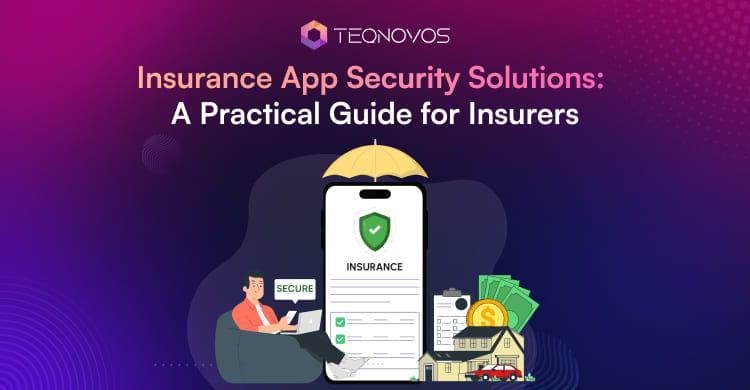
Insurance App Security Solutions: A Practical Guide for Insurers
Insurance apps manage policy records, claims documents, payment details, and account access in one place. This makes insurance app security solutions a core requirement for insurers that need to protect sensitive customer information and maintain reliable digital operations through well-planned insurance app development services.
Strong insurance app security goes beyond a login screen. It requires secure user access, protected data flows, and controlled document sharing. It also requires regular checks across customer and internal workflows. This guide explains the risks that matter most and the security practices insurers can use before launch and during future updates.
Why Insurance Apps Need Security Beyond Basic Login
Insurance apps hold more than basic customer details. They may store identity records, policy information, and claims files. Other sensitive details might include medical documents, payment activity, and communication history. A single weak point can expose sensitive data across several business workflows.
Insurance mobile app security also involves a larger attack surface. An attack surface is every point where a user or an external system can access the app. Policyholder portals, payment gateways, and connected systems all create potential entry points.
Strong protection needs to cover the full journey. It must protect users when they sign in, submit a claim, make payments, or access policy information. This is why insurers need security planning before development starts instead of adding controls after launch.
Key Security Risks Insurers Need to Control
Insurance apps handle sensitive information across many connected workflows. Weak insurance application security can expose policy records, claim details, payment activity, and customer documents.
The key risks include:
- Account takeover: Attackers can access accounts through stolen credentials or weak recovery flows.
- Insecure APIs: Poorly protected connections can expose data shared with payment gateways and third-party tools.
- Unsafe document uploads: Claims files can contain harmful content or become visible to unauthorized users.
- Excess internal access: Agents, adjusters, support teams, and administrators may see data beyond their work role.
- Weak activity tracking: Missing audit logs make it harder to identify suspicious actions or investigate an incident.
Strong insurance data security limits access based on user roles. Effective insurance cybersecurity solutions also record sensitive actions across policy, claims, and payment workflows.
Essential Security Controls Every Insurance App Needs
Effective security controls for insurance apps need to protect every user action. They must secure the login, data access, and claims documents. Payments and system connections must also be secured. Strong controls reduce the impact of human error or suspicious activity.
The most important controls include:
- Multi-factor authentication: Multi-factor authentication requires more than one step to confirm a user’s identity. It reduces the risk of account takeover.
- Role-based access control: Each user gets access only to the records and actions required for their role.
- Data encryption: Encryption helps in protecting the data when it is stored or moved between multiple systems.
- Secure APIs: An API helps in connecting the app with third party applications.
- Protected document uploads: File checks, malware scanning, and restricted access keep claim evidence safer.
- Audit logs and monitoring: Activity records help teams detect unusual actions and investigate incidents faster.
These security features for insurance apps need to work together. A secure login alone cannot protect policyholder data if user permissions or connected systems remain weak.
How to Protect Policyholder Data in an Insurance App
Insurers collect personal details, policy records, and claim evidence. They also ask for payment information or medical documents. Insurance products that manage medical records need stricter privacy controls.
This is especially important in health insurance app development, where claims and member data can include highly sensitive information. Each data point needs protection from collection through storage and sharing.
Strong insurance app security best practices start with data minimisation and the right security features for insurance apps. The app should collect only the details needed for a policy, claim, or support request. Teams also need to encrypt sensitive records and limit access by user role.
Key actions include:
- Control data access: Show records only to authorised policyholders, agents, and internal teams.
- Secure data sharing: Protect information shared with payment services, policy systems, and approved partners.
- Limit data retention: Remove or archive records when business and legal requirements no longer require active access.
- Protect notifications: Avoid sending policy details, claim data, or payment information in push notifications or emails.
- Track sensitive actions: Record document views, downloads, and permission changes in audit logs.
Effective insurance data security covers the full data lifecycle. A data lifecycle is the path data follows from collection to storage, and use to retention and deletion.
Control Access Beyond Login
A login check only confirms a user’s identity at the start. Insurers also need to control what happens after access begins. Risk can rise when a customer changes bank details, when an agent opens claim records, or when an adjuster views medical evidence.
Practical steps include:
- Add step-up verification: Request another identity check before high risk actions such as password resets, payout detail changes, or large claim updates.
- Restrict sensitive changes: Require approval for actions that affect payments, claim decisions, or user permissions.
- Flag unusual device activity: Review access attempts from unknown devices, unusual locations, or repeated failed login attempts.
- Limit claim-level access: Give agents and adjusters access only to assigned policies or claim files.
- Review inactive accounts: Remove access when an employee leaves, an agent changes role, or an external partner no longer needs system access.
These actions strengthen insurance mobile app security by reducing risk after a user signs in. They also protect sensitive workflows that basic login controls cannot cover.
Secure Claims Documents From Upload to Access
Claims teams often handle photos, repair estimates, or medical records. These files can reveal private details that do not appear in a standard policy record.
Strong insurance app security needs to protect the full document journey. The app must keep each file connected to the right claim. It must also prevent users from sharing or opening evidence outside their assigned case.
Teams need to focus on these actions:
- Use claim-specific upload spaces: Attach each file to a defined claim instead of placing it in a shared document area.
- Remove hidden file details: Strip location data and other metadata that may expose extra personal information.
- Set document-level rules: Limit who can view, download, or replace a specific file.
- Use time-limited sharing links: Expire access links after a set period or after one approved use.
- Separate review from storage: Keep new uploads in a restricted review area before they enter the main claims record.
These controls reduce exposure when a claim involves highly sensitive evidence. They also give insurers more control over how documents move between policyholders, adjusters, and internal teams.
Clear document access and case-level evidence controls also create a more reliable foundation for claims fraud detection software development where systems rely on accurate claim data to flag unusual patterns.
Test Insurance App Security Before Every Release
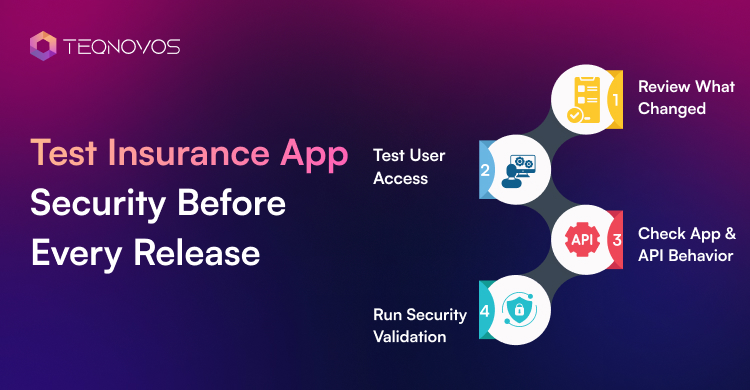
A new release can create risks in areas that previously worked as expected. Even a small update can affect claim access, document visibility, or connected systems. Insurance app security best practices treat security testing as part of every release cycle. Regular release testing also keeps insurance cybersecurity solutions aligned with new app features and system changes.
Review What Changed
Teams planning how to secure an insurance app need to identify what information the app will collect. This may include claim submission, policy access, document sharing, or payment actions. The review needs to focus on data exposure and permission changes.
Test User Access
The team needs to ensure that all users have access to only the information relevant to their job position. These include the policyholder, agent, and administrator. The testing should also include critical functions like changing bank details and changing claim statuses.
Check App and API Behavior
The app needs testing for weak error messages and exposed data in logs. They also need testing for unsafe mobile permissions and broken connections with external systems.
Run Security Validation
Vulnerability scanning highlights any known vulnerabilities in the code or configuration, while penetration testing is the act of trying to exploit those vulnerabilities. These security tests provide teams with enough time to address risks before deployment.
Your App Is Only as Secure as Its Connected Partners
Insurance apps rarely work alone. They may rely on identity verification tools, payment providers, and cloud platforms. They might also require repair networks, telematics services, and fraud systems. Each external provider can create risk when it receives policyholder or claims data.
Similar integration risks also affect financial apps that share customer or payment data with external systems. Teams can also review our guide to fintech app security solutions for related controls around API access and third party services.
Review Data Before Sharing
Teams need to define what data a provider needs. They also need to confirm why the provider needs it. A vendor should receive only the information required for its service.
Set Clear Security Responsibilities
Contracts need to define who protects the data. They also need to state how the provider reports incidents. This includes access removal, data retention, and breach communication requirements.
Recheck Vendor Access Regularly
A provider may change its tools, staff, or service scope over time. Regular reviews help insurers identify inactive accounts, unused data access, and integrations that no longer support a business need.
Strong insurance cybersecurity solutions extend beyond the app itself. They also cover every external service that can view, store, or process sensitive insurance information.
Security Must Start Before Development Begins
Insurance app security solutions work best when teams plan them before app development starts. Adding controls later can create delays. It can also leave gaps across claims, payments, and partner integrations.
Map Sensitive Data First
Teams need to identify what information the app will collect. This can include policyholder details, claim evidence, and payment data. Each data type needs clear storage, access, and sharing rules.
Review Risks Before Building Features
Threat modeling is a structured process that identifies how an attacker or unauthorised user may misuse an app workflow. It allows teams to review risks in claim submission and password recovery. They also help with document access and external integrations before development begins.
Set Security Requirements Early
Secure insurance app development needs clear requirements for user access, data handling, and API controls. Product teams and security teams need to agree on these rules before features move into development.
Early planning makes insurance application security part of the product design. It prevents teams from treating security as a final stage before launch.
Security Is Not Enough Without Proof
Strong insurance application security needs clear evidence that teams follow approved security processes. During an audit or incident review, insurers need to show who accessed sensitive records, what changed, and how the team responded.
Important records include:
Access certification records: Keep proof that managers reviewed and approved user access for sensitive systems.
Data retention records: Document how long policyholder data and claim files remain available before archive or deletion.
Policy exception approvals: Record cases where teams approve an exception to a standard security rule.
Control ownership records: Define which team owns each security control and when they last reviewed it.
Compliance review evidence: Maintain records of internal checks for data handling and workflow requirements.
Corrective action records: Track how teams close gaps found during audits or internal reviews.
Audit readiness is not about collecting every record. It is about keeping the right evidence available when insurers need it.
Not Every Insurance Workflow Needs the Same Security Controls
Insurance apps do not carry the same risk across every workflow. A claim upload needs different protection than a policy renewal. An agent dashboard needs different rules than a customer profile page. This is why security controls for insurance apps need to match the data and action behind each workflow.
Policy access
Policyholder pages need safe account access and clear visibility rules. The app should show only the policies linked to that user. It should also protect profile changes that affect contact details or ownership records.
Claims workflows
Claims workflows need stronger document and evidence protection. Photos, invoices, medical files, and incident reports should stay linked to the correct claim. Review teams also need a clear record of who viewed or changed the file.
Agent and broker portals
Agent portals need strict account boundaries. One agent should not view records outside an assigned book of business. Managers also need control over team access when roles change.
Payment-related actions
Premium payments and payout changes need extra review. The app should treat bank detail updates, refund requests, and claim payout changes as high risk actions.
AI-driven workflows
AI features need careful data handling. Insurers need to control what data enters an AI workflow. They also need to review who can access or act on its output. These checks are important during AI-powered insurance app development.
This workflow-based view makes insurance app security solutions more practical. It helps insurers decide which controls matter most instead of applying the same security level everywhere.
Build Insurance App Security in the Right Order
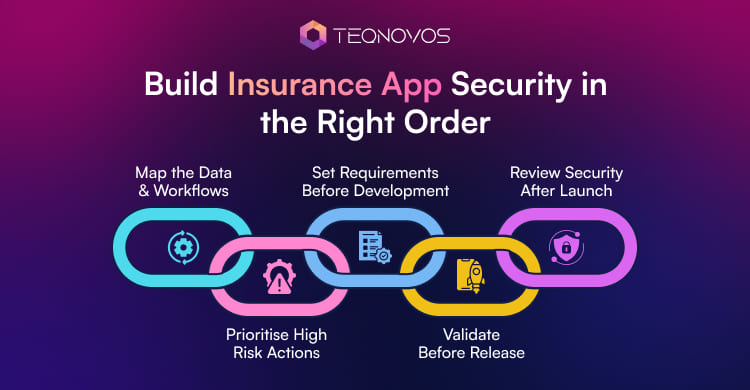
Insurance app security solutions become harder to manage when teams add controls after each issue appears. Teams that need to understand how to secure an insurance app can set priorities before development starts and continue security reviews after launch.
1. Map the Data and Workflows
Teams first need to identify what the app handles. This includes policy records, claim evidence, and internal activity. Each workflow needs a clear owner and risk level.
2. Prioritise High Risk Actions
Insurers need to focus first on actions that can expose data or affect money. These may include claim submissions, bank detail changes, and payout approvals. document sharing. and administrator access.
3. Set Requirements Before Development
Security controls for insurance apps need clear requirements before features move into development. Teams need to decide who can access each workflow. What data can the app collect? And how long the data remains available.
4. Validate Before Release
Each new feature needs a security review before users receive it. Teams need to confirm that the update does not create gaps in user access, data handling, or system connections.
5. Review Security After Launch
App security needs regular review as workflows change, new partners, new claim processes, and new user roles can create risks that did not exist at launch.
This approach gives insurers a practical way to manage security without treating every control as equally urgent.
Common Insurance App Security Mistakes That Create Avoidable Risk
Insurance app security best practices can fail when teams treat security as a final checklist. Most avoidable gaps start with planning decisions. They can also appear during routine app changes.
- Building first and reviewing risk later: Secure insurance app development starts with risk reviews before teams finalise the app structure. This can create delays and leave gaps across important workflows.
- Using one rule for every user: A policyholder, agent, and administrator do not need the same level of access.
- Giving partners permanent access: External providers may keep access long after a project or service ends. This creates unnecessary risk.
- Collecting more data than needed: Extra data creates extra responsibility, and apps need to request only the information required for a policy or payment process.
- Treating updates as low risk: A small feature change can affect claims access, document sharing, or connected systems. Therefore, each release needs a security impact review.
- Ignoring ownership gaps: Security tasks can fail when no team owns access reviews, vendor checks, or incident follow up.
Insurers can reduce these risks by making security decisions early and reviewing them as workflows change.
A Practical Insurance App Security Checklist
Use this checklist to review a new app idea or assess an existing insurance platform. It does not replace a full security assessment. It helps teams identify areas that need attention before risks grow.
- Map sensitive data: List the customer details, claim files, and internal records the app collects or shares.
- Review each workflow: Check how the policy access, claim submission, and document uploads work. It also reviews payment changes and support requests that handle sensitive information.
- Define user boundaries: Confirm that policyholders, agents, and administrators can access only what their role requires.
- Protect high risk actions: Add stronger checks for password resets, bank detail updates, and payout approvals. Implement security checks for permission changes and account recovery as well.
- Review connected services: Record every payment provider, identity tool, and external system that receives app data.
- Secure claims evidence: Keep document uploads linked to the correct claim. Set clear rules for file access, downloads, and sharing.
- Check mobile exposure: Insurance mobile app security requires a review of local storage, locked screen notifications, and screen capture risks.
- Test before release: Review new features for access issues, data exposure, and security gaps before launch.
- Prepare incident ownership: Assign clear responsibility for detection, customer communication, and recovery.
- Keep security evidence: Maintain records for access reviews, risk decisions, and policy exceptions.
This checklist gives teams a simple starting point for insurance app security solutions and the security features for insurance apps that need priority.
Final Thoughts
Insurance apps need security that fits the risks in each workflow, claims, and policy access. Documents, payments, and partner connections all need clear protection. Strong insurance app security solutions start early. Teams need to plan access, data handling, testing, and response processes before risks affect customers or operations. A secure app is not built through one feature. It comes from consistent security decisions across the full product lifecycle.
Teqnovos helps insurers plan secure workflows for policy access, claims, and documents. Businesses can hire insurTech developers to build or improve secure insurance applications.