
























How to Choose a Scalable Solution for Outcome-Driven Mental Healthcare
Healthcare organizations now need more than systems that manage appointments and store patient records. They need to understand if care is helping patients make real progress.
Mental healthcare leaders rarely struggle to collect data. They struggle to turn it into timely action. Notes may show what happened during a session. Scheduling tools may show attendance. Yet neither view alone shows which patients need attention or which care pathways deliver stronger results.
Choosing scalable behavioral health software is a clinical decision as much as a technology decision. The right mental health software helps teams connect daily care activities with meaningful progress as services grow.
What Mental Healthcare Teams Need to See Sooner
Records Do Not Show the Full Picture
Appointments and session notes confirm that a consultation took place. They rarely show how a patient responds to the care plan between visits. Clinicians need timely context to identify changes in symptoms. They also need visibility into engagement and treatment progress.
Growth Creates More Blind Spots
Higher patient volumes bring more assessments and follow up tasks. Missed check ins or overdue reviews can become difficult to find when data sits across separate systems. Care teams need a clear view of where support is needed without spending time searching through records.
Connected Data Supports Timely Care
Behavioral health software solutions can connect attendance data with assessments and care plans. It can also bring clinician observations into the same care journey. This gives clinicians a clearer view of patient progress. It also helps care leaders review patterns across programs.
Progress Needs Regular Review
Meaningful behavioral health outcomes depend on consistent assessment and timely follow up. The right technology helps teams review progress during care. It also supports better service decisions as patient demand grows.
Get Scalable Behavioral Health Software. Have a Quick Call!
Schedule a CallUnderstand Your Care Needs Before Selecting a Scalable Solution
Comparing features too early can lead healthcare leaders toward the wrong solution. The first step is to understand how care moves through the organization today. A platform that works for a small therapy practice may not support a multi site provider that manages psychiatry group sessions and coordinates referrals.
1. Service Pathways
Each service line creates different operational needs. Individual therapy may need flexible booking and private clinical notes. Group programs may need attendance visibility and shared schedules. Psychiatry teams may need structured follow ups and access to relevant patient records. The selected Behavioral health software must support these care paths without forcing every program into the same workflow.
2. Progress Measures
Care teams also need to agree on what meaningful progress looks like. One program may focus on symptom improvement and care plan completion. Another may need to track missed sessions and patient engagement. Clear measures help leaders assess if a platform can support informed care decisions instead of simply storing information.
3. Future Growth
Growth often brings new clinicians and changing patient needs. The right solution does not need the longest feature list. It needs the flexibility to support new programs and refined care processes over time. This clarity makes vendor demonstrations more useful and keeps the decision tied to real clinical goals.
Healthcare app development services help businesses build platforms ready for the future.
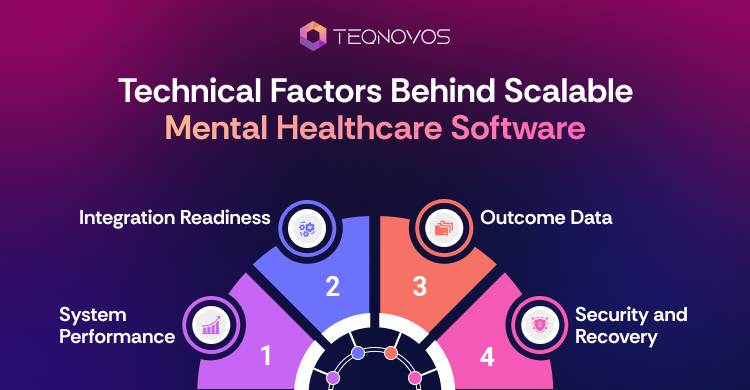
Technical Factors Behind Scalable Mental Healthcare Software
1. System Performance
The platform must remain stable as more clinicians access records and patients complete assessments. A scalable behavioral health software solution needs to support daily care activities without slowing down during high demand.
- Check platform response time during busy appointment hours
- Ask how the system handles concurrent user activity
- Confirm support for multiple locations and care programs
- Review how the vendor manages increasing patient data volumes
2. Integration Readiness
Mental healthcare platforms often connect with EHR systems and telehealth tools. The system needs secure APIs that allow data to move without repeated manual exports.
- Ask which systems the platform can integrate with
- Confirm support for FHIR based healthcare data exchange
- Review how duplicate patient records are handled
- Check how failed data transfers are identified and resolved
3. Outcome Data
Outcome tracking needs structured data that teams can review over time. Assessment scores must connect with the patient record and treatment stage. This supports more reliable behavioral health software solutions as services expand.
- Check support for repeated patient assessments
- Confirm automated reminders for incomplete forms
- Review alerts for overdue assessments or score changes
- Ask how progress data appears in clinical and leadership reports
4. Security and Recovery
Mental healthcare organizations need strong access controls and reliable recovery processes. A credible HIPAA compliance solution must protect sensitive records while keeping systems available during unexpected disruptions.
- Review role based access controls for each user group
- Confirm encryption for stored and transmitted patient data
- Ask for the audit log and permission tracking details
- Request backup and disaster recovery documentation
How to Assess Clinical Workflow Fit Before Choosing a Platform
A platform can look efficient during a product demonstration, yet still create friction during daily care. Healthcare leaders need to assess how the system supports each stage of the patient journey. This includes clinical documentation, scheduling, follow ups, and team oversight.
1. Intake Flow
The intake process sets the tone for patients and staff. The platform needs to collect the right details without asking patients to repeat information later in the care journey.
- Custom forms for different care programs
- Digital consent and signature capture
- Insurance and eligibility checks
- Intake data that flows into the patient record
2. Assessment Flow
Assessment workflows need to fit naturally into care delivery. Clinicians need to know which assessments are due and when a patient has completed them.
- Assigned assessments based on care needs
- Automated reminders for pending forms
- Alerts for overdue assessments
- Results linked with the patient record
3. Documentation Flow
A behavioral health EHR needs to support the documentation styles used by therapists, psychiatrists, case managers, and other care teams. Generic templates can create extra work when they do not match the clinical service.
- Configurable note templates
- Treatment plans linked with progress notes
- Signature and co-signature workflows
- Easy access to past clinical records
4. Scheduling Flow
Mental healthcare teams often manage recurring therapy sessions, short medication reviews, group programs, and urgent follow ups. The scheduling process needs to reflect these different appointment patterns.
- Flexible appointment types
- Group session scheduling
- Waitlist and cancellation management
- Automated appointment reminders
5. Care Coordination
Workflow fit also depends on how easily teams can manage referrals and follow ups. Care coordinators need clear visibility without searching through several records.
- Referral status tracking
- Follow up task assignment
- Secure communication between care teams
- Clear handoff records for each patient
6. Caseload View
Supervisors and program leaders need a practical view of clinical workload. A strong system helps them identify uneven caseloads, missed follow ups, and patients who may need more timely support.
- Clinician workload visibility
- Open task tracking
- Missed appointment alerts
- Care activity views by program
A reliable behavioral health EHR software solution reduces duplicate work across these workflows. It also gives clinicians a clearer path through daily tasks. Competitor content often lists these features separately. The stronger buying question is whether the platform connects them without forcing staff to move between disconnected tools.
Read our blog to create a mental health support app using a no-code app builder to build your app today!
How to Evaluate Outcome Tracking in Mental Healthcare Software
Outcome tracking only matters when it helps clinicians make a timely care decision. A platform that simply stores completed questionnaires can create more data without showing what needs attention. During a vendor review, healthcare leaders need to check how the system captures results and supports follow up.
1. Relevant Measures
The platform needs to support measures that match the care model. A therapy program may focus on symptom severity or daily functioning. On the other hand, the psychiatry service may also need measures tied to medication response. The real question is not how many forms the system includes. The real question is whether each program can use the right measure at the right stage of care.
2. Timely Collection
Assessment requests need to appear at meaningful points in the patient journey. This may include intake, planned reviews, or discharge. The system also needs to send reminders when a form remains incomplete. A late assessment should be visible before it affects a clinical review.
3. Clinical Context
Scores need to appear within the patient record where clinicians can review them during care. Earlier results should remain visible beside treatment goals and recent notes. A clinician should not need to move through several screens to understand a change in progress.
4. Data Accuracy
Outcome reports are only useful when the underlying records are complete. Each assessment needs a clear completion date. It also needs to identify the patient, assigned clinician, and care program. The system needs to flag incomplete submissions and overdue measures before they affect reporting.
5. Program Insights
Leadership teams need to review patterns across care programs without relying on manual spreadsheets. The platform needs filters for location, service line, and selected time periods. Clear reporting makes behavioral health outcomes easier to assess. It also helps leaders identify where care delivery needs closer attention.
Find the Right Mental Healthcare Solution. Talk to Our Experts!
Schedule a CallKey Platform Features to Review Before Selection
A strong platform supports the full care journey and keeps each workflow connected. That is how behavioral health software becomes easier to evaluate during demos and vendor discussions.
| Capability | What to check |
| Patient intake | Check for custom forms, consent capture, and eligibility checks that move into the patient record without repeat entry. |
| Clinical documentation | Review note templates, configurable workflows, and audit history that support therapy, psychiatry, and care coordination. |
| Telehealth support | Confirm that virtual visits connect with scheduling, session notes, follow-up tasks, and billing inside one workflow. |
| Patient engagement | Review reminders, secure messaging, and digital assessments that support better follow through between visits. |
| Reporting | Check outcome trends, service quality views, and operational reports that help leaders review care delivery. |
| Administration | Confirm user roles and permissions and program setup controls that support secure access across teams. |
| Billing support | Review claims workflows, payment visibility, and reporting that reduce missed steps between care and reimbursement. |
| Analytics | Check care quality trends, caseload patterns, and engagement data that support stronger planning. |
A capable system should keep these functions connected instead of treating them as separate tools. This matters because behavioral health EHR software often looks similar at the surface level. The real difference appears when intake flows into documentation and telehealth flows.
How Data Integration Supports Scalable Mental Healthcare Delivery
A mental healthcare platform can look complete and still create problems after launch. The issue often appears when teams move information across intake systems, clinical records, and billing platforms. When those systems do not connect well, the care team loses time and context. The problem grows as patient volume rises and more programs start using the same data.
1. Care Continuity
Mental healthcare depends on timely follow through. A referral may enter one system while assessments sit in another, and visit history stays elsewhere. If that information does not move smoothly, the next clinician may start without the full picture.
- Referral details need to move into the care workflow without delay
- Assessment history needs to stay visible at the point of care
- Visit records need to support the next clinical decision
- Care teams need one connected view of the patient journey
2. Record Alignment
Scalable delivery also depends on a clean record flow. Patient details should not require repeat entry each time a person moves between programs or providers. A strong behavioral health EHR setup keeps core information aligned across systems so teams can work with the same context.
- Patient records need one clear source of truth
- Duplicate entries need to stay low across systems
- Provider handoffs need consistent patient information
- Program changes need to update the full care record
3. Outcome Access
Outcome tracking loses value when scores stay isolated inside one module. Clinicians need to see progress in the same place where they review visits and treatment goals. Leaders also need a broader view across services.
- Assessment results need to stay connected with the patient record
- Progress trends need to appear beside the care history
- Outcome data needs to support both clinicians and leadership teams
- Score visibility needs to improve action during care
4. Reporting Quality
Growth creates more reporting pressure. Leadership teams need to understand attendance patterns and service demand without pulling data by hand from separate tools. Connected systems improve reporting quality because the data comes from a more complete care workflow.
- Reporting needs to reflect the full care journey
- Program reviews need cleaner data inputs
- Manual spreadsheet work needs to stay limited
- Leadership teams need more reliable trend visibility
5. Future Expansion
A platform may fit today and still create limits later. New locations, new care models, and added tools can all strain a weak integration design. That is why integration needs attention during software selection and not after launch. Healthcare interoperability challenges often become more expensive once teams try to scale disconnected systems.
- New services need flexible integration support
- Added tools should not break existing workflows
- Expansion should not increase record fragmentation
- Integration planning needs to support long term growth
How to Review Privacy and Compliance in Mental Healthcare Software
Choosing a scalable platform also means checking how it protects sensitive mental healthcare data. Privacy and compliance need review at both the product level and the vendor level. The goal is to confirm that the system protects records during daily use and supports safer growth over time.
1. Verify Access Controls
- Role Based Access: Ensure clinicians, coordinators, supervisors, and admin teams only see the data needed for their role. A strong HIPAA compliance solution should not give broad record access to every user.
- Secure Authentication: Check for strong login controls such as multi factor authentication for staff access and secure session management across devices.
- Sensitive Record Restrictions: Review how the platform limits access to highly sensitive patient details and protects confidential notes from unnecessary exposure.
- Audit Visibility: Confirm that record access permission changes and user activity are logged for review.
2. Assess Technical Safeguards
- Data Encryption: Ensure patient data stays protected during storage and transmission so records are not exposed during routine system use.
- Audit Logs: Verify that record views, edits, exports, and deletions are captured in a clear activity trail.
- Consent Controls: Review how the platform manages patient consent and data sharing permissions across programs and care teams.
- Data Retention: Confirm how records are stored, archived, and deleted based on policy and legal requirements.
3. Review Vendor Governance
- Risk Assessment: Ask how the vendor identifies security risks and how often those reviews take place.
- Incident Response: Check if the vendor has a clear process for security events, breach response, and customer communication.
- Update Management: Review how security patches and platform updates are tested and applied.
- Compliance Readiness: Confirm that the vendor can clearly explain its healthcare security practices and support required compliance documentation.
Read our blog on data privacy and security in healthcare app development to get a broader view of technical safeguards.
How Reporting Supports Better Mental Healthcare Decisions
Reporting should do more than fill a dashboard with charts. It should help mental healthcare teams see where care is progressing and where pressure is building. A strong Behavioral health software platform turns routine activity into a clearer view of patient progress and team capacity.
Clinical View: Clinicians need reporting that supports care and not just documentation. When reporting stays close to the care journey, it becomes easier to identify who may need added attention before the next visit.
Operational View: Supervisors and program managers need to understand how care moves across the organization. They can show which programs struggle with follow through and which teams carry uneven workloads.
Leadership View: Teams need reporting that supports planning and not just observation. They need to see how programs perform over time and where demand is increasing and where gaps in care delivery are starting to appear.
Better Questions: The real test is not how many reports a vendor can show in a demo. The real test is whether those reports help each team act with more confidence. Good reporting gives clinicians a better context. It also gives leaders a stronger basis for growth decisions.
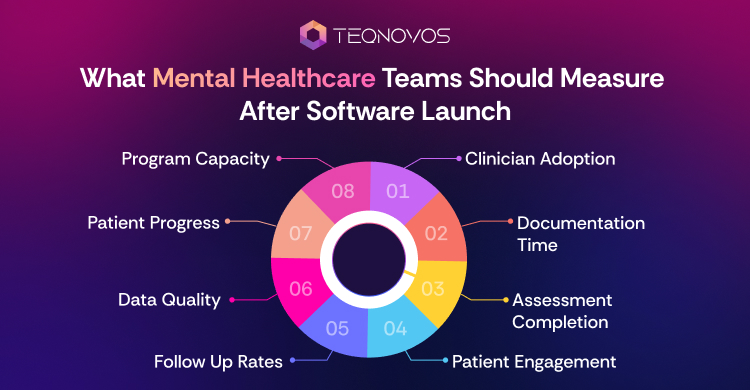
What Mental Healthcare Teams Should Measure After Software Launch
Going live is only the start. The real value shows up in daily use. A new system should make work easier for care teams and make progress easier to review for leadership.
1. Clinician Adoption
Clinicians should start using the system as part of routine care without falling back on side notes or separate trackers. Strong adoption usually shows that the workflow makes sense in real practice.
2. Documentation Time
Documentation should feel faster and more manageable after the first learning phase. When note entry still feels heavy, the system may not fit the care process well.
3. Assessment Completion
A better platform should help teams collect assessments at the right time. It should also make it easier to see what is still pending before the next review point.
4. Patient Engagement
Teams should gain a clearer view of how patients respond between visits. Better engagement often shows up through form completion, visit follow-through, and steady contact across the care journey.
5. Follow Up Rates
A stronger system should make follow up work easier to manage. Care teams need a simple way to spot missed actions before patients lose momentum.
6. Data Quality
Reports only help when the underlying data stays complete and reliable. Missing entries, delayed updates, and weak tracking can reduce the value of every decision that follows.
7. Patient Progress
The platform should make Behavioral health outcomes easier to review over time. Progress data should support care decisions and not sit unused inside completed records.
8. Program Capacity
Leaders also need to see how demand affects teams and services after launch. A useful system helps them spot pressure early so they can adjust before care quality starts to slip.
Common Buying Mistakes to Avoid in Mental Healthcare Software
A poor software decision rarely fails in the demo. It usually fails after rollout when clinicians face friction, data starts to split across tools, or leaders realize the system cannot support growth. These mistakes are easier to spot before the contract is signed.
1. Price Focused
Price matters, but it should not drive the full decision. A low cost system can create more expense later when teams need workarounds, extra tools, or major changes after launch.
- A cheaper system may still create higher operating costs later
- A low price does not guarantee workflow fit for mental healthcare teams
- Contract terms and support quality matter as much as license cost
- Short term savings can lead to long term platform limits
2. Workflow Gaps
A platform may look strong on paper and still fail in daily care. Mental healthcare teams need workflows that match intake, documentation, follow up, and review points across the patient journey.
- Clinician workflow needs should shape the vendor review
- User testing should happen before a final decision is made
- Outcome tracking should support real care activity and not sit as a side feature
- Staff will create workarounds when the system does not fit routine care
3. Data Risks
Data problems often start before launch. Integration planning and migration planning need attention early because weak data flow can disrupt care continuity and reporting quality.
- Integration planning should start during vendor selection and not after it
- Data migration needs mapping and validation before records move
- Reporting flexibility matters when programs need different performance views
- Poor data flow can weaken both clinical review and leadership reporting
4. Growth Limits
A platform may support today’s needs and still fail under growth. New programs, more providers, and added locations can expose limits that were not obvious during the buying stage.
- The system should support growth across programs and locations
- Buyers should check how the platform handles future service expansion
- Reporting and access controls need to stay useful as teams grow
- Long term fit matters more than a strong first impression
Conclusion
Mental healthcare organizations need more than a system that works for today. They need a platform that can support changing care models and new reporting needs without slowing teams down. The right behavioral health software setup should protect sensitive data and keep integrations ready as services expand.
Teqnovos works with healthcare organizations that need custom platforms built around real care delivery. Book your free consultation call with us and get started.