















Legacy Application Modernization Strategy: Choosing the Right Approach
The right approach for legacy modernization does not start with a cloud platform or a new codebase. It starts with a clear view of the application. A business must understand its value. It must also assess its risks, dependencies, data, cost, and future needs.
One system may only need a platform upgrade. Another may need deeper code changes. Some applications should remain in place. Others should be retired or replaced. A strong decision connects business goals with technical evidence.
This guide explains how leaders can assess each application. It compares the available modernization paths. It also explains how to reduce disruption and protect essential business logic. The goal is not to adopt the newest technology. The goal is to select a path that creates lasting value without adding avoidable risk.
What Defines the Right Modernization Approach?
The right approach for legacy modernization creates measurable business value without exposing the organization to unnecessary risk. It must reflect the current condition of the application. It must also match its expected role within the business.
Leaders should first define the problem that modernization must solve. The system may restrict product growth. It may create high maintenance demands. It may also fail to meet security or compliance needs. Each problem can require a different response.
A suitable legacy modernization strategy considers business importance. It reviews technical health, checks system dependencies, and data sensitivity. It also accounts for available skills, delivery time, budget limits, and future plans.
Age alone should not determine the decision. A stable application may remain valuable with focused improvements. A fragile system may require bigger architectural change. The final choice should balance immediate needs with long-term value. Businesses can also review why legacy modernization matters before comparing the available paths.
Migration, Modernization, and Replacement Are Not the Same
Approach |
What It Means |
Best Fit |
Main Limitation |
| Migration | Moves an application and its data to new infrastructure | Systems with outdated hosting or infrastructure limits | Core code and architecture issues may remain |
| Modernization | Improves the code architecture, platform data flow, or integrations | Valuable systems that restrict performance growth or delivery | Requires deeper assessment, testing, and planning |
| Replacement | Removes the existing system and adopts another product | Standard business processes with low custom value | Existing workflows may need to change |
A business can combine these paths. It may migrate stable components, modernize valuable functions, or replace tools that no longer justify further investment.
A strong legacy application modernization strategy identifies the real problem first. Infrastructure limits may justify migration. Structural limits may require modernization. Low business value may favor replacement. Treating these options as the same decision can increase cost and project risk.
Assess the Existing Application Before Selecting a Path
A business should complete an application modernization assessment before choosing a technical path. The assessment shows how the application works today. It also reveals the risks that may affect modernization.
Review Business Criticality
The team should identify the processes that depend on the application. It should also review the users and departments that rely on it. A critical system will need stronger continuity controls.
Examine Technical Health
The team should inspect the codebase and architecture. It should review performance issues and maintenance needs. Unsupported frameworks may increase project risk.
Map System Dependencies
The team should document every connected database and internal tool. It should also record third-party services and external applications. Hidden dependencies can cause failures during migration.
Check Data Condition
The review should cover data quality and ownership. It should also assess formats and retention rules. Poor data can delay testing and system transfer.
Assess Security and Compliance
The team should identify access risks and outdated controls. It should also review privacy rules and audit needs. These factors can change the project scope.
Evaluate Team Readiness
The business should review available skills and system knowledge. It should also check the quality of existing documentation. Skill gaps can increase delivery time and cost.
Define Future Requirements
The team should identify expected growth and new functions. It should also review future integration and reporting needs. The modernized application must support long-term plans.
Review Financial Fit
The business should compare current operating costs with expected project value. It should avoid investing heavily in an application with limited future use.
The findings will shape the legacy modernization strategy. A stable application may need focused platform changes. A fragile but valuable system may need refactoring or rebuilding. A low-value application may need retirement or replacement.
Modernize Your Legacy Applications With the Right Strategy. Explore Modernization Services!
Schedule a CallUse Evidence to Select the Best Modernization Path
An assessment gathers evidence. A modernization decision framework turns that evidence into a defensible choice. It prevents personal preferences from driving the project.
Set the Decision Criteria
The team should define the factors that will shape the final choice. Each factor should have a clear meaning. The criteria should reflect the expected business outcome and the acceptable level of change.
Assign a Score
The team can score each modernization option on a scale of one to five. A low score can show poor alignment. A high score can show strong alignment.
The scoring process should compare:
- Business value
- Implementation effort
- Operational impact
- Delivery speed
- Expected system life
- Financial return
- Change complexity
- Long-term flexibility
Give Critical Factors More Weight
Not every factor carries equal importance. A regulated system may place more weight on compliance. A customer platform may place more weight on availability and user impact. A short-term application may place more weight on cost and delivery speed.
Compare the Available Options
The team should score retain. retire. rehost. replatform. refactor. rebuild. and replace. The result will reveal which options deserve deeper analysis.
Record the Final Reasoning
The final decision should include the selected option. It should also record rejected options and their limitations. This record will improve stakeholder alignment. It will also make future reviews easier.
The right approach for legacy modernization should come from evidence and agreed priorities. A scoring framework will guide the discussion. Expert judgment should confirm the final choice.
Compare Modernization Paths Before Making a Commitment
Businesses can use several legacy modernization approaches. Each option changes a different part of the application. The chosen path should match the required level of change.
| Approach | What It Involves | Best Use Case | Main Tradeoff |
| Retain | Keeps the application in its current state | The system remains stable and meets current needs | Existing limitations remain |
| Retire | Keeps the application in its current state | The system remains stable and meets current needs | Existing limitations remain |
| Encapsulate | Adds a modern access layer around the existing system | Core functions still work, but integration remains difficult | The old architecture stays in place |
| Rehost | Moves the application to new infrastructure with minimal code changes | The business needs a faster infrastructure move | Technical debt remains |
| Replatform | Moves the application and improves selected platform components | The system needs better hosting or managed services | Core architecture changes remain limited |
| Refactor | Restructures parts of the existing code | The application has business value and a usable foundation | Testing needs increase |
| Rearchitect | Redesigns the application structure | The current architecture blocks scale or integration | Delivery effort and complexity increase |
| Rebuild | Creates a new application around required business functions | The existing foundation cannot meet future needs | The project demands more time and resources |
| Replace | Moves users to an existing software product | The application performs a standard business function | Custom workflows may need adjustment |
The option names can vary across industry frameworks. Microsoft uses six core modernization paths. Amazon Web Services (AWS) uses seven migration strategies. Both frameworks show that one path will not suit every application.
A company may also combine several options. It can retain stable components, refactor valuable services, and retire duplicate tools. This selective model can reduce unnecessary change across a large application portfolio.
Prioritize Which Applications to Modernize First
A business should not modernize every application at the same time. Portfolio sequencing should form part of the legacy application modernization strategy. It allows the team to balance business value with delivery risk.
Start With a Controlled First Project
The first project should offer visible value without creating extreme operational risk. A smaller application can test the delivery process. It can also expose gaps in governance and technical skills. The team can apply these lessons before it handles critical systems.
Focus on Business Blockers
Applications that delay product launches or restrict customer service may need early attention. Systems with rising support demands may also deserve priority. The team should confirm that modernization will remove the actual constraint.
Keep Connected Systems Together
Some applications share data or infrastructure. Moving one system without its connected services may create extra work. The team should place closely linked applications within the same delivery wave when practical.
Respect Business Timing
Modernization should avoid peak sales periods and financial closing dates. It should also account for planned product releases. This timing can protect daily operations.
A phased legacy system modernization program should group applications into manageable waves. A strong legacy modernization roadmap should begin with a controlled project. Later waves can address systems with greater complexity or wider business impact.
Decide How the Modernized System Should Work
A team should define the target architecture before it changes the existing application. The target architecture describes how the modernized system should operate. It also guides technical choices throughout the project.
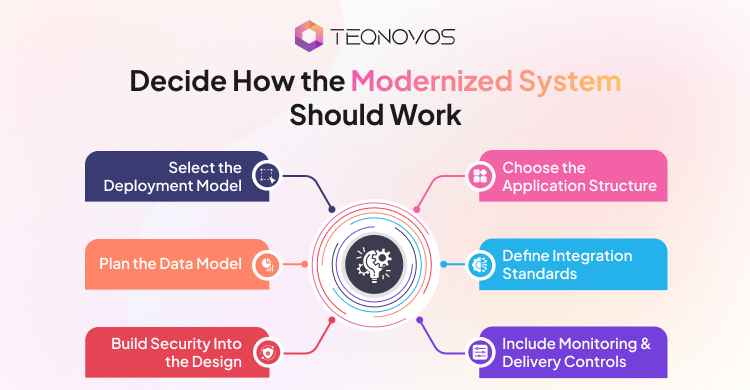
1. Select the Deployment Model
The business should decide where the application will run. It may use cloud infrastructure. It may also use a hybrid model when some systems must remain on private infrastructure.
2. Choose the Application Structure
The team should decide if the system needs a modular design. It should not adopt microservices only because they are popular. A simpler architecture may suit an application with limited scale or change needs.
3. Plan the Data Model
The future data structure should reflect current business needs. The team should define data ownership, access rules, storage needs, and retention controls.
4. Define Integration Standards
An Application Programming Interface or API allows different systems to exchange information. The team should define how the modernized application will connect with internal tools and external services.
5. Build Security Into the Design
The target architecture should include identity controls, data protection, audit records, and permission rules. Security should shape the design before development begins.
6. Include Monitoring and Delivery Controls
The team should plan system monitoring, error tracking, automated testing, and deployment processes. These controls will make the new application easier to operate.
A clear target state keeps the legacy application modernization strategy focused on future needs. It also prevents legacy system modernization from becoming a series of disconnected technical changes.
A related Web4Realty legacy modernization case study can show how refactoring and cloud planning fit within a wider modernization project.
Protect the Business Logic That Keeps the System Running
Legacy applications often contain critical rules that do not appear in formal documents. These rules may exist inside code, database procedures, integrations, or manual workflows. A legacy system modernization project must preserve this knowledge before the underlying technology changes.
1. Document Critical Business Rules
The team should record how the application calculates values. It should also document approval rules, exceptions, and system responses. Long-term users can explain workflows that the code alone may not reveal.
2. Trace Every Data Flow
The team should track how data enters the system. It should then record where the data moves and how each process changes it. This work can expose hidden transformations and ownership issues.
3. Record System Dependencies
The team should document every service that relies on the application. It should also record the order in which connected processes run. A missing dependency can interrupt a complete workflow.
4. Create a Behavior Baseline
Regression testing means checking that existing functions still work after a change. The team should create tests for critical processes before it modifies the code. These tests will establish expected behavior.
5. Compare Old and New Results
The modernized application should produce the same result for the same valid input unless the business approves a change. The team should compare calculations, reports, records, and integration outputs.
6. Transfer System Knowledge
The team should store technical findings in a shared knowledge base. It should also review the findings with business users and application owners. This step reduces dependence on a few long-term employees.
An application modernization assessment identifies which workflows need the strongest protection. Clear documentation and repeatable tests then keep valuable business behavior intact throughout the transformation.
How to Modernize Legacy Systems Without Disruption
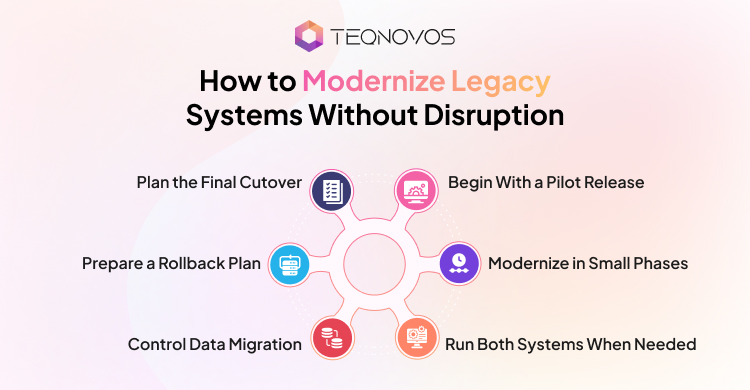
Business continuity should remain a core part of every modernization plan. A team must protect daily operations while it changes systems and data. The best way to understand how to modernize legacy systems without disruption is to divide the work into controlled stages.
1. Begin With a Pilot Release
The team should test the new approach on a limited process or user group. A pilot can reveal technical issues before they affect the wider business. It can also confirm that users can complete essential tasks.
2. Modernize in Small Phases
The team should release one function or service at a time. Smaller releases make testing easier. They also reduce the impact of unexpected problems.
3. Run Both Systems When Needed
Critical applications may require parallel operation. The old system can remain active while the team validates the modernized version. The business can switch users only after the new system meets agreed standards.
4. Control Data Migration
The team should move data in planned batches. It should validate each batch before the next transfer begins. Reconciliation checks can confirm that records remain complete and accurate.
5. Prepare a Rollback Plan
Every release should include a clear recovery path. The team should define when a rollback will begin. It should also assign responsibility for each recovery action.
6. Plan the Final Cutover
The business should choose a low-risk period for the final transition. It should notify users before the change. It should also arrange immediate support after launch.
Teams can hire DevOps engineers to improve release control through automated testing and deployment workflows. Careful sequencing can protect operations without slowing the wider legacy modernization roadmap.
Unlock Better Performance With Legacy Modernization. Talk to Modernization Experts!
Schedule a CallWhat Affects Legacy Modernization Cost?
No fixed price applies to every modernization project. The final investment depends on the system condition and the required level of change. Understanding the main legacy modernization cost factors can prevent weak budgets and unexpected scope increases.
Application Size and Complexity
Large applications contain more functions and user roles. They also require more development and validation work. Complex workflows can increase the time needed to understand the existing system.
Selected Modernization Path
Rehosting usually requires fewer code changes. Refactoring and rearchitecting demand deeper engineering work. Rebuilding can require new design and development across the full application.
Technology Condition
Outdated programming languages may require specialist skills. Unsupported frameworks can also limit available tools. Poor documentation can increase the effort needed to understand the codebase.
Data and Integration Work
Large data volumes can increase preparation and validation needs. Complex connections with payment tools and internal systems can also expand the project scope. Each integration must work correctly after the transition.
Testing Requirements
Critical applications need wider test coverage. Regulated systems may also require detailed records and approval steps. Parallel system operation can add temporary infrastructure and support costs.
Team Structure
The delivery model can affect the budget. Internal teams may need external specialists for architecture or cloud engineering. Businesses can hire dedicated developers when the internal team lacks the required capacity. Training may also become necessary when the modernized system introduces new technologies.
Ongoing Operating Costs
The project budget should include more than development. It should account for cloud usage and monitoring. It should also include maintenance and technical support.
A complete legacy modernization strategy should compare project cost with Total Cost of Ownership (TCO). TCO represents the full cost of owning and operating the system. The business should also estimate Return on Investment (ROI). ROI shows if the expected value justifies the investment.
Reviewing these legacy modernization cost factors early can improve financial planning. It can also prevent the business from choosing an approach that costs more than the remaining value of the application.
Final Thoughts
The right approach for legacy modernization depends on evidence. It should reflect business value, system condition, project risk, and future needs. No single path fits every application.
A clear strategy reduces guesswork. It also protects operations during change. The business should assess each system carefully, then select a suitable path, and move through controlled stages.
Legacy modernization works best when leaders focus on long-term value rather than quick technical fixes.