


























A Practical DPDP Checklist for Healthcare Software Companies in India
Healthcare software can collect patient identity details and consultation records. It may also process diagnostic results and device readings. Each data flow creates a specific responsibility under the Digital Personal Data Protection Act 2023 (DPDP Act).
This DPDP compliance checklist for healthcare software gives development companies a product level method to review those responsibilities. It connects each legal requirement to a screen event, service, or database action.
The guide is written for product leaders and developers. It also applies to quality assurance teams and privacy owners. It covers new products and existing healthcare platforms that process digital personal data in India. The focus stays on system behavior that developers can build, and testers can verify. It turns approved legal interpretations into engineering scope and does not replace legal advice.
How to Use This Checklist as a Release Gate
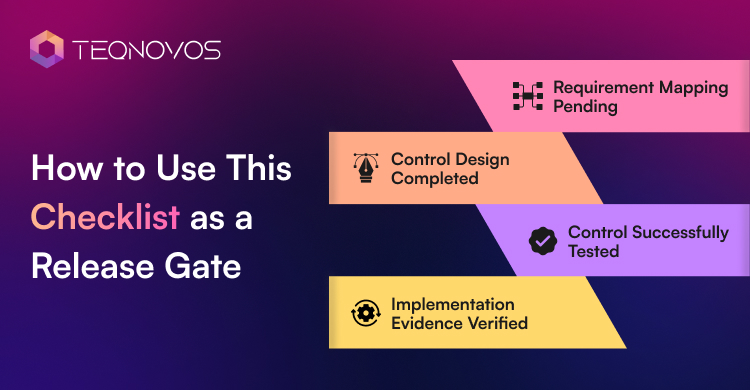
Teams can use each checklist item as a release gate. A control moves through four review stages.
Not Mapped
The team has not linked the requirement to a data flow or system behavior. The item remains open.
Designed
The team has defined the expected response and named the responsible component. Design approval does not prove implementation.
Tested
Quality assurance has run positive and negative tests against the expected response. The review also covers failed integrations and blocked actions.
Evidenced
The team can produce a record that proves the control worked in the approved environment. The record may include a consent event or access log. It may also include a configuration snapshot or signed test result. Each artifact needs the product version and test date.
Technical acceptance occurs only after the evidence stage. A policy file or completed development ticket cannot prove runtime behavior. This model gives legal and engineering teams one shared view of readiness. It also keeps unresolved dependencies visible before release.
Turn DPDP Requirements Into Testable Product Controls. Start Your DPDP Review!
Schedule a CallCurrent DPDP Status for Healthcare Product Teams
As of September 2026, the Digital Personal Data Protection Rules 2025 provide for phased commencement. Based on the Gazette date of 13 November 2025, Rule 4 is scheduled for 13 November 2026, while Rules 3, 5–16 and 22–23 are scheduled for 13 May 2027.
Since the law is entering force in stages, DPDP compliance for healthcare software needs to follow the applicable commencement dates rather than treating every provision as active at once.
Product teams should therefore distinguish between requirements currently in force and those with a future commencement date by maintaining a dated obligation register
The DPDP Act 2023 does not create a separate statutory category called sensitive health data. It defines personal data as data about an identifiable individual. Data sensitivity still matters when the government assesses Significant Data Fiduciary status. A diagnosis or device reading can still qualify as personal data when it relates to an identifiable person.
Healthcare teams need to use the Indian definition in product specifications. They must not import a category from another privacy law unless that law also applies.
Essential DPDP Compliance Checklist for Healthcare Software
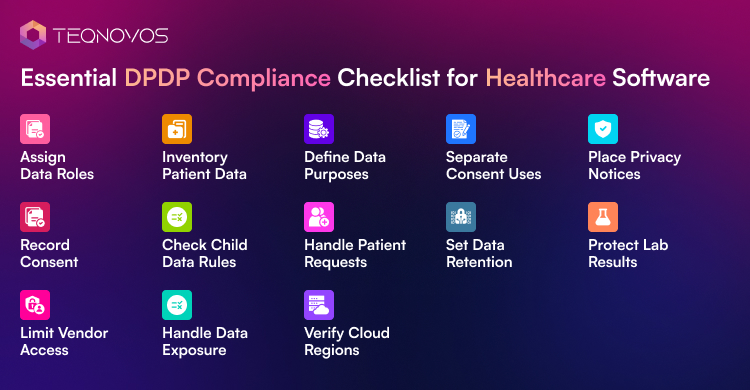
The checks below separate legal accountability from technical data location and processing purpose. Each issue needs its own record. Combining them in one privacy worksheet can hide gaps until product testing or a patient request.
1. Assign Every Processing Role
For each healthcare workflow, identify who determines why patient data is processed and who processes it on that party’s instructions. For example, a hospital may determine the purpose of processing consultation records, while a software provider processes those records under the hospital’s instructions.
A Data Fiduciary determines the purpose and means of processing personal data. A Data Processor handles personal data on behalf of that fiduciary.
The classification must reflect actual control. A vendor may become a Data Fiduciary for a separate activity if it independently reuses production data for its own product analytics. A contract label cannot change that decision structure. Clear classification prevents DPDP Act compliance for healthcare companies from resting on broad labels such as platform provider or technology partner.
The role matrix should name the instruction owner and system operator for each activity. It should also record the approval authority and every subprocessor. A healthcare software development company needs this record before assigning engineering ownership.
2. Inventory Patient Data by Product Function
A useful inventory follows product events instead of relying on database table names. Teams can start with patient registration and consultation uploads. They also need to trace connected healthcare device events and report downloads. Each event exposes a different route through the product.
Every entry needs a source and receiving component. It also needs the persistence layer and export route. The review must include data that never reaches the primary database. Common examples include mobile storage and message queues. Other copies may sit in observability traces and temporary files.
The completed inventory should show where each copy exists and which component creates it. This view exposes data held in caches and background services without mixing the inventory with purpose or retention decisions.
3. Map Every Data Element to a Specified Purpose
A specified purpose is the exact outcome stated in the notice given to the patient. Each collected field needs a direct connection to that outcome. Broad descriptions such as service improvement or healthcare operations do not give developers an enforceable processing rule.
A purpose register can connect appointment details to scheduling logic. It can connect a device reading to a defined monitoring alert. The official Digital Personal Data Protection Act example rejects contact list access for a telemedicine service because those contacts are not necessary to deliver the requested service.
The DPDP requirements for healthcare become testable when each entry names the approved system action and permitted output. A field without a necessary product function becomes a removal task. This keeps the product specification tied to actual behavior instead of abstract privacy wording.
4. Separate Consent From Certain Legitimate Uses
DPDP compliance for healthcare software requires teams to separate consent based activities from the limited uses permitted under Section 7 of the Act. Healthcare teams need to test each activity against the exact statutory condition. The fact that data is processed for a medical purpose does not automatically exempt the processing from DPDP requirements.
The Act permits limited handling during a medical emergency that threatens life or health. Routine consultations and scheduled treatment do not automatically meet that threshold. Another statutory example covers a pharmacy using a voluntarily supplied mobile number to send a payment receipt.
The basis matrix needs to name the activity and relevant clause. It also needs the qualifying facts and decision owner. Legal review becomes necessary when the facts do not fit the wording of the selected clause.
5. Place Notices at the Decision Point
A notice needs to appear before or alongside a request for personal data. A footer link alone does not give a patient enough context at the decision point.
The notice needs to stand on its own. Rule 3 of the Digital Personal Data Protection Rules 2025 calls for an itemized description of the personal data involved and the service or use enabled by its processing. It also requires a direct route for consent withdrawal and rights requests.
A symptom intake screen can name the requested fields and explain why each one is needed for triage. A concise first layer may link directly to the complete notice. The interface must not force patients to search account settings to find it. Language access also needs to follow the options specified under the Act.
6. Capture Consent as a Versioned Transaction
Consent needs to be captured as a versioned transaction instead of a single true or false value. The consent receipt needs the notice version and displayed language. It also needs the selected categories and timestamp. The channel and affirmative action complete the evidence.
Preselected boxes and silence cannot demonstrate a clear affirmative action. Bundling optional analytics with patient account creation also prevents a specific choice.
A withdrawal request needs to change the consent status and issue a stop instruction to affected processors. This instruction does not apply where Indian law requires or authorizes continued handling. The withdrawal route needs to be as easy as the original choice. If agreement takes two taps while withdrawal requires a support ticket, then the journey fails the comparability test.
7. Check the Child Health Exception
The Act treats anyone under 18 as a child. The general rule calls for verifiable parental consent before a child’s personal data is processed. Tracking and targeted advertising directed at children are also restricted.
The Digital Personal Data Protection Rules 2025 create a narrow exception for clinical establishments and healthcare professionals. It applies only when the information is needed to protect the child’s health. Allied healthcare professionals receive a similar exception when following a treatment or referral plan.
A wellness app or software vendor cannot claim this exception merely because its product relates to health. The operator type and exact use need to meet the stated conditions. Other cases still need a reliable way to confirm that the parent is an identifiable adult.
8. Create One Route for Patient Requests
In a hospital portal, DPDP Act compliance for healthcare companies requires a verified patient route for access, correction, updating, erasure, and complaints. Deletion and complaint review require clear routes as well.
An access reply needs to summarize the personal data being used. It also needs to identify outside Data Fiduciaries and Data Processors that received it when the Act requires disclosure. Correction requests need to update the main clinical source before dependent views are refreshed.
Each request needs an owner and due date. The response must state the result and available complaint route. Closing a support ticket without a clear outcome does not complete the request.
9. Set Deletion Dates by Data Category
Healthcare software cannot use one deletion date for every category. A clinical document may need longer retention under another Indian law. A marketing profile or unused intake draft may not need the same period.
The retention schedule needs to name the category and legal authority. It also needs a start event and end date. Labels such as keep for legal reasons are not enough unless they identify the applicable law.
When withdrawal or expiry makes deletion due, the removal job needs to reach every location already listed in the inventory. A legal hold can pause that job only for the affected category. The software must also prevent an expired copy from returning during recovery.
10. Protect Lab Result Access
DPDP compliance for healthcare software becomes measurable when a lab result enters the patient portal only after the application confirms the user and permitted care role. The result page needs encryption during transfer and storage. Download links need short expiry times, and a removed clinician account must lose access immediately.
The audit log needs to capture every view and download. It also needs to capture changes and failed access attempts. Shared administrator accounts make these events hard to trace. Each employee and vendor needs an individual login.
Teams responsible for healthcare app data privacy and security can test this workflow by confirming that an expired link cannot open the report and a disabled account cannot regain access.
11. Limit Diagnostic Vendor Access
A hospital may connect its platform to an outside diagnostic service. Healthcare app interoperability challenges can occur when the two systems use different field structures or access rules. The integration needs to map the required fields accurately and exclude patient details that the test does not need.
A valid processing contract needs to define permitted instructions and security duties. It also needs to set conditions for subcontractors and incident alerts while explaining how patient information and access will be removed at the end of the engagement. An email approval cannot replace this agreement.
These contract limits then need to appear in the integration itself. The application programming interface key must work only with approved endpoints, while test environments use synthetic patient details. Production exports require separate approval. The hospital also needs a way to disable the vendor connection without interrupting the patient portal.
12. Respond to an Exposed Teleconsultation Link
If a teleconsultation link becomes public, the response team first disables the link and checks who opened it. The review then identifies affected patients and the exposure window. It also confirms which consultation details were visible.
Under Rule 7 of the Digital Personal Data Protection Rules 2025 affected patients need notice without delay through a registered channel. The first notice to the Board also needs to be sent without delay. Detailed information follows within 72 hours unless the Board permits more time.
Patient messages need to explain what happened and what information was exposed. They also need to include likely effects and safety steps. A contact person must be named, and the team must not wait for the full investigation before sending the first notice.
13. Verify Cloud Regions Before Failover
When a Mumbai hosted platform switches to an overseas backup region, DPDP requirements for healthcare need to be checked against the transfer restrictions and safeguards that apply on the failover date.
Before launch, every healthcare SaaS platform needs to confirm its primary and recovery regions. The review must also identify overseas support locations that can view patient information.
Before launch, the cloud setup needs to confirm the primary region and recovery region. It also needs to identify any overseas support location that can view patient information. Section 16 of the Digital Personal Data Protection Act allows the Central Government to restrict transfers to notified countries or territories. Other Indian laws with stricter limits still apply.
The hosting configuration can block unapproved regions and alert the team when a cloud provider changes a service location. Automatic failover cannot go live until every destination has passed legal review. A provider notified as a Significant Data Fiduciary may also face added limits for specified personal data.
Turn Legal Requirements Into Testable Healthcare Software Controls. Plan Your DPDP Review!
Schedule a CallFinal Thoughts
A prescription renewal offers a practical final review. The patient sends a request while the clinician checks only the relevant history. The pharmacy receives the approved order, and any unfinished draft expires at the set time. Each stage can reveal a different weakness without reducing privacy work to a policy review.
The DPDP compliance checklist for healthcare software gives legal and clinical teams one patient journey to examine with developers. Any failed check becomes a defined product change before release.