




























How to Implement DPDP Safeguards for Data Across APIs, Databases, and Cloud
Personal data rarely stays within a single application. An API receives it, and the database stores it. Logs record fragments of data while backups preserve older copies. Cloud services and external processors may receive it again. The DPDP Act places responsibility on the Data Fiduciary even when another provider processes that information.
Written policies cannot control an exposed endpoint, an overprivileged service account, or an unencrypted database export. Effective DPDP security safeguards operate at each point where personal data enters, moves, rests, and leaves the system. This guide explains how teams can protect those paths across APIs, databases, and cloud infrastructure. It also shows what evidence can confirm that each control is working.
What Rule 6 Requires From Data Fiduciaries and Data Processors
Rule 6 turns the duty to prevent personal data breaches into a minimum set of controls. The reasonable security safeguards under DPDP apply to information held directly by a Data Fiduciary and to processing performed on its behalf. This removes a common accountability gap.
A business cannot treat a cloud host or external service provider as the sole owner of security once they receive personal data. DPDP implementation services help teams turn compliance requirements into practical changes across applications and infrastructure. It keeps implementation aligned with real system needs.
- Protective Techniques: Apply encryption, masking, obfuscation, or virtual tokens according to exposure and operational use.
- Access Restrictions: Control which people, services, and computer resources can reach the information.
- Access Visibility: Maintain logs and review processes that can reveal unauthorized activity and guide remediation.
- Processing Continuity: Keep recoverable backups or equivalent measures for restoring access after destruction or compromise.
- Record Retention: Preserve the relevant logs and personal data for one year. Used for investigation and continuity, unless another law requires a different period.
- Processor Contracts: Include security obligations in agreements with each Data Processor that handles personal data.
- Organizational Controls: Assign responsibility for implementation and document corrective action.
These DPDP security safeguards require operational proof. A policy or contract alone cannot confirm that access controls, alerts, backups, or corrective actions work as intended. Under the DPDP Act data protection schedule, Rule 6 takes effect 18 months after the Rules were published. A later government notification could change that date.
Why Complete Data Flow Mapping Must Come Before Applying DPDP Controls
Before applying DPDP controls, organizations need to understand where personal data enters and moves. They need to know where the data is stored and gets duplicated across systems. Complete data flow mapping reveals hidden copies and ownership gaps that could otherwise undermine compliance efforts.
1. Trace Entry Points
A reliable DPDP compliance implementation begins with a record of where personal information enters the system. Teams need to trace requests through API gateways and application services. This creates a usable system map instead of a policy-only inventory.
2. Find Hidden Copies
Effective personal data protection under DPDP also depends on identifying copies created outside primary databases. Caches, message queues, application logs, monitoring tools, replicas, and backups may preserve information after the main record changes or is erased.
3. Record External Processing
Cloud services and external processors can extend the same record across different accounts or providers. Strong data protection requires teams to document each transfer and storage location. They also need to keep track of the retention conditions and deletion mechanism.
4. Close Ownership Gaps
The DPDP Act keeps the Data Fiduciary accountable for processing completed on its behalf. A complete flow map shows who controls each copy and which safeguard applies. It also shows how correction or erasure reaches every connected system.
How to Choose the Right Protection Method for Each Personal Data Use
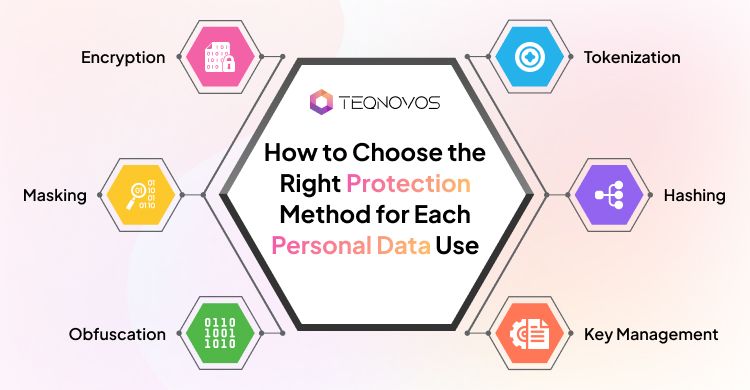
Rule 6 lists several techniques, but they do not solve the same exposure problem. A data protection decision starts by asking if the application recovers the original value or avoids storing it. That answer determines the control.
1. Encryption
Converts data into unreadable ciphertext and restores it with a key. Use it when systems still need the original value.
- Protects personal data during storage.
- Secures information during transmission.
- Allows authorized users or systems to recover the original value.
- Requires strong keys, access controls, and secure key storage.
2. Tokenization
Replaces a sensitive value with a reference. It reduces direct exposure across applications, analytics, and connected services.
- Stores a token instead of the original personal data.
- Keeps the original value in a separate protected system.
- Limits exposure across applications and databases.
- Requires controls to protect the token-to-value mapping.
3. Masking
Hides selected characters or substitutes realistic values. It fits support screens, demonstrations, and non-production environments.
- Displays only limited portions of sensitive information.
- Helps prevent unnecessary disclosure to employees or users.
- Supports testing and demonstrations without exposing real data.
- Should be applied according to the user’s role and business need.
4. Obfuscation
Makes information harder to interpret while preserving limited usability. It is weaker when the transformation can be easily reversed.
- Changes the appearance or format of personal data.
- Can preserve selected patterns needed by an application.
- Reduces casual viewing of sensitive information.
- Should not replace encryption when strong confidentiality is required.
5. Hashing
Produces a one-way digest for comparison or verification. Rule 6 does not name it directly, so teams must use it only where recovery is unnecessary.
- Converts data into a fixed-length value.
- Supports comparisons without storing the original value.
- Is commonly used for verification and integrity checks.
- Requires suitable algorithms and additional safeguards against guessing attacks.
6. Key Management
Encryption fails if keys share the same access path as the data. Teams need separation, restricted permissions, rotation, recovery, and usage logs.
- Stores encryption keys separately from protected data.
- Limits key access to authorized systems and personnel.
- Supports regular key rotation and secure backup.
- Records key use to support monitoring, investigation, and accountability.
How Teams Can Prevent Personal Data Exposure Across API Requests
APIs often expose personal data through apparently valid requests, not obvious infrastructure failures. Strong DPDP security safeguards need controls at the caller, object, property, and response levels. An API gateway can confirm a token and still pass a request that retrieves another customer’s record. Engineering teams must validate identity and permission inside each endpoint.
The DPDP Act impact on software development is especially visible here because developers need to treat authorization and logging as part of application design rather than post-release security checks.
1. Verify Every Caller
Each service account and workload needs a distinct identity. Access tokens require narrow scopes and short lifetimes. It also needs secure storage and rotation. Services reject expired or replayed tokens and tokens with the wrong audience. They cannot trust every credential signed by the expected issuer.
2. Enforce Record Ownership
Object-level authorization must confirm that the caller can act on the specific record named in the request. Property-level checks must also block fields the role cannot read or change. OWASP ranks failures in these areas among its principal API security risks.
3. Limit Data Output
Endpoints need response schemas that return only fields required for the current function. Personal values do not belong in URL paths or reusable error messages. API and application logs need redaction rules before events reach monitoring platforms.
4. Track Every Integration
Effective DPDP data security requires an inventory of active endpoints and external recipients. Teams need to test partner APIs and failure responses. Removing an endpoint from documentation does not remove the exposure if traffic can still reach it.
Strengthen How Your Systems Handle Personal Data Under DPDP. Talk to Our DPDP Experts!
Schedule a CallHow to Protect Personal Data Across Primary Databases & Backups
Database security covers more than live production records. Personal data can also exist in replicas, exports, archives, analytical platforms, warehouses, and backups. Begin by creating a complete data inventory and applying controls based on access requirements.
1. Classify Fields
Classify identity, contact, financial, behavioral, and account recovery data according to sensitivity and potential harm. Use column-level encryption for highly sensitive values, and apply table or application-layer encryption where appropriate. Store encryption keys separately in a managed key system with independent permissions.
- Attach an owner and retention rule to every personal data field.
- Inspect JSON objects and derived attributes that may contain unclassified information.
- Require classification approval before database migrations introduce or modify personal data fields.
- Reassess combined fields when their linkage reveals a more sensitive profile than individual values.
2. Control Privileges
Limit database access to approved business responsibilities. Use time-bound access for administrators and other privileged users instead of permanent unrestricted permissions. Monitor bulk reads, unusual joins, and disabled audit logs. Protect exported files with separate permissions and documented deletion procedures.
- Separate read, write, export, and schema modification permissions across database roles.
- Issue administrator access through a ticket that records the database and expiry time.
- Trigger alerts when queries cross account boundaries or exceed approved record-volume thresholds.
- Send exports only to controlled locations and verify their removal when the approved task closes.
3. Isolate Testing
Do not use identifiable production records as routine test data. Generate synthetic datasets or apply irreversible deidentification before information enters development or testing environments. Restrict access to these environments and maintain an inventory of replicas and other systems receiving synchronized data.
- Block production connection strings and credentials from nonproduction secret stores.
- Scan database dumps and staging logs for real personal records.
- Assign an accountable owner and automatic deletion date to every temporary database clone.
- Test deidentification resistance before sharing datasets.
4. Propagate Changes
Correction and erasure requests must reach every system containing the affected information. Track backups and replication jobs that may retain outdated records. Maintain evidence of the systems updated and completion times so that personal data protection under DPDP remains effective.
- Assign a stable subject identifier that locates the same person across disconnected data stores.
- Publish correction and erasure events to controlled consumers registered for each affected system.
- Retry failed update jobs and quarantine events that require manual investigation.
- Keep the request open until every registered system returns verifiable completion evidence.
5. Verify Recovery
Encrypt backups and manage them through separate credentials and administrative controls. Conduct restoration drills to confirm secure and timely recovery. After restoration, verify that encryption and completed correction or erasure instructions remain in place. This prevents deleted or restricted information from reappearing.
- Restore backups inside an isolated network before reconnecting applications or user traffic.
- Compare record counts and schema versions with the approved recovery point.
- Replay correction and erasure actions completed after the restored backup was created.
- Test corrupted backups and incomplete replicas to expose hidden recovery dependencies.
How to Harden Cloud Infrastructure That Stores or Processes Personal Data
Cloud providers secure defined infrastructure layers, but the Data Fiduciary remains accountable for how personal data is configured, accessed, and processed. Effective DPDP security safeguards depend on controls applied inside each cloud account and workload.
1. Restrict Identities
Identity and Access Management policies need least privilege roles rather than broad administrator access. Human accounts require separate identities, while applications use a workload identity instead of embedded credentials. Teams need to remove dormant roles and review privilege escalation paths.
2. Contain Workloads
Cloud storage policies must deny public access unless a documented use case requires it. Segment workloads by sensitivity and environment. Security groups need named owners, approved ports, and expiry dates for temporary rules. Private service endpoints can reduce exposure to public networks.
3. Protect Secrets
Secrets and encryption keys need managed rotation through a Key Management Service. Applications cannot keep long lived credentials in code or deployment files. Backup copies need separate accounts and deletion controls so that a compromised production identity cannot alter recovery data.
4. Detect Drift
Centralized logs must capture identity changes and network rule updates. Configuration monitoring needs to flag public buckets and disabled audit trails. A common inventory across providers gives security teams the multi cloud visibility needed for consistent DPDP data security.
5. Define Accountability
Shared responsibility defines the boundary, not a transfer of accountability. Providers operate selected infrastructure controls. The Data Fiduciary still owns data classification and evidence that cloud configurations work as intended.
How to Extend DPDP Controls to Vendors, SaaS Platforms, and Other Data Processors
A Data Fiduciary remains responsible when a Data Processor handles information on its behalf. The reasonable security safeguards under DPDP need to appear in the processing contract and in the technical controls.
- Fix the Scope: List permitted data, purposes, processing operations, storage locations, and retention periods. Prohibit secondary use.
- Constrain Access: Limit vendor access to named roles, approved systems, and defined support windows. Capture user-level activity logs.
- Approve Subprocessors: Require a current register, advance change notices, processing locations, and equivalent safeguard obligations.
- Escalate Breaches: Set the reporting route, named contacts, evidence preservation duties, investigation roles, and required incident details.
- Control the Exit: Require verified data return or deletion across active systems, exports, and recoverable backups.
- Recheck Changes: Collect assessment reports, test results, and remediation evidence. Review controls after major ownership, architecture, hosting, or service changes.
Effective data protection depends on testing these commitments. A signed contract alone cannot prove that vendor access, deletion, or escalation controls work in practice.
How Organizations Can Prove That DPDP Security Controls Work in Practice
Written policies describe intended behavior. Evidence shows whether DPDP security safeguards are active, reviewed, and corrected when they fail. Each control needs a named owner and a remediation path tied to a due date.
| Control area | Control owner | Audit evidence | Testing frequency |
| Access and keys | IAM owner | Access review records and key rotation logs | Monthly review and quarterly sampling |
| API security | Application security lead | API security test results, monitoring alerts, and incident tickets | Every release and quarterly retesting |
| Data stores | Database administrator | Database audit records and privileged query findings | Weekly review and quarterly testing |
| Cloud recovery | Cloud security lead | Configuration findings and backup restoration test results | Continuous scanning and quarterly restoration |
| Vendor oversight | Vendor risk owner | Vendor assessment records, subprocessor changes, and remediation evidence | Onboarding, annually, and after material changes |
A mature DPDP compliance implementation does not mark a control complete because a tool is enabled. The control owner retains results and verifies closure. For database security, missing audit periods or unexplained privilege changes count as failed evidence.
How Technical Teams Investigate and Report Data Breaches Under DPDP
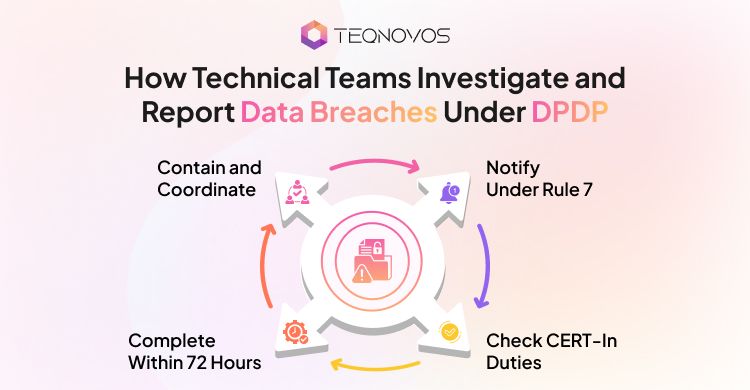
A suspected breach needs one incident response record. Teams identify affected systems and personal data categories. They also check the access path and timeline. Preserve logs and forensic images before containment removes evidence.
1. Contain and Coordinate
Revoke exposed credentials, isolate workloads, block malicious sessions, and close the exploited path. Data Processors preserve evidence and provide facts for notification decisions.
2. Notify Under Rule 7
Rule 7 requires clear notice to affected Data Principals without delay. It describes the breach and the related consequences. The DPDP Act notification process also requires initial information to reach the Data Protection Board of India without delay.
3. Complete Within 72 Hours
Within 72 hours of learning about the breach, the Data Fiduciary sends detailed information to the Board. This covers updated facts, cause, mitigation, and findings about the responsible actor. It also includes preventive measures and a report of individual notices.
4. Check CERT-In Duties
CERT-In uses a separate reporting route. Specified cyber incidents require reporting within six hours of noticing them or being informed. A breach may trigger both regimes, so DPDP Act data protection workflows need a parallel CERT-In eligibility check.
Plan DPDP Compliance in Clear Implementation Stages
A strong DPDP compliance implementation works better when teams follow a clear sequence. Each phase needs a defined output before the next phase begins. This prevents teams from building controls without knowing which systems create the highest privacy risk.
1. Build the Inventory
List every system that stores or processes personal data. Assign an owner who can confirm its purpose and current use.
2. Trace Data Movement
Map how personal data moves between applications and external processors. Record where data enters the environment and where it leaves.
3. Set Priorities
Rank systems by data sensitivity and exposure. Start with systems that combine high data volume with broad access or external sharing.
4. Plan Controls
Define the safeguards required at each technical layer. Connect every planned control to a known risk or compliance requirement.
5. Test Implementation
Deploy controls in controlled stages. Verify that each safeguard works under normal use and failure conditions. Businesses can use a practical roadmap for implementing the DPDP Act to manage this sequence.
6. Record Evidence
Capture test results and implementation records. Resolve any gaps before treating the control as complete.
7. Track Change
Review system changes after release. New integrations and product updates can introduce fresh data paths. A DPDP compliance checklist for software development companies can then help teams verify that each phase has been completed.
Build Stronger DPDP Safeguards Across Your Data Environment. Strengthen Your DPDP Compliance Strategy!
Schedule a CallAvoid Controls That Create a False Sense of Compliance
A control can appear complete and still leave personal data exposed. DPDP data security depends on how well each safeguard works during real system use.
- Encryption without key protection: Encrypted data remains at risk when encryption keys sit in the same environment or use the same access path.
- API access without ownership checks: Authentication confirms identity. It does not confirm whether a user can access a specific record.
- Personal data inside logs: Application logs can capture names or tokens without teams noticing.
- Production data in testing: Real customer records can spread into development systems with weaker access controls.
- Unprotected secondary copies: Replicas and archived exports can retain sensitive records even after primary systems change.
- Inactive privileged accounts: Old administrator access can remain active long after the business need ends.
- Overreliance on cloud providers: Cloud security does not remove the organization’s responsibility for its own data use and access controls.
- Evidence without validation: Screenshots and policy records have limited value when teams never test whether the control works.
- Processors outside incident exercises: Data Processors need to take part in response testing when they handle personal data.
Strong personal data protection under DPDP requires teams to verify each control through real testing rather than treating documentation as proof.
Conclusion
Effective DPDP security safeguards depend on more than isolated technical controls. Businesses need clear ownership across systems and teams. They also need reliable evidence that each control works as intended.
The DPDP Act makes security an ongoing responsibility rather than a one-time compliance task. Teams need to review how systems change and how new data flows affect existing protections. This approach helps businesses maintain stronger control over personal data as products and infrastructure evolve.
Teqnovos supports businesses that need technical guidance across architecture and security implementation. Book a free consultation call with us.