



























How DPDP Compliance Impacts Software Development
India’s Digital Personal Data Protection (DPDP) Act changes how software work is scoped, estimated, assigned, and accepted. The DPDP Act impact on software development reaches beyond legal documentation. Privacy obligations now create engineering tasks with owners, dependencies, and completion criteria.
The law received presidential assent on August 11, 2023. Its effect on delivery is structural. Product leaders can no longer leave privacy review until the end of a build. Engineering managers need to reserve capacity for legal interpretation, implementation work, and operational ownership.
This shift changes how product leaders plan scope and how engineers define completion. A feature that works technically can still fail its compliance purpose if downstream services continue processing data outside the approved use. DPDP readiness therefore depends on verifiable behavior across the full software lifecycle.
Who Must Comply
Coverage follows the data processing activity, not the company’s office address or software category. The Act applies to digital personal data processed in India. It also covers offline data digitized later. Section 3 of the Act extends coverage outside India when processing relates to offering goods or services to individuals there. A foreign software platform can fall within scope even when its servers and development team remain overseas.
For DPDP compliance for software companies, the decisive question is who controls each activity. A data fiduciary decides the purpose and means of processing. A data processor handles personal data on the fiduciary’s behalf. One business may hold both roles. A software provider may operate as a processor for customer records while acting as a fiduciary for employee or sales contact data.
This distinction matters for hosted software products and mobile applications. It also affects cloud platforms, analytics systems, and outsourced development arrangements. Access to production data can place a delivery partner inside the processing chain. Teams need to classify each activity separately instead of applying one label to the company.
Product Requirements
Product teams need to interpret legal duties before design begins. The DPDP requirements for software developers start with a decision record for every feature that collects, creates, or changes personal data.
Requirement Record
Each record answers four questions:
- Which data fields enter the feature?
- What specific business purpose requires them?
- Does processing rely on consent or one of the Act’s certain legitimate uses?
- Which event ends the stated purpose?
Acceptance Criteria
Every relevant backlog item also records:
- Data fields and their source.
- Required notice or consent state.
- Retention or erasure trigger.
- Age and parental conditions.
These details expose unnecessary collection before coding starts. A profile field used for account recovery and advertising needs separate purpose decisions even when one screen collects it.
Child Data
Products likely to include users under 18 need an early age handling decision. The Act generally requires verifiable parental consent. It also restricts tracking, behavioral monitoring, and targeted advertising directed at children.
The notified Rules contain conditional exemptions that apply when relevant provisions commence. Legal review must precede a universal age flow.
The related guide on DPDP compliance implementation can connect these decisions with design reviews and acceptance tests.
Data Architecture
Architecture must reveal every place personal data can persist. A database view is incomplete. DPDP Act software development needs a field level map that follows information across the entire system.
Map Every Copy
Teams trace personal data through:
- Application programming interfaces (APIs)
- Primary databases and replicas
- Caches and search indexes
- Analytics stores and logs
- File exports and third-party services
Each location receives an owner, purpose, retention rule, and deletion method. The map also identifies the system of record and every derived copy.
Track Deletion
Retention works best as explicit states:
- Active
- Awaiting deletion
- Retained under another law
- Deleted
Automated jobs need safe retry behavior and evidence from every connected store. This prevents one cleared table from producing a false completion result while data remains searchable elsewhere.
Restore Safely
Backups need a different pattern. Immediate row deletion may be impossible when stored copies cannot be edited.
One practical design lets backups age out under a defined schedule. It also stores tombstones, which are persistent deletion markers. Restored information is removed before normal processing resumes.
Apply Rule 8
The notified 2025 rules create an additional constraint. Once Rule 8 takes effect, personal data, associated traffic data, and processing logs must be retained for at least one year for listed statutory purposes. Another law may require a longer period.
Legal and engineering teams need one matrix that records the deletion trigger and authority for each exception. This reconciles purpose based erasure with mandatory retention.
Consent Workflows
Consent needs to function as a live processing control. For DPDP compliance in software development, recording a checkbox is not enough. Each purpose needs a current permission state that other services can check.
Consent Record
Every consent record links:
- User identifier
- Purpose identifier
- Notice version
- Capture time
- Collection channel
- Current status
These fields preserve what the person saw and approved at a particular time.
Runtime Checks
Purpose identifiers travel with processing requests. Recommendation services, marketing connectors, and analytics workers check the current state before using personal data.
The same check applies to scheduled jobs and queued background tasks. This closes a gap where the interface records a withdrawal but unattended processes continue using older permissions.
Withdrawal Flow
A withdrawal starts a controlled sequence:
- The consent status changes immediately.
- The system sends a withdrawal signal to connected processors.
- Each recipient confirms that processing stopped.
- Unconfirmed actions enter a review list.
The Act requires withdrawal with ease comparable to giving consent. It also requires the data fiduciary to cause its processors to stop within a reasonable time unless another legal ground permits continued processing.
Notice Changes
Notice changes require version control. A wording correction may need only a new notice record. A new purpose may require fresh consent before that use starts.
Legal review decides the trigger while the system preserves earlier permission history.
Completion Test
A consent flow is complete only when capture, enforcement, withdrawal, and evidence share one state model.
Development Controls
Application controls restrict who can reach personal data and what each request may return. DPDP compliant software development places these decisions inside code. An administrator role or trusted internal network cannot replace explicit access rules.
These application controls work with broader DPDP security safeguards across APIs and databases. The same safeguards extend to cloud infrastructure and connected services.
Access Checks
Each application programming interface (API) request verifies:
- Caller identity
- Assigned role
- Permitted action
- Record ownership
- Tenant boundary
- Requested fields
A tenant boundary is the rule that prevents one customer account from reaching another customer’s records. Checks run before the database query. This avoids retrieving excessive records and filtering them afterward.
Response Limits
Endpoints return only the fields required for the completed operation. Bulk exports use a separate permission and higher review threshold.
Error messages avoid revealing account existence, identifiers, or internal storage paths.
Secret Handling
Service keys and database credentials remain outside source code. Each environment uses separate credentials. Access expires when a developer, vendor, or automated service no longer needs it.
Processor Access
Data processors receive restricted credentials tied to a valid contract. The Act keeps the data fiduciary responsible for processing performed on its behalf.
Integration permissions remain separate from employee permissions. One revoked account does not need to disrupt unrelated work.
Failure Defaults
If the identity or role service becomes unavailable, the application blocks the personal data request. It records a failure code for review. A timeout never becomes approval.
Testing Evidence
Testing must prove privacy outcomes without restating how each control works. The DPDP requirements for software developers become measurable when every obligation has an assigned test and retained result.
Test Matrix
Quality assurance (QA) teams map each obligation to:
- Feature owner
- Test case
- Test environment
- Expected result
- Evidence location
This mapping reveals duties that exist in policy but have no executable test.
Scenario Design
Each control receives:
- Positive case where an authorized action succeeds.
- Negative case where a prohibited action is rejected.
- Boundary case using incomplete information or an unavailable dependency.
- Recovery case that checks the final state after interruption.
For statutory rights such as correction and erasure, the team checks every affected record and the reason behind any retained copy.
Safe Test Data
Development and test environments use generated records or data with identifying values removed. This prevents evidence gathering from creating a new privacy exposure.
Evidence Pack
Each test run stores:
- Requirement identifier
- Build version
- Execution time
- Expected result
- Actual result
- Defect link
- Reviewer
Screenshots prove user facing behavior. System events confirm server results. Evidence remains tied to its ticket and build.
The DPDP compliance checklist for software development companies guides broader test coverage during internal reviews.
Release Governance
A release can pass functional testing and still lack accountable authorization. The DPDP Act impact on software development changes the decision needed before code reaches production.
Impact Rating
Every release receives one classification:
- No data impact: Code does not change personal data behavior.
- Controlled impact: Implementation changes without changing the approved use.
- Material impact: Collection, use, sharing, retention, or user rights change.
The classification determines review depth. The number of changed code lines does not.
Decision Owners
A controlled impact needs product and engineering approval. A material impact adds legal, privacy, security, and operational review.
Named deputies keep the decision path available during urgent releases.
Approval Record
The approval record stores:
- Impact classification
- Approver names
- Open risks
- Accepted exceptions
- Monitoring period
- Recovery owner
Every exception receives an expiry date and follow up ticket. Missing authorization blocks promotion to production.
What Changes After Launch for Privacy Compliance?
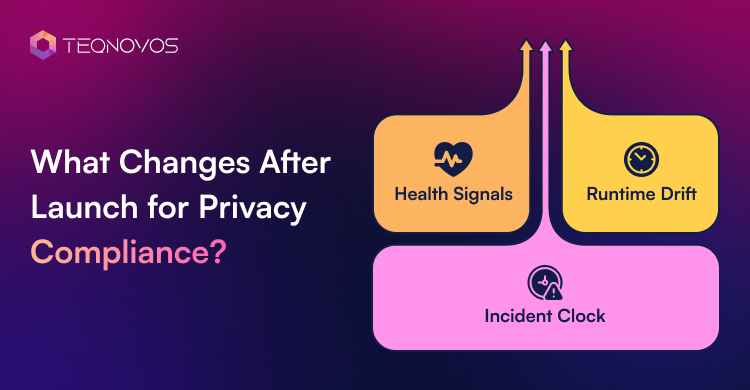
Production oversight verifies that approved behavior remains stable. For DPDP compliance in software development, operations teams need measurable signals and named responders. A policy review alone cannot reveal a silent production failure.
Health Signals
A privacy job is an automated task that carries out a compliance obligation. Its dashboard can track:
- Failed or delayed privacy jobs
- Unresolved processor incident reports
- Aged exception tickets
- Unusual growth in rights request queues
Each signal needs a threshold, severity rating, owner, and response time. This converts an invisible issue into accountable work.
Runtime Drift
Runtime drift occurs when production settings move away from an approved baseline. Cloud configurations, vendor endpoints, scheduled tasks, or alert routes can change without a feature release.
A scheduled comparison should identify each variance. The assigned owner then records its impact and correction date.
Incident Clock
A suspected personal data breach needs a recorded awareness time. The incident record should identify the affected systems, relevant data categories, and the person directing containment.
As of August 2026, Rule 7 of the Digital Personal Data Protection Rules, 2025 has been notified but has not taken effect. Once it applies, affected individuals must receive notice without delay. The Data Protection Board of India must also receive an initial description without delay. A detailed report is due within 72 hours unless the Board permits more time.
A production runbook can place these responsibilities within application maintenance services. It should also name the responder available outside normal business hours.
What Does DPDP Readiness Cost?
The cost of DPDP compliance for software companies depends on the change surface rather than company size alone. The change surface includes every workflow, platform, vendor connection, and operating role affected by the program.
Budget Layers
A useful estimate separates the initial program from the recurring budget.
The initial program includes discovery, implementation, specialist review, and readiness setup. The recurring budget covers staff capacity, platform subscriptions, vendor oversight, and periodic evaluations.
This separation prevents implementation expenses from hiding future operating needs.
Cost Drivers
The largest variables usually include:
- Number of personal data workflows
- Number of affected platforms
- Complexity of vendor connections
- Amount of manual handling
- Quality of existing documentation
- Availability of relevant technical specialists
One application with several affected workflows may require more effort than multiple tools with limited personal data use. Estimators should therefore count work packages instead of applications or employees.
Estimate Method
A practical first-year formula is:
Discovery + implementation + specialist review + annual operating capacity + contingency
Each figure should state its assumptions and exclusions. The estimate should include expected and upper ranges. A fixed quote becomes credible only after discovery exposes technical dependencies.
The practical roadmap for implementing the DPDP Act can turn this estimate into sequenced funding stages.
Move From DPDP Planning to Technical Execution Across Your Software Lifecycle. Explore DPDP Implementation Services!
Schedule a CallRetrofit or Replace Legacy Software?
Older applications can turn DPDP compliant software development into a modernization decision. Age alone does not make software unsuitable. The key question is whether a component can be changed, observed, and retired without destabilizing a critical service.
Triage Model
Technical leaders can assign each component one of three paths:
- Contain. Stop new functions from deepening their dependence on the fragile component.
- Wrap. A wrapper is a controlled interface placed around an older module. New functions communicate through this interface while the core code remains unchanged.
- Replace. Retire the component when change risk, missing vendor assistance, or downtime exposure outweighs phased redevelopment.
Decision Factors
The assessment should examine:
- Ability to change the code safely
- Importance to business operations
- Availability of vendor assistance
- Acceptable service interruption
- Observability of system behavior
Observability means the ability to see a system’s internal state and resulting outcomes. Poor observability makes defects harder to locate and remediation harder to verify.
Historical Records
Historical records need a separate legal classification before migration. Their age does not prove valid permission. Missing collection context should trigger a review rather than an assumption.
Section 5(2) of the DPDP Act creates a specific notice path for consent obtained before the Act’s commencement. Teams should therefore avoid applying one blanket migration rule to every historical record.
An application modernization services engagement can apply this triage and plan each cutover around critical operations.
Five Failures Hidden Between Systems
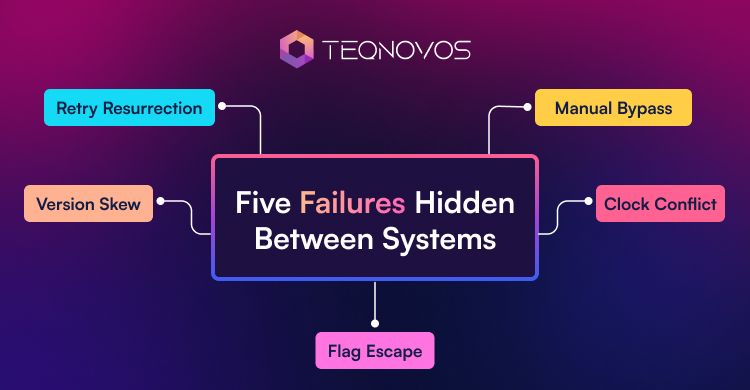
Many compliance failures do not exist inside one screen or database. They emerge when connected product paths disagree. DPDP requirements for software developers therefore extend to clients, queues, configuration switches, timestamps, and human workarounds.
Version Skew
Version skew occurs when active web, mobile, and Application Programming Interface clients run different versions of the same behavior.
An older mobile release may send a value that the current server interprets incorrectly. Products need a retirement policy for client versions that cannot follow the latest privacy logic.
Flag Escape
A feature flag is a configuration switch that activates code for selected users. Experimental paths can bypass the logic used by the default product experience.
Every active path must produce the same legally required outcome. Turning off the visible experiment may not remove its background processing.
Retry Resurrection
A message queue stores events until another service processes them. Failed events may enter a retry cycle.
A delayed event can recreate information or override a more recent instruction. Idempotency prevents this problem. The term means that repeating the same event does not create a different result.
Clock Conflict
Connected services may record creation time, receipt time, and completion time differently. This can place events in the wrong order.
Systems need a defined source of truth for event sequencing. Device time alone cannot reliably determine which instruction came last.
Manual Bypass
Support teams sometimes export records to resolve unusual cases. These temporary copies can remain in spreadsheets, tickets, or shared folders after the issue closes.
Where Should Teams Start?
Teams can convert the DPDP Act impact on software development into a ranked engineering backlog. The starting point is not always the newest application or most visible screen. Priority belongs to workflows where failure would be difficult to reverse.
Priority Score
Each affected workflow can receive a score from one to five across four dimensions:
- Reach: Number of people and business processes connected to the workflow
- Reversibility: Difficulty of undoing an incorrect outcome
- Dependency: Number of services that consume its output
- Recovery: Time required to correct a failure
The highest combined score identifies the strongest implementation candidate. A mandatory legal deadline can override the calculated position.
Delivery Order
Workflows that depend on the same core service can enter one delivery group. This prevents separate teams from changing the same component at different times.
The first group needs a clear boundary. It must remain small enough to manage while covering every component responsible for the final outcome.
This model directs engineering effort toward material exposure instead of cosmetic updates. Organizations needing coordinated legal and technical execution can connect the ranked backlog with DPDP implementation services.
Convert DPDP Obligations Into Secure Product Decisions Your Engineering Teams Can Execute. Talk to Our DPDP Experts!
Schedule a CallFinal Thoughts
The DPDP Act makes privacy a measurable software quality rather than a final legal checkpoint. Teams need to connect product intent with system behavior and operational evidence. The DPDP Act impact on software development becomes manageable when each obligation has an owner, a test, and a defined response path.
Companies do not need to rebuild every platform at once. They need a risk-led backlog that targets irreversible failures and shared dependencies first. This approach creates a practical delivery sequence and limits expensive rework. It also helps legal and engineering teams assess readiness through actual system results. Sustainable compliance comes from software that can explain what data it uses and why it uses it and how that use stops when required.