



















How To Integrate Midjourney API Services For Better Development?
AI plays a major role in visual creation. Teams use it for product concepts. They also use it for campaign ideas and digital experiences.
An API lets one software system communicate with another. That idea creates interest in Midjourney API integration services. Yet Midjourney does not offer a general public API. Its current rules also prohibit automated interaction unless Midjourney grants explicit permission.
This distinction matters for development teams. The Midjourney API remains a common search topic because businesses want image generation inside websites and software products. In practice, teams need to separate Midjourney creative work from automated image generation through an official developer interface.
The article explains how that approach works today. It also covers current Midjourney features and practical development options.
Importance of Midjourney API Integration Services
The business need behind Midjourney API integration services has not disappeared. Teams still want faster visual creation. Product teams still want image features inside software. Creative teams also want better control over style and iteration.
The practical meaning has changed. Midjourney API integration now needs careful planning around what Midjourney officially supports. A team can use Midjourney for human led creative work. The same team can use a documented API when a product needs automated generation.
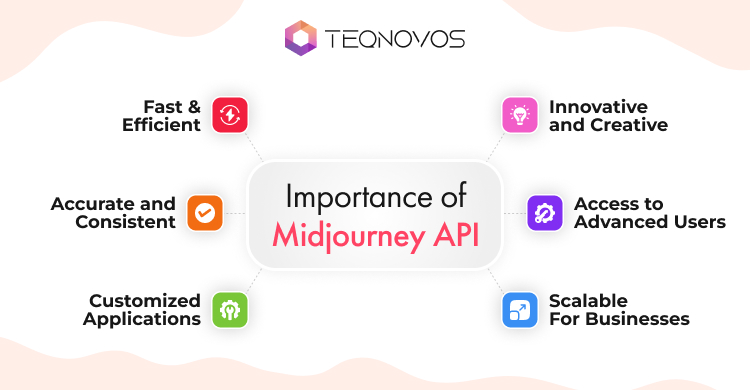
1. Fast & Efficient
Manual visual production can take time when a team needs to test many directions. Midjourney can speed up early concept work through text prompts and image references.
The web experience now gives users direct access to creation tools. It supports image prompts, Style References, and Personalization. Teams can also edit work without relying only on Discord.
This is useful during prototyping. Designers can test visual directions before production begins. Marketing teams can compare concepts before final assets move into approval.
An automated product workflow needs a different setup. A supported AI image generation API can handle programmatic requests inside an application.
2. Accurate and Consistent
Visual consistency matters when a project uses many related assets. Midjourney now offers tools that give users more control over visual direction.
Style References help carry the visual feel of an existing image into new generations. Personalization adapts results around a preferred aesthetic. Moodboards use selected images to guide a wider visual direction.
Seed values still have a role. A seed can help with testing and prompt comparison. Midjourney notes that seeds do not guarantee the same result across different sessions or settings.
This makes references and saved settings more useful for consistent creative work. Human review still matters when the final assets need to follow a specific design system.
Plan the Right Midjourney Integration Approach —Talk to Our AI Experts Today!
Schedule a Call3. Customized Applications
A product can include image generation as a built in feature. The technical route depends on the provider and the application goal.
A website or app that needs live generation can connect with a documented API. This fits broader AI software development, where image creation forms one part of a larger system.
Midjourney developers can still use Midjourney during concept development. They can create visual references and test prompt directions. They can also document style rules for the wider product team.
4. Innovative and Creative
Midjourney supports much more than basic text to image generation. Midjourney says the update focuses on aesthetics, image quality, creativity, and personalization.
Current workflows include image prompts, Style References, and Moodboards. Users can also work with editing tools and video generation.
These capabilities make the platform useful during design exploration. They can help teams move from a rough visual idea to a clearer creative direction.
5. Access to Advanced Users
Midjourney provides controls for aspect ratio, stylization, image references, and model settings. Users can also create variations from an existing generation.
These controls make experimentation easier. They also help creative teams test how prompt changes affect an image.
The Midjourney API does not expose these controls through a general public developer interface. That difference remains important when software teams plan automated workflows.
6. Scalable For Businesses
Midjourney supports different subscription plans and generation capacity. That can help teams handle larger volumes of human led creative work.
Programmatic scale is different. Software products often need authentication, request handling, usage limits, error states, and storage rules.
That type of system needs a supported API layer. An unofficial connection creates more risk because the provider can change access rules or block the workflow.
Midjourney API integration for SaaS platforms
Midjourney can be a powerful addition to SaaS products that rely on visual content generation. However, integration requires careful planning since there is no official public API. Teams building similar products can also review this AI enriched SaaS development guide for more context on AI workflows and product architecture.
- SaaS platforms use image generation for tools like design, marketing, education, and content creation
- There is no official Midjourney API, so direct backend integration is not supported
- Teams often combine Midjourney for creative workflows with other image APIs for production use
- A complete system includes prompt handling, user access control, storage, and usage tracking
- The focus should be on building a stable workflow around supported services rather than bypassing platform limits
The STC AI driven SaaS case study gives a practical example of AI working inside a scalable SaaS platform.
How API Integration Can Support the Development Process
API integration can support image generation across websites and software products. It can also give development teams more control over how visual features work inside an application.
1. Custom Applications
Image generation can become part of a website or mobile application when the product uses a supported interface. This approach fits naturally within mobile application development when visual creation becomes part of the user experience.
- Connect generated images with user accounts
- Manage output settings inside the application
- Add moderation controls for generated content
- Store approved visuals for later use
2. Batch Processing
Batch processing handles several planned requests as one workload. A documented AI image generation API can support this type of workflow through approved endpoints.
- Process multiple image requests together
- Manage request queues more efficiently
- Apply usage limits across workloads
- Retry failed requests when needed
3. Seed Values for Testing
Seed values can help users compare prompt changes during testing. They do not guarantee identical results when model settings or other generation details change.
- Compare different prompt variations
- Test changes with similar starting conditions
- Save prompts for future reference
- Record settings used during experiments
4. Web Based Creative Workflow
Midjourney now offers a broader web based creative experience. Users can work with image prompts and Style References and editing tools without relying only on Discord.
- Create images directly through the web interface
- Add image prompts for visual guidance
- Use Style References for creative direction
- Generate video from a starting image
5. Flexible Application Architecture
A flexible architecture keeps product logic separate from the image provider. This approach also appears across generative AI development where AI features work as one part of a larger application.
- Keep prompt logic inside the product
- Manage permissions through the application
- Store generated assets in controlled systems
- Change providers when technical needs change
6. Better User Experience
Image generation becomes easier to use when the product gives users clear guidance. The interface can explain what is happening at each stage of the generation process.
- Show clear prompt instructions
- Display generation progress
- Explain errors in simple language
- Save approved images and prompt history
Key Features of Midjourney API Integration Services
Midjourney offers several tools for visual creation and refinement. These features help teams explore ideas and improve consistency across creative workflows.
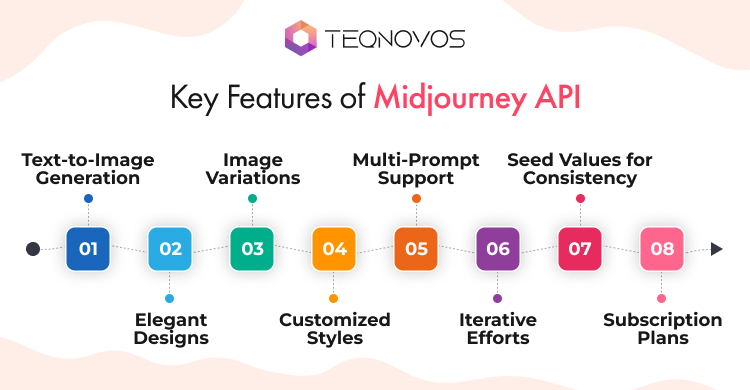
1. Text to Image Generation
Midjourney creates images from natural language prompts and model controls. This remains a key reason teams explore Midjourney API integration services during early product planning and testing work.
- Turn written prompts into visuals
- Adjust style through prompt details
- Guide mood through model controls
- Test concepts during early planning
2. Elegant Designs
Image prompts let users guide a new generation with an existing visual. This adds useful context beyond text and helps teams shape composition style and subject direction with more control today too.
- Add visual references to prompts
- Guide subject direction more clearly
- Shape the overall composition
- Improve visual context during creation
3. Image Variations
Image Variations help users explore related versions of a concept without starting again. Teams can adjust details and composition while keeping the original visual direction in place during testing.
- Create related image versions
- Test different visual details
- Adjust composition without restarting
- Keep the core concept in place
4. Customized Styles
Style References help guide lighting texture color and visual medium. This gives teams more control over the overall look while connecting with generative AI in content creation during creative work.
- Guide lighting across visuals
- Apply a defined visual style
- Control texture and color direction
- Keep creative output more consistent
5. Multi Prompt Support
Personalization and Moodboards help guide image generation around user preferences. They reduce repeated prompt changes and support a clearer visual direction across a wider creative workflow process.
- Guide outputs around user preferences
- Build direction through Moodboards
- Reduce repeated prompt adjustments
- Support a consistent creative theme
6. Iterative Efforts
Midjourney supports image editing that lets users change selected areas and adjust the canvas. This makes refinement easier and reduces the need to recreate a full concept after every visual change.
- Edit selected areas of an image
- Adjust the existing canvas
- Refine concepts without restarting
- Test visual changes more efficiently
7. Video Generation
Midjourney can turn a starting image into a short video. This gives teams another way to test motion concepts and visual ideas while keeping the workflow focused on creative exploration and testing.
- Turn still images into motion
- Explore early video concepts
- Test movement around visual ideas
- Extend static creative experiments
8. Subscription Plans
Midjourney offers several subscription tiers with different access and generation limits. Teams can review current plan details when usage capacity or production needs affect wider project planning.
- Compare available subscription tiers
- Review generation capacity
- Check access based on project needs
- Plan usage around production volume
What Can Developers Use for Programmatic Image Generation?
Some products need automatic image generation for each user request. In that case, a provider with an official API gives the development team a clearer technical foundation. An AI image generation API can support product visualization, creative tools, and personalized media.
The provider needs documented authentication and usage rules and request limits. Developers can then connect the generation layer with databases, user accounts, and analytics. This approach also helps Midjourney developers separate creative research from production architecture. Midjourney can support concept work while another approved service handles automated requests.
Develop an AI Image Workflow That Fits Your Product —Start Your AI Project Today!
Schedule a CallConclusion
Midjourney has moved well beyond a Discord-focused workflow. Its web experience includes stronger creation controls and Style References. It also includes Personalization and Moodboards. At the same time, the Midjourney API still does not exist as a general public developer interface. Midjourney also restricts unauthorized automation.
That makes Midjourney API integration services more useful when they separate creative Midjourney work from production software architecture. A team can use Midjourney for visual exploration.
Build image generation workflows around supported technologies with Teqnovos. Get in touch with us today!