AI in Personalized Treatment Plans for Diseases
Patients with the same diagnosis may respond differently to the same treatment. Their medical histories affect which options a clinician considers. Earlier treatment responses also influence that decision. Clinical software combines this information with current test results. AI uses computer models to analyze patient data. These models highlight relevant patterns for further clinical assessment. AI in personalized treatment plans helps clinicians assess treatment options.
Clinicians review the evidence behind each finding and consider its limitations. AI software development services integrate these models into clinical systems. Development teams then test how the software works in practice. This guide explains technology’s role in personalized treatment. It also covers how teams develop and evaluate these solutions.
Quick Answer
AI in personalized treatment plans analyzes patient data based on the clinical question posed. It is able to provide risk estimates or pattern recognition to possibly assist in treatment decisions. Clinicians analyze these results, clinical evidence, and patient status.
How Does Technology Change Personalized Treatment?
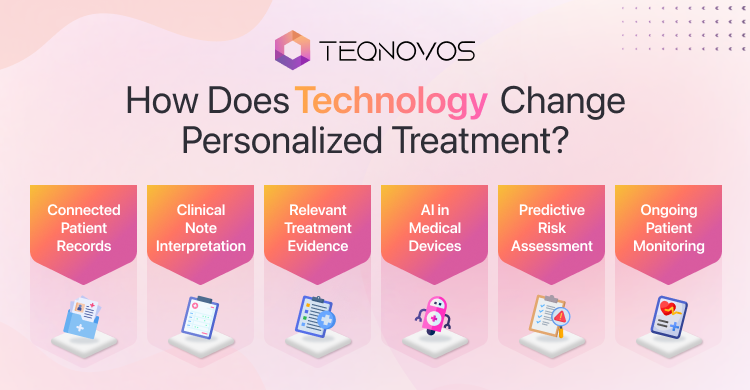
Technology in personalized treatment enables healthcare practitioners to look at the data collected from various sources. Electronic health records allow viewing of the data generated previously. Advanced diagnostics provide new results that can influence treatment. AI utilizes computer programs for analysis of patient data.
1. Connected Patient Records
Electronic Health Record refers to a digital medical record of the patient. EHR integration services help combine laboratory tests and treatment history. The specialists examine this information before making recommendations on care options. An entry of a drug allergy may influence medication choice.
- Previous decision-making is accessible to the following clinical team.
- The dates assist the clinicians to separate new results from old information.
- Medication history gives insight into the medications that the patient used previously.
- The records shared provide necessary information to the referral team before the meeting.
2. Clinical Note Interpretation
Natural language processing (NLP) helps software analyze written clinical notes. It can turn medication details into separate fields. A treatment platform can display these fields beside other patient information. This brings details recorded in text into the treatment review.
- Models can identify medication names and doses.
- They can classify documented treatment starts and stops.
- Timing labels separate past changes from future plans.
- Clinicians check extracted details against the original note.
3. Relevant Treatment Evidence
Laboratory tests can identify biomarkers that inform cancer treatment. A biomarker is a measurable biological feature such as a gene change. Some findings point to therapies that target that feature. Reporting tools present the results for clinical review.
- Reports may identify a relevant therapy.
- Some findings suggest that a treatment may not work.
- Genetic findings with unclear effects do not establish a treatment match.
- A tumor’s biomarkers can change over time.
4. AI in Medical Devices
Computer vision is an AI method that analyzes image patterns. It can identify features in scans or digital images of tissue samples. AI in precision medicine can combine these findings with other patient data. Clinicians assess them alongside relevant treatment evidence.
- Image tools can highlight areas for closer review.
- Models can measure selected features within an image.
- Clinical measurements add context to image findings.
- Image quality checks help teams assess whether inputs suit the task.
5. Predictive Risk Assessment
Machine learning is an AI method that learns patterns from data. AI in personalized medicine can use those patterns to estimate a specific risk. One example is the chance of returning to hospital after discharge. Clinicians consider the estimate alongside the patient’s current condition. These applications of AI in healthcare need testing in their intended care setting.
- Each estimate addresses a specific clinical question.
- The prediction period states when an event might occur.
- Higher estimated risk can prompt further assessment.
- Treatment selection needs separate evidence about likely treatment benefit.
6. Ongoing Patient Monitoring
Connected medical device software for personalized treatment collects readings between appointments. A continuous glucose monitor estimates blood sugar throughout the day. Connected patient monitoring covers devices and reading collection workflows. Care teams review the pattern alongside the patient’s treatment plan.
- Graphs show whether measurements have increased or decreased.
- Some devices alert the user when measurements exceed defined thresholds.
- Applications can help record food and medication consumption.
- Some applications let the user share measurement data with a selected caregiver.
How Does AI in Personalized Treatment Plans Support Clinical Decisions?
AI in personalized treatment plans can support clinical decisions by analyzing relevant patient data. A treatment platform can check inputs and present findings with supporting evidence. Clinicians review those findings before choosing or adjusting care. The steps below describe a practical workflow for this process.
1. Check Patient Inputs
The platform gathers the records needed for its clinical task. It checks that each result belongs to the correct patient. Missing required information pauses analysis and prompts review.
- Identity checks flag records that may belong to another patient.
- Date checks identify results outside the accepted time window.
- Unit checks identify measurements that need conversion.
- Source links retain access to the original record.
2. Analyze Defined Outcomes
The model analyzes the checked inputs for its intended task. A risk model estimates the chance of a specified event. A treatment benefit model estimates how outcomes may differ between treatment options. Teams must evaluate each model for its particular task.
- Output labels state what the model has estimated.
- Prediction periods show how far ahead the estimate applies.
- Input checks flag data outside the model’s stated scope.
- Version records identify which model produced the result.
3. Present Supporting Evidence
An AI-powered platform for precision medicine can present model results within a proposed review screen. It also shows the evidence behind any proposed treatment option. Clinicians use this context to assess whether the finding applies to the patient.
- Evidence links open the relevant guidance or publication.
- Dates show when the supporting material was updated.
- Limitation notes describe where the model may underperform.
- The screen identifies the patient information used for analysis.
4. Record Clinical Review
The clinician can accept or reject a proposed option. The platform records the decision and its reason. The approved care plan remains separate from the original model output. This preserves what the software suggested and what the clinician chose.
- Review records identify the clinician and decision time.
- Decision notes explain why the clinician selected or rejected an option.
- Plan status distinguishes a proposal from an active care plan.
- Version history preserves the information available during review.
5. Reassess New Information
Another evaluation may be called for based on new data collected from either test results or monitoring readings. It will then be checked if this data fits the inputs required by the model. Another prediction may help make the reassessment possible.
- Collection times identify when each new reading was taken.
- Review tasks assign flagged changes to a responsible team.
- Updated findings remain linked to the earlier review.
- Model changes follow separate testing and release controls.
How Is AI Used in Personalized and Precision Medicine?
Personalized medicine and precision medicine use patient characteristics to inform care. They can use AI for personalized treatment and patient-specific care to analyze information relevant to a clinical decision.
1. AI in Personalized Medicine
AI models can identify patterns across patient records. A model can apply those patterns to information about an individual patient. Clinicians assess whether the output supports the specific treatment decision. Developers must test the model using data that represent the intended patients.
2. AI in Precision Medicine
Genetic analysis using an AI model is yet another method of analyzing genetic discoveries. This discovery will give information regarding the risk of getting a disease or how one reacts to certain drugs. It requires clinical evidence to establish the connection between the discovery and the treatment.
3. Genetic Medication Insights
Pharmacogenomics studies investigate the influence of genes on drug reactions. AI tools that help make personalizing medications better could provide useful genetic results. These results would be considered by doctors together with current drug regimens and health history. Genetic information could be considered without assurance of drug response.
What Does Personalized Medicine Software Development Involve?
Personalized medicine software development connects patient information with tools for clinical use. The platform’s design depends on its intended purpose. It also depends on the systems already used by the care team. An AI platform can include the following components.
1. Clinical Data Connections
An API enables computer programs to communicate information with each other. Fast Healthcare Interoperability Resources is an open standard that facilitates the electronic exchange of health information. Developers can utilize FHIR APIs to extract specific EHR data. The fields needed are specified, along with the process of handling failed transmissions.
2. Model Execution
A model service runs a trained model on new patient data. This process is called inference. The service checks whether the inputs meet the model’s requirements. It also records which model version produced each result. This record helps the team investigate unexpected outputs.
3. Clinical Evidence Storage
A platform can store clinical references alongside rules for decision support. These rules connect relevant findings with guidance for a defined clinical question. The software identifies the source and version of that guidance. Clinical specialists can then review proposed updates before the team releases them.
4. Clinician Workspace
Clinicians may open the software from an EHR or through a separate application. The interface identifies the selected patient. Developers also define where the software stores reviewed decisions. System capabilities and access permissions determine which information the application can read or write.
5. Access and Operational Controls
Access controls protect patient data privacy and security. Access controls restrict users’ access to certain types of information that they cannot edit or modify. Audits allow to document any actions taken. The secure connection makes sure that data is protected during transmission. There is a possibility to implement additional service unavailability checks.
How Are AI Solutions for Personalized Treatment Developed?
AI development for personalized treatment starts with a specific clinical task. The clinicians and the programmers agree on what the program should do. The development steps are detailed below.
| Development stage | What the team does | What the stage produces |
| Define the purpose | Clinical specialists identify the decision the software will support. Developers establish the required inputs and success criteria. | The scope states the intended patients and users. |
| Prepare the data | Data specialists check record quality and outcome labels. They keep training data independent from test data. | The team documents the data sources and selection rules. |
| Develop the model | Engineers select an existing model or train one for the task. They record its configuration and input requirements. | The team can trace each model version to its configuration. |
| Build the prototype | Developers connect the model with the review interface. FHIR can support data exchange with compatible clinical systems. | The prototype makes the proposed workflow available for testing. |
| Evaluate clinical use | Evaluators test performance using independent data. Clinicians assess whether they understand the outputs and limitations. | The evaluation records results and issues requiring further work. |
| Manage the release | The team defines release conditions and support responsibilities. Operators monitor the deployed system. Updates follow a controlled review process. | Each release has a monitoring plan and an assigned owner. |
The testing phase may highlight issues with previous designs, which would then require the team to go back to that stage and assess the improved design before implementation.
Where Are These Technologies Being Applied?
Technology enables the completion of different processes in a clinical setting. Technology connects the patient information to the treatment process.
1. Radiotherapy Treatment Planning
- Radiotherapy uses radiation to treat cancer.
- Some AI tools outline nearby organs on patient scans.
- Specialists review and adjust these outlines before planning treatment.
- A planning screen could let specialists edit and save the reviewed outlines.
2. Medication Response Review
- Genetic results influence the decision-making process on prescription drugs.
- Physicians interpret these results through the patient’s medical history and current drug prescriptions.
- The prescribing alert identifies any pertinent results when the physician prescribes the drug.
- The alert is attached to the original test result and guidelines.
3. Connected Diabetes Care
- The automatic insulin delivery system builds a link between a glucose monitor and an insulin pump.
- The program uses glucose readings to control insulin delivery.
- A monitoring screen might show glucose readings with insulin delivery records.
- The two sets of records can be reviewed by clinicians on the same timeline.
How Can the Clinical Performance and Reliability Be Measured?
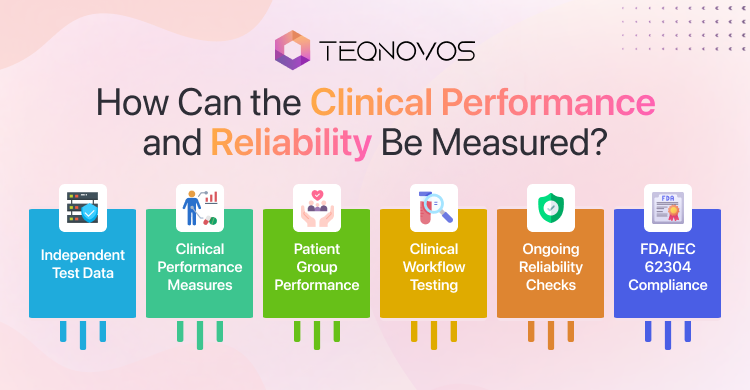
AI in customized treatment plans must be evaluated against its clinical purpose. Teams assess its performance within the intended care setting.
1. Independent Test Data
The machine learning model can perform very well for cases it has already seen. The independent test determines its performance on new patients’ information.
- Evaluators exclude data used to train or tune the model.
- They check for overlapping patients across training and test sets.
- They select records that reflect the intended care setting.
2. Clinical Performance Measures
The clinical task determines which errors matter most. A missed finding may have different consequences from an unnecessary alert.
- Clinical specialists define acceptable performance before testing begins.
- Evaluators compare outputs with a reference suited to the task.
- They document the frequency and clinical consequences of relevant errors.
3. Patient Group Performance
An overall result can hide differences between patient groups. Separate reporting helps teams identify where performance is weaker or uncertain.
- Evaluators examine results across clinically relevant patient groups.
- They report how many patients each group includes.
- They describe uncertainty and gaps in the available test data.
4. Clinical Workflow Testing
Evaluation also examines how people use the software. Users need to understand what an output means before applying it to a clinical task.
- Clinicians complete representative care tasks with the software.
- Evaluators check their understanding of outputs and known limitations.
- They record user errors and failures in the review process.
5. Ongoing Reliability Checks
Reliable operation depends on the systems around the model. A failed connection can prevent required information from reaching the software.
- Developers test responses to missing inputs and unavailable services.
- Support teams monitor performance changes after deployment.
- They investigate reported problems and evaluate updates before release.
6. FDA/IEC 62304 Compliance
The Food and Drug Administration regulates medical devices. Teams assess the intended use and individual software functions. Some healthcare software functions fall outside the medical device definition. The International Electrotechnical Commission publishes IEC 62304. This standard defines life cycle processes for medical device software. The FDA recognizes the standard for relevant submissions. Conformance alone does not establish FDA clearance or approval.
- Teams determine the regulatory status of each software function.
- Development records link software requirements with verification results.
- Change controls document software updates and maintenance.
What Developments Shape Personalized Treatment?
Emerging technologies could expand how AI supports individual treatment plans. New directions include shared model training and patient simulations. AI tools are also helping researchers design experimental treatments.
1. Federated Model Training
Federated learning allows several institutions to train a shared AI model. Each institution keeps patient records within its own systems. This approach supports collaboration when individual centers have limited data.
- Each site trains the model on local records.
- Participating sites share model updates.
- A coordinating system combines those updates into a shared model.
2. Patient Simulation Models
A digital twin is a computer model that represents aspects of a patient. Research systems use these models to simulate possible responses to treatment. They can explore how a sequence of decisions might affect later outcomes.
- Simulated responses can inform the next step in a treatment scenario.
- Visual displays can compare projected outcomes across treatment paths.
- Timelines can show how predicted symptoms might change over time.
3. Personalized Cancer Vaccine Design
AI tools can help researchers select targets for experimental cancer vaccines. Some targets are neoantigens. These are proteins that arise after certain genetic changes in cancer cells. Vaccine designs can use these features to target an individual tumor.
- Computational tools identify potential targets within tumor data.
- AI models estimate which targets might trigger an immune response.
- Structural analysis explores how immune cells may recognize those targets.
Conclusion
AI in personalized treatment plans can be effective where there is a defined clinical problem that needs to be addressed through it. The effectiveness of such usage will depend upon how the findings will be used in clinical practice.
Healthcare organizations exploring this technology can discuss their software requirements with Teqnovos. A focused project brief can identify the intended users and the first feature to build. This gives the development team a concrete starting point for turning a care need into a software project.